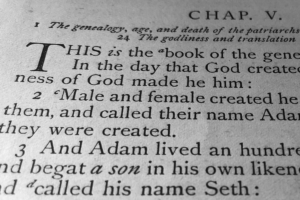
Did People Once Live For Hundreds of Years? Evaluating the Long Life-Spans of Genesis 5 & 11
I do not believe this evidence to be decisive in favor of a non-literalist interpretation of those ages, but it does call for caution against dogmatism in reading the ages given in the Biblical genealogies literally.

The Search for Adam and Eve: Human Origins According to Scripture and Science
The historicity of Adam and Eve is a question which strikes at the heart of the Christian faith. If the primordial pair did not exist, then the historical and biblical doctrine of the fall becomes extremely difficult to maintain.

Did Death Exist Before Man Sinned? Appraising a Creationist Argument
Some may wonder why I have chosen to address this topic prior to engaging with other topics (such as the meaning of the ‘days’ in Genesis 1). I have done so because many young earth creationists consider this to be the more pressing concern, and perhaps even the strongest argument for their position from Scripture.

The Propriety of Allowing Science to Illuminate Scripture
The “young earth” teaching introduces an unnecessary and erroneous tension between Scripture and science that has confused many and I have personally met many people who have turned aside from their faith due to what they see as the impossible challenge of trying to reconcile that understanding of Scripture with the clear scientific evidence. They end up being neither ‘old’ or ‘young’ earth and worst of all not believing that God is the Creator at all.

Do Extraordinary Claims Require Extraordinary Evidence? Assessing Carl Sagan’s Dictum
So confident was David Hume about this principle that he said, humble man that he was, “I flatter myself that I have discovered an argument…which, if just, will, with the wise and learned, be an everlasting check to all kinds of superstitious delusion, and consequently, will be useful as long as the world endures.”

Grappling with Divine Hiddenness: Why Does God Not Make His Existence More Obvious?
One of the most challenging objections to the existence of God is the problem of divine hiddenness. Closely related to the problem of evil, the problem of divine hiddenness asks “Where is God?”; “Why doesn’t God make His existence more obvious?”; “Why does God leave any room for doubt?”

The Evidential Value of 1 Corinthians 15:3-8 to the Case for the Resurrection
The text is of evidential value given that it allows us to establish, in harmony with other independent lines of evidence, that the resurrection claim goes back to the apostolic eyewitnesses themselves.

Should Christians Use the Argument from Martyrdom? A Reply to Bart Ehrman
It is a common misstep made by many atheists to think that if a particular piece of evidence fails to logically entail a conclusion, then that same piece of evidence also fails to support the said conclusion. However, this is poor epistemology. A piece of evidence may be confirmatory of a conclusion without establishing it.

Did Jesus Exist? A Critical Appraisal of Richard Carrier’s Interpretation of the Pauline Corpus
Richard Carrier is an ancient historian who has risen to prominence as the lead advocate of Jesus Mythicism, a school of thought that entertains the idea that Jesus of Nazareth may never have existed at all.