ingThe argument from Christian persecution was developed most fully by William Paley, in his 1794 book, A View of the Evidences of Christianity. [1] Indeed, Paley devotes the first nine chapters of his book to defending the thesis “that there is satisfactory evidence that many professing to be original witnesses of the Christian miracles, passed their lives in labours, dangers, and sufferings, voluntarily undergone in attestation of the accounts which they delivered, and solely in consequence of their belief of those accounts; and that they also submitted, from the same motives, to new rules of conduct.” [2] This proposition, if true, goes a long way towards establishing that the early apostles — that is, those who were purportedly witnesses to Jesus’ resurrection — were sincere in their conviction that they had encountered the raised Christ. Indeed, people are unlikely to voluntarily endure hardship, dangers, and persecutions on account of a claim that they believe to be false. As Paley notes [3],
Then as to the kind and degree of exertion which was employed, and the mode of life to which these persons submitted, we reasonably suppose it to be like that which we observe in all others who voluntarily become missionaries of a new faith. Frequent, earnest, and laborious preaching, constantly conversing with religious persons upon religion, a sequestration from the common pleasures, engagements, and varieties of life, and an addiction to one serious object, compose the habits of such men. I do not say that this mode of life is without enjoyment, but I say that the enjoyment springs from sincerity. With a consciousness at the bottom of hollowness and falsehood, the fatigue and restraint would become insupportable. I am apt to believe that very few hypocrites engage in these undertakings; or, however, persist in them long. Ordinarily speaking, nothing can overcome the indolence of mankind, the love which is natural to most tempers of cheerful society and cheerful scenes, or the desire, which is common to all, of personal ease and freedom, but conviction.
Of course, a successful demonstration of the sincerity of the apostles is not by itself sufficient to justify belief in the resurrection (though it is a significant step in that direction). If the apostles were sincere in their conviction that they had encountered the risen Christ and were witnesses to other miracles, it remains to be asked how they came to arrive at those beliefs. Having argued for the sincerity of the apostles, one can then proceed to mine details from the gospels & Acts (sources which, as I and others have argued in detail elsewhere, represent the testimony of the alleged witnesses of Jesus alive after his death) in an effort to evaluate whether the set of claims concerning his resurrection are the kind about which one may be plausibly sincerely mistaken. In this article, I will discuss the evidence that the apostles did in fact encounter hardships, dangers and persecutions on account of their Christian convictions. First, I shall survey the evidence for a general context of persecution (what may be called the indirect part of the case). I will then proceed to argue that the apostles in particular voluntarily submitted themselves to danger, hardship and persecution on account of their conviction of the gospel’s truth.
The General Context of Persecution
There is abundant evidence of a general context of persecution in the first century, from both secular and Christian sources. The was also a reasonable expectation of persecution right from the very beginning. As William Paley explains [4],
Our books relate, that Jesus Christ, the founder of the religion, was, in consequence of his undertaking, put to death, as a malefactor, at Jerusalem. This point at least will be granted, because it is no more than what Tacitus has recorded. They then proceed to tell us, that the religion was, notwithstanding, set forth at this same city of Jerusalem, propagated thence throughout Judea, and afterwards preached in other parts of the Roman empire. These points also are fully confirmed by Tacitus, who informs us, that the religion, after a short check, broke out again in the country where it took its rise; that it not only spread throughout Judea, but had reached Rome, and that it had there great multitudes of converts: and all this within thirty years after its commencement. Now these facts afford a strong inference in behalf of the proposition which we maintain. What could the disciples of Christ expect for themselves when they saw their master put to death? Could they hope to escape the dangers in which he had perished? If they had persecuted me, they will also persecute you, was the warning of common sense. With this example before their eyes, they could not be without a full sense of the peril of their future enterprise.
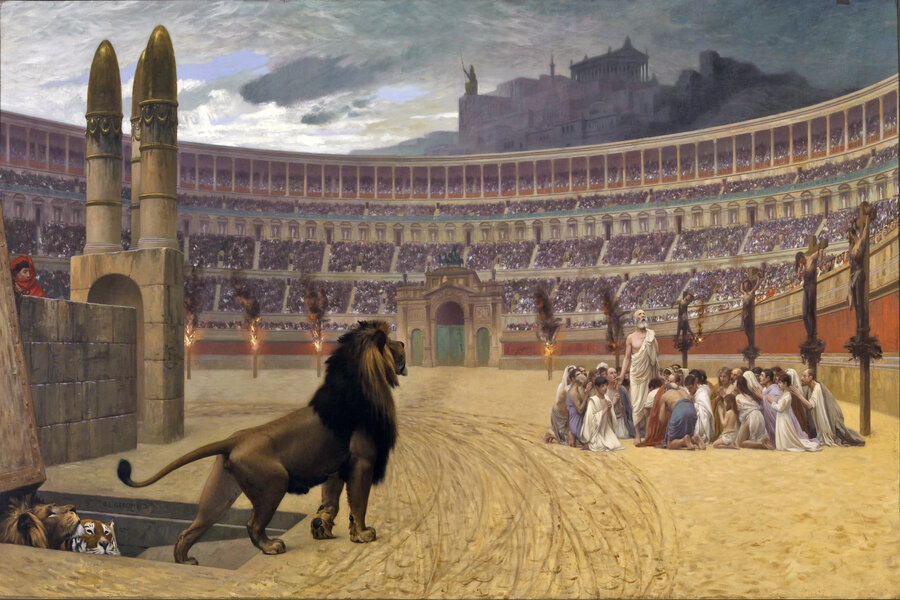
This reasonable expectation accords with reality, as historical records abundantly attest. Cornelius Tacitus (56-120 C.E), a member of the Roman senate and historian of Rome wrote about the first officially sanctioned state persecution of Christians under the emperor Nero. This ensued from a fire that broke out in Rome in 64 C.E. According to Tacitus, there was a circulating rumor among the populace that the conflagrations were the result of an order from Nero himself. Tacitus explains that “all human efforts, all the lavish gifts of the emperor, and the propitiations of the gods, did not banish the sinister belief that the conflagration was the result of an order,” (Annals 15:44). Thus, Nero needed a scapegoat in order to deflect the blame for the fire away from himself. Tacitus continues (Annals 15:44) [5],
Consequently, to get rid of the report, Nero fastened the guilt and inflicted the most exquisite tortures on a class hated for their abominations, called Christians by the populace. Christus, from whom the name had its origin, suffered the extreme penalty during the reign of Tiberius at the hands of one of our procurators, Pontius Pilatus, and a most mischievous superstition, thus checked for the moment, again broke out not only in Judæa, the first source of the evil, but even in Rome, where all things hideous and shameful from every part of the world find their centre and become popular. Accordingly, an arrest was first made of all who pleaded guilty; then, upon their information, an immense multitude was convicted, not so much of the crime of firing the city, as of hatred against mankind. Mockery of every sort was added to their deaths. Covered with the skins of beasts, they were torn by dogs and perished, or were nailed to crosses, or were doomed to the flames and burnt, to serve as a nightly illumination, when daylight had expired.
Nero offered his gardens for the spectacle, and was exhibiting a show in the circus, while he mingled with the people in the dress of a charioteer or stood aloft on a car. Hence, even for criminals who deserved extreme and exemplary punishment, there arose a feeling of compassion; for it was not, as it seemed, for the public good, but to glut one man’s cruelty, that they were being destroyed.
Suetonius (69 – after 122 C.E.), a biographer of the twelve Caesars, likewise writes that Nero “inflicted punishment on the Christians, a sort of people who held a new and impious superstition,” (Life of Nero, 16). [6] Notice that Tacitus indicates that Christians were already hated for their abominations, and were referred to as Christians by the populace — making them an easy scapegoat. William Paley notes [7],
These things, as has already been observed, took place within thirty-one years after Christ’s death, that is, according to the course of nature, in the lifetime, probably, of some of the apostles, and certainly in the lifetime of those who were converted by the apostles, or who were converted in their time. If then the founder of the religion was put to death in the execution of his design; if the first race of converts to the religion, many of them, suffered the greatest extremities for their profession; it is hardly credible, that those who came between the two, who were companions of the Author of the institution during his life, and the teachers and propagators of the institution after his death, could go about their undertaking with ease and safety.
Confirming Paley’s inference, there are sources, dating prior to the persecution under Nero commencing in 64 C.E.,, which indicate a widespread persecution of Christians significantly before this time. The apostle Paul wrote a letter to the church in Philippi, a Macedonian city, during his first Roman imprisonment (60-62 C.E.). Therein, he writes, “For it has been granted to you that for the sake of Christ you should not only believe in him but also suffer for his sake, engaged in the same conflict that you saw I had and now hear that I still have,” (Phil 1:29-30). Paul’s letter to the Romans (dating to around 57-59 C.E.) likewise encourages his readers, “we rejoice in our sufferings, knowing that suffering produces endurance, and endurance produces character, and character produces hope,” (Rom 5:3-4) Further, “Who shall separate us from the love of Christ? Shall tribulation, or distress, or persecution, or famine, or nakedness, or danger, or sword? As it is written, ‘For your sake we are being killed all the day long; we are regarded as sheep to be slaughtered,” (Rom 8:35-36). Even prior to this period, Paul wrote a letter to the Christians in Corinth (a Greek city), around 55 or 56 C.E., in which he states, “We are afflicted in every way, but not crushed, perplexed, but not driven to despair, persecuted but not forsaken, struck down, but not destroyed, always carrying in the body the death of Jesus, so that the life of Jesus may also be manifested in our bodies. For we who live are always being given over to death for Jesus’ sake, so that the life of Jesus also may be manifested in our mortal flesh. So death is at work in us, but life in you,” (2 Cor 4:8-12). Even before this time, Paul addressed the Christians in Thessalonica (in Macedonia), in a letter composed around 51 or 52 C.E. — “Therefore we ourselves boast about you in the churches of God for your steadfastness and faith in all your persecutions and in the afflictions that you are enduring,” (2 Thess 1:4).
Outside of the letters of Paul, there are also other early Christian references to first century persecution against Christians. For example, the writer to the Hebrews (an epistle, or perhaps more appropriately a Homily, which is difficult to precisely date but very probably was composed prior to A.D. 70) notes, “But recall the former days when, after you were enlightened, you endured a hard struggle with sufferings, sometimes being publicly exposed to reproach and affliction, and sometimes being partners with those so treated. For you had compassion on those in prison, and you joyfully accepted the plundering of your property, since you know that you yourselves had a better possession and an abiding one,” (Heb 10:32-34). The author further encourages these Jewish believers by reminding them of those Old Testament saints, “who through faith conquered kingdoms, enforced justice, obtained promises, stopped the mouths of lions, quenched the power of fire, escaped the edge of the sword, were made strong out of weakness, became mighty in war, put foreign armies to flight. Women received back their dead by resurrection. Some were tortured, refusing to accept release, so that they might rise again to a better life. Others suffered mocking and flogging, and even chains and imprisonment. They were stoned, they were sawn in two, they were killed with the sword. They went about in skins of sheep and goats, destitute, afflicted, mistreated — of whom the world was not worthy — wandering about in deserts and mountains, and in dens and caves of the earth,” (Heb 11:33-38). The book of James likewise encourages persecuted believers, “As an example of suffering and patience, brothers, take the prophets who spoke in the name of the Lord. Behold, we consider those blessed who remained steadfast. You have heard of the steadfastness of Job, and you have seen the purpose of the Lord, how the Lord is compassionate and merciful. The letter of 1 Peter further instructs believers, “do not be surprised at the fiery trial when it comes upon you to test you, as though something strange were happening to you. But rejoice insofar as you share Christ’s sufferings, that you may also rejoice and be glad when his glory is revealed. If you are insulted for the name of Christ, you are blessed, because the Spirit of glory and of God rests upon you,” (1 Pet 4:12-14).
Thus, we have early Christian letters, addressing readers all around the Mediterranean, exhorting them to bear up in the midst of persecution. This is impossible to explain if there were no such context of early persecution against Christians to speak of. Though the first officially state sanctioned persecution began in 64 C.E., under the emperor Nero, there was a widespread disdain for, and persecution of, Christians long before this time. Paley notes [8],
What could all these texts mean, if there was nothing in the circumstances of the times which required patience,—which called for the exercise of constancy and resolution? Or will it be pretended, that these exhortations (which, let it be observed, come not from one author, but from many) were put in, merely to induce a belief in after-ages, that the Christians were exposed to dangers which they were not exposed to, or underwent sufferings which they did not undergo? If these books belong to the age to which they lay claim, and in which age, whether genuine or spurious, they certainly did appear, this supposition cannot be maintained for a moment; because I think it impossible to believe, that passages, which must be deemed, not only unintelligible, but false, by the persons into whose hands the books upon their publication were to come, should nevertheless be inserted, for the purpose of producing an effect upon remote generations. In forgeries which do not appear till many ages after that to which they pretend to belong, it is possible that some contrivance of that sort may take place; but in no others can it be attempted.
Paul, of course, also speaks in his letters of his own persecution against the Christians in the early years prior to his conversion (Gal 1:13, 23; 1 Cor 15:9; Phil 3:6).
In addition to the aforementioned epistles, there are also references to the early context of persecution in the Olivet Discourse, recorded by the synoptic gospels. In Matthew 24:9, Jesus indicates that “they will deliver you up to tribulation and put you to death, and you will be hated by all nations for my name’s sake.” Mark 13:9-13 expands further: “But be on your guard. For they will deliver you over to councils, and you will be beaten in synagogues, and you will stand before governors and kings for my sake, to bear witness before them. And the gospel must first be proclaimed to all nations. And when they bring you to trial and deliver you over, do not be anxious beforehand what you are to say, but say whatever is given you in that hour, for it is not you who speak, but the Holy Spirit. And brother will deliver brother over to death, and the father his child, and children will rise against parents and have them put to death. And you will be hated by all for my name’s sake. But the one who endures to the end will be saved.” One does not need to assume the historicity of these sayings of Jesus in order to make the argument that this evinces persecution within the apostles’ own lifetimes. As Paley rightly comments [9],
I am not entitled to argue from these passages, that Christ actually did foretell these events, and that they did accordingly come to pass; because that would be at once to assume the truth of the religion: but I am entitled to contend, that one side or other of the following disjunction is true; either that the Evangelists have delivered what Christ really spoke, and that the event corresponded with the prediction; or that they put the prediction into Christ’s mouth, because, at the time of writing the history, the event had turned out so to be: for, the only two remaining suppositions appear in the highest degree incredible; which are, either that Christ filled the minds of his followers with fears and apprehensions, without any reason or authority for what he said, and contrary to the truth of the case; or that, although Christ had never foretold any such thing, and the event would have contradicted him if he had, yet historians who lived in the age when the event was known, falsely, as well as officiously, ascribed these words to him.
In other words, if there were no such early persecution to speak of, it is unlikely that the evangelists would have attributed these words to Jesus, regardless of whether the historical Jesus actually uttered those sayings.
This general context of persecution against Christians implies that there would have been a reasonable expectation of danger that would accompany the proclamation of the gospel in the first century. This already suggests that those who boldly proclaimed the resurrection, the Messianic identity of Jesus of Nazareth, and the exclusivity of salvation through Christ, were sincere — they declared those truths despite a hostile context and with full awareness that their activities could well result in imprisonment, suffering, or death.
The Persecution of the Apostles — Evidence from the Apostolic Fathers
We now turn to what may be called the more direct evidence — that is, the sources which indicate that not only was there a general persecution (and thus a reasonable expectation of danger) but that the apostles themselves voluntarily underwent sufferings and hardships on account of the gospel. Our first evidence is Paul’s statement in his letter to the church in Corinth (dating to around 53 C.E.), that “I think God has exhibited us apostles as last of all, like men sentenced to death, because we have become a spectacle to the world, to angels, and to men. We are fools for Christ’s sake, but you are wise in Christ. We are weak, but you are strong. You are held in honor, but we in disrepute. To the present hour, we hunger and thirst, we are poorly dressed and buffeted and homeless, and we labor, working with our own hands. When reviled, we bless; when persecuted, we endure; when slandered, we entreat. We have become, and are still, like the scum of the world, the refuse of all things.” This indicates the peril encountered by the original apostles as they labored for the gospel.
Our earliest source, which relates the martyrdom of Peter, is John 21:18: “Truly, truly, I say to you, when you were young, you used to dress yourself and walk wherever you wanted, but when you are old, you will stretch out your hands, and another will dress you and carry you where you do not want to go.” John adds, “This he said to show by what kind of death he was to glorify God,” (v. 19). Though it takes the form of a prophecy attributed to Jesus, it seems unlikely (whether we take this saying to be authentic or not) that John would have attributed such a prediction to Jesus if Peter had not, in fact, died as a martyr (the early church held that John’s gospel was the last to be written, and it was likely composed towards the end of the first century).
Towards the end of the first century, Clement of Rome wrote a letter to the church in Corinth. He wrote (1 Clement 5) [10],
But not to dwell upon ancient examples, let us come to the most recent spiritual heroes. Let us take the noble examples furnished in our own generation. Through envy and jealousy, the greatest and most righteous pillars [of the Church] have been persecuted and put to death. Let us set before our eyes the illustrious apostles. Peter, through unrighteous envy, endured not one or two, but numerous labors; and when he had at length suffered martyrdom, departed to the place of glory due to him. Owing to envy, Paul also obtained the reward of patient endurance, after being seven times thrown into captivity, compelled to flee, and stoned. After preaching both in the east and west, he gained the illustrious reputation due to his faith, having taught righteousness to the whole world, and come to the extreme limit of the west, and suffered martyrdom under the prefects. Thus was he removed from the world, and went into the holy place, having proved himself a striking example of patience.
Irenaeus of Lyons writes concerning Clement, “This man, as he had seen the blessed apostles, and had been conversant with them, might be said to have the preaching of the apostles still echoing [in his ears], and their traditions before his eyes. Nor was he alone [in this], for there were many still remaining who had received instructions from the apostles,” (Against Heresies 3.3.3). [11] Clement is plausibly alluded to by Paul himself in Philippians 4:3 (Paul wrote this epistle from Rome, and so there is a high likelihood this is the same Clement). Given Clement’s personal connection to the apostles, he was thus in an ideal position to know about their persecution and ultimate fate.
Another important source is Polycarp of Smyrna (69-155 C.E.). Like Clement, we have one surviving letter of Polycarp’s, which is his letter to the Philippians (dating to around 110 C.E.). In chapter 9 of this letter, we read [12],
I exhort you all, therefore, to yield obedience to the word of righteousness, and to exercise all patience, such as ye have seen [set] before your eyes, not only in the case of the blessed Ignatius, and Zosimus, and Rufus, but also in others among yourselves, and in Paul himself, and the rest of the apostles. [This do] in the assurance that all these have not run in vain, but in faith and righteousness, and that they are [now] in their due place in the presence of the Lord, with whom also they suffered. For they loved not this present world, but Him who died for us, and for our sakes was raised again by God from the dead.
Like Clement, Polycarp was also personally connected to the apostles. Irenaeus, himself a disciple of Polycarp, informs us that “Polycarp also was not only instructed by apostles, and conversed with many who had seen Christ, but was also, by apostles in Asia, appointed bishop of the Church in Smyrna, whom I also saw in my early youth, for he tarried [on earth] a very long time, and, when a very old man, gloriously and most nobly suffering martyrdom, departed this life, having always taught the things which he had learned from the apostles, and which the Church has handed down, and which alone are true.” [13] Irenaeus, in a fragment preserved in an quotation by Eusebius from a now-lost work, even recalls “how he would speak of his familiar intercourse with John, and with the rest of those who had seen the Lord; and how he would call their words to remembrance.” [14] Polycarp, therefore, was likewise close up to the facts and in a position to be informed regarding the fate of the apostles.
The Persecution of Paul — The Value of the Epistles
We now turn to what may be deduced about the persecution experienced by the apostle Paul from his own letters. Consider Paul’s list of his experiences in 2 Corinthians 11:24-27:
24 Five times I received at the hands of the Jews the forty lashes less one. 25 Three times I was beaten with rods. Once I was stoned. Three times I was shipwrecked; a night and a day I was adrift at sea; 26 on frequent journeys, in danger from rivers, danger from robbers, danger from my own people, danger from Gentiles, danger in the city, danger in the wilderness, danger at sea, danger from false brothers; 27 in toil and hardship, through many a sleepless night, in hunger and thirst, often without food, in cold and exposure.
Paul also expresses in 1 Corinthians 4:9-13:
9 For I think that God has exhibited us apostles as last of all, like men sentenced to death, because we have become a spectacle to the world, to angels, and to men. 10 We are fools for Christ’s sake, but you are wise in Christ. We are weak, but you are strong. You are held in honor, but we in disrepute. 11 To the present hour we hunger and thirst, we are poorly dressed and buffeted and homeless, 12 and we labor, working with our own hands. When reviled, we bless; when persecuted, we endure; 13 when slandered, we entreat. We have become, and are still, like the scum of the world, the refuse of all things.
Paul rejoiced in his own sufferings for the name of Christ. He wrote to the Philippians, “Even if I am to be poured out as a drink offering upon the sacrificial offering of your faith, I am glad and rejoice with you all. Likewise you also should be glad and rejoice with me,” (Phil 2:17-18).
Shamefully Treated at Philippi
In Acts 16, Paul and Silas, while in Philippi, cast out a spirit of divination from a slave girl. This leads to them being dragged into the marketplace before the rulers by the slave girl’s owners, and ultimately lands them in prison for causing a disturbance, their feet being fastened in stocks. At midnight, as they are praying and singing in the prison, there is a great earthquake, which shakes the foundations of the prison. The text tells us that “immediately all the doors were opened, and everyone’s bonds were unfastened,” (v. 26). The jailer is about to take his own life, but Paul cries out, “Do not harm yourself, for we are all here,” (v. 28). This ultimately leads to the conversion and baptism of the jailer and his household. In verses 35-40, we read,
35 But when it was day, the magistrates sent the police, saying, “Let those men go.” 36 And the jailer reported these words to Paul, saying, “The magistrates have sent to let you go. Therefore come out now and go in peace.” 37 But Paul said to them, “They have beaten us publicly, uncondemned, men who are Roman citizens, and have thrown us into prison; and do they now throw us out secretly? No! Let them come themselves and take us out.” 38 The police reported these words to the magistrates, and they were afraid when they heard that they were Roman citizens. 39 So they came and apologized to them. And they took them out and asked them to leave the city. 40 So they went out of the prison and visited Lydia. And when they had seen the brothers, they encouraged them and departed.
Paul briefly alludes to this episode in a letter to the Thessalonians: “But though we had already suffered and been shamefully treated at Philippi, as you know, we had boldness in our God to declare to you the gospel of God in the midst of much conflict,” (1 Thess 2:2, emphasis added). This raises the question as to how the Thessalonians knew about Paul’s shameful treatment in Philippi. Turning to Acts 17:1, we read, immediately following Paul’s experience in Philippi, “when they had passed through Amphipolis and Apollonia, they came to Thessalonica.” The route taken by Paul was, in fact, a major Roman highway, the Via Egnatia. Amphipolis and Apollonia were overnight stops along that route. Paul’s route from Philippi to Thessalonica is depicted in the map below.

One can imagine, then, Paul arriving in Thessalonica having just come from Philippi, still full of indignation about the unjust and illegal treatment he had received there, and recounting to the new converts in Thessalonica what had happened. This dovetails with Paul’s allusion in 1 Thessalonians 2:2 to how he had “been shamefully treated at Philippi, as you know…”
The evidential force of this coincidence is enhanced by the fact that Acts does not appear to be utilizing 1 Thessalonians is a source — that is to say, these two writings are independent of one another. In support of this, it may be observed that 1 Thessalonians 1:9 emphasizes the conversion of pagans in Thessalonica: “…you turned to God from idols to serve the living and true God…” The book of Acts, on the other hand, emphasizes the conversion of Jews and god-fearing gentiles (Acts 17:4). These are, of course, not mutually exclusive. Nonetheless, if the author of Acts were using 1 Thessalonians as a source, one would expect him to lay more emphasis on the conversion of pagans.
Driven Out of Macedonia
We also read in Acts 17 about the persecution endured by Paul from a mob of Jews who stirred up trouble for him. According to Acts 17:5-9:
5 But the Jews were jealous, and taking some wicked men of the rabble, they formed a mob, set the city in an uproar, and attacked the house of Jason, seeking to bring them out to the crowd. 6 And when they could not find them, they dragged Jason and some of the brothers before the city authorities, shouting, “These men who have turned the world upside down have come here also, 7 and Jason has received them, and they are all acting against the decrees of Caesar, saying that there is another king, Jesus.” 8 And the people and the city authorities were disturbed when they heard these things. 9 And when they had taken money as security from Jason and the rest, they let them go.
Paul thus had to leave in haste to go to Berea (Acts 17:10). We read in Acts 17:13 that “when the Jews from Thessalonica learned that the word of God was proclaimed by Paul at Berea also, they came there too, agitating and stirring up the crowds.” Paul thus, again, had to leave in haste to travel to Athens — “Then the brothers immediately sent Paul off on his way to the sea, but Silas and Timothy remained there. Those who conducted Paul brought him as far as Athens, and after receiving a command for Silas and Timothy to come to him as soon as possible, they departed.” Paul’s route from Berea to Athens is shown in the map below.

Acts leaves unexplained why Paul left behind Silas and Timothy. This unexplained allusion is itself a hallmark of verisimilitude in the text. It is the texture of testimony — one does not typically leave loose ends like this in a fictitious work. Moreover, Silas and Timothy are instructed to rejoin Paul “as soon as possible.” We are therefore led to presume that they did rejoin Paul in Athens shortly thereafter (though the text does not indicate explicitly). Acts 17:16 actually says that “Paul was waiting for them at Athens.” Nonetheless, they are next reported to rejoin Paul not in Athens but in Corinth — and they arrived not from Athens but from Macedonia, where the cities of Thessalonica and Berea are (Acts 18:5).
What accounts for this gap in the text? An explanation is provided by 1 Thessalonians 3:1-5:
Therefore when we could bear it no longer, we were willing to be left behind at Athens alone, 2 and we sent Timothy, our brother and God’s coworker in the gospel of Christ, to establish and exhort you in your faith, 3 that no one be moved by these afflictions. For you yourselves know that we are destined for this. 4 For when we were with you, we kept telling you beforehand that we were to suffer affliction, just as it has come to pass, and just as you know. 5 For this reason, when I could bear it no longer, I sent to learn about your faith, for fear that somehow the tempter had tempted you and our labor would be in vain.
Thus, Paul indicates, under the circumstances, he had been concerned for the wellbeing of the Christians in Thessalonica, and so he commissioned Timothy to go back from Athens to Thessalonica to check on the believers there. This explains the gap in the account in Acts, and thereby corroborates the account in Acts. This undesigned coincidence is, again, all the more striking given the independence (as I have shown) between Acts and 1 Thessalonians.
Working as a Tent Maker
Connected to this, there is another undesigned coincidence relating to Paul’s time in Corinth (Acts 18:1-5):
After this Paul left Athens and went to Corinth. 2 And he found a Jew named Aquila, a native of Pontus, recently come from Italy with his wife Priscilla, because Claudius had commanded all the Jews to leave Rome. And he went to see them, 3 and because he was of the same trade he stayed with them and worked, for they were tentmakers by trade. 4 And he reasoned in the synagogue every Sabbath, and tried to persuade Jews and Greeks. 5 When Silas and Timothy arrived from Macedonia, Paul was occupied with the word, testifying to the Jews that the Christ was Jesus.
Paul encounters Aquila and Priscilla in Corinth, who had been exiled from Rome at the instigation of the emperor Claudius. The Roman biographer Suetonius also mentions this episode: “He [Claudius] banished from Rome all the Jews, who were continually making disturbances at the instigation of one Chrestus,” (Life of Claudius 25). [15] Our text in Acts indicates that Paul worked with them as a tentmaker to earn his keep during the week, and that he engaged in his evangelistic work on the Sabbath day, when he went into the synagogue and tried to persuade Jews and Greeks that Jesus is the Christ. However, in response to the arrival of Silas and Timothy from Macedonia, he changed his ministry model such that he devoted himself entirely to the work of the ministry. What prompted this change? Acts does not inform us. However, we read in 2 Corinthians 11:7-9:
7 Or did I commit a sin in humbling myself so that you might be exalted, because I preached God’s gospel to you free of charge? 8 I robbed other churches by accepting support from them in order to serve you. 9 And when I was with you and was in need, I did not burden anyone, for the brothers who came from Macedonia supplied my need. So I refrained and will refrain from burdening you in any way.
Apparently the brothers who came from Macedonia (whom we learn from Acts included Silas and Timothy) brought financial aid to Paul, which enabled him to devote himself entirely to the ministry. This detail, however, is not supplied by Acts. This is further corroborated by Philippians 4:14-16, in which we read (in a letter addressed to one of the churches in Macedonia),
14 Yet it was kind of you to share my trouble. 15 And you Philippians yourselves know that in the beginning of the gospel, when I left Macedonia, no church entered into partnership with me in giving and receiving, except you only. 16 Even in Thessalonica you sent me help for my needs once and again.
This, once again, serves to confirm the account in Acts — which reveals that Paul was willing to work for his keep as a tentmaker. In other words, he was evidently not in ministry for the purpose of extorting people for money. Moreover, the account in Acts continues with a note about another episode of opposition against Paul: “And when they opposed and reviled him, he shook out his garments and said to them, ‘Your blood be on your own heads! I am innocent. From now on I will go to the Gentiles,’” (Acts 18:6). This coincidence is all the more striking given the independence of Acts and 2 Corinthians, as demonstrated earlier in this article.
Persecuted in Antioch, Iconium, and Lystra
Another undesigned coincidence bearing on Paul’s sufferings relates to Paul’s statement in 2 Timothy 3:10-11:
10 You, however, have followed my teaching, my conduct, my aim in life, my faith, my patience, my love, my steadfastness, 11 my persecutions and sufferings that happened to me at Antioch, at Iconium, and at Lystra—which persecutions I endured; yet from them all the Lord rescued me.
The sufferings mentioned here are described in Acts 13:50-51 and 14:1-7, 19-21. Paul seems to imply, in his letter to Timothy, that Timothy had in fact witnessed the persecutions that he had endured in those cities. According to Acts, Paul embarked on a second missionary journey through the same country as the first journey. The purpose of his second missionary trip is given in Acts 15:36: “Let us return and visit the brothers in every city where we proclaimed the word of the Lord, and see how they are.” Thus, we learn, that the purpose of the journey was to check on those who had been converted during the first journey, to see how they were doing. In Acts 16;1-2, we further learn, “Paul came also to Derbe and to Lystra. A disciple was there, named Timothy, the son of a Jewish woman who was a believer, but his father was a Greek. 2 He was well spoken of by the brothers at Lystra and Iconium.” We are thereby informed that Timothy’s hometown was either Derbe or Lystra. And it is apparent from the text that Timothy had already been converted by this time. Paul himself refers to Timothy as “my true child in the faith” (1 Tim 1:2) and “my beloved child” (2 Tim 1:2). This implies that Timothy was probably Paul’s own convert. It then follows that Timothy was very likely converted during Paul’s preceding missionary journey through these cities, at the very time when Paul had undergone the persecutions referred to in the epistle. This supports both the historicity of Acts, as well as the genuineness of the pastoral epistles (which are among the disputed Pauline letters). For a more detailed discussion of the authenticity of the pastoral epistles, see my essay here.
There is also external evidence that corroborates the accounts in Acts concerning Paul’s suffering for the gospel. For example, Acts 22:25-29 describes Paul being before the Roman tribune:
25 But when they had stretched him out for the whips, Paul said to the centurion who was standing by, “Is it lawful for you to flog a man who is a Roman citizen and uncondemned?” 26 When the centurion heard this, he went to the tribune and said to him, “What are you about to do? For this man is a Roman citizen.” 27 So the tribune came and said to him, “Tell me, are you a Roman citizen?” And he said, “Yes.” 28 The tribune answered, “I bought this citizenship for a large sum.” Paul said, “But I am a citizen by birth.” 29 So those who were about to examine him withdrew from him immediately, and the tribune also was afraid, for he realized that Paul was a Roman citizen and that he had bound him. [emphasis added]
Note the tribune’s words to Paul, “I bought this citizenship for a large sum.” What is the historical background here? The second century Roman historian Cassius Dio informs us that, during the reign of Claudius it was introduced that one could purchase a Roman citizenship for a great sum. He writes (Historiae Romanae 60.17) [16],
For inasmuch as Romans had the advantage over foreigners in practically all respects, many sought the franchise by personal application to the emperor, and many bought it from Messalina and the imperial freedmen. For this reason, though the privilege was at first sold only for large sums, it later became so cheapened by the facility with which it could be obtained that it came to be a common saying, that a man could become a citizen by giving the right person some bits of broken glass.
Thus, though the privilege of Roman citizenship sold at first for great sums of money, the price progressively came down, until it had become so cheapened that it came to be a common saying that one could become a Roman citizen by bringing the right person some pieces of broken glass. This adds color to the tribune’s words, “I bought this citizenship for a large sum,” insinuating that Paul was able to acquire his citizenship for much less. Paul, in turn, corrects the tribune that he was a citizen by birth. Acts does not explain, for the sake of his readers, this historical background. Cassius Dio, in providing this background, renders the narrative in Acts quite credible.
Many Adversaries
That Paul wrote his first Corinthian epistle from Ephesus is indicated by his statement that “I will stay in Ephesus until Pentecost,” (1 Cor 16:8) together with other clues such as the fact that he sends greetings from Aquila and Priscilla, who are known to have been in Ephesus at this time. We can nail down the dating of this epistle quite precisely to Acts 19:22 at the time when he sent Timothy and Erastus through Macedonia while Paul remained behind in Asia Minor.
In 1 Corinthians 16:9, Paul explains that the reason he will remain in Ephesus is that “a wide door for effective work has opened to me.” This corresponds to the narrative in Acts 19:20: “So the word of the Lord continued to increase and prevail mightily.” Moreover, Demetrius the silversmith, in his complaint against Paul to the other workmen, states, “And you see and hear that not only in Ephesus but in almost all of Asia this Paul has persuaded and turned away a great many people, saying that gods made with hands are not gods,” (Acts 19:26).
Not only does 1 Corinthians 16:9 indicate that not only had a wide door for effective work opened for Paul in Ephesus, but that he also indicates that “there are many adversaries.” This again comports with Luke’s statement that “when some became stubborn and continued in unbelief, speaking evil of the Way before the congregation, he withdrew from them and took the disciples with him, reasoning daily in the hall of Tyrannus,” (Acts 19:9).
“Once I was Stoned”
As discussed earlier in this article, there is ample reason to think that Acts and 2 Corinthians are independent of one another. Among those lines of evidence is the fact that Paul’s laundry list of sufferings in 2 Corinthians 11 (all of which must have happened to him prior to Acts 20:1-2 when he wrote this epistle) cannot be readily correlated with Acts.
This presents no problem for Acts, since the author is clearly selective in what events in Paul’s life he recounts. Indeed, As Paley notes, referring to Acts 18-20, “the history of a period of sixteen years is comprised in less than three chapters; and of these, a material part is taken up with discourses.” [17] Moreover, Paul’s time in Tarsus (comprising several years) is skipped almost entirely (Acts 9:29-30; 11:25-26). Paul’s lengthy stay in Iconium is also glossed over very briefly: “So they remained for a long time, speaking boldly for the Lord, who bore witness to the word of his grace, granting signs and wonders to be done by their hands,” (Acts 14:3). Lengthy periods in Antioch are also described only in passing (Acts 11:25-26; 14:27-28).. Yet, strikingly, this account of the persecutions endured by Paul does not contradict Acts at any point, though it very well could have done so. For example, when Paul indicates that he was beaten with rods three times, Acts only reports one beating with rods (which happened in Philippi — Acts 16:22-23). This is consistent with the account in 2 Corinthians. But if Acts had mentioned four beatings with rods, we would have a very real contradiction between Acts and 2 Corinthians. More striking is Paul’s statement that “once I was stoned.” Acts also mentions exactly one time that Paul was stoned (which happened in Lystra in Lycaonia) (Acts 14:19-23). If, however, Acts had mentioned even one further instance of Paul being stoned, there would be an actual contradiction between Acts and the epistle. Consider too that there had been previously an intent to stone Paul in Iconium, though this plot failed: “But the people of the city were divided; some sided with the Jews and some with the apostles. When an attempt was made by both Gentiles and Jews, with their rulers, to mistreat them and to stone them, they learned of it and fled to Lystra and Derbe, cities of Lycaonia, and to the surrounding country, and there they continued to preach the gospel,” (Acts 14:4-7). Had Luke reported that this plot was successful, he would have contradicted 2 Corinthians. Paley remarks, “Truth is necessarily consistent: but it is scarcely possible that independent accounts, not having truth to guide them, should thus advance to the very brink of contradiction without falling into it.” [18]
The Riot in Ephesus
It may be established that Paul composed 2 Corinthians from Macedonia, at a time corresponding to Acts 20:1-2. Thus, 2 Corinthians was written very shortly following the uproar in Ephesus that was instigated by Demetrius the silversmith along with other craftsmen, of which we read in Acts 19:23-41. The riot was instigated by Demetrius’ stated concern that Paul’s message was a threat to their trade in idols. In verses 28-34, we read,
28 When they heard this they were enraged and were crying out, “Great is Artemis of the Ephesians!” 29 So the city was filled with the confusion, and they rushed together into the theater, dragging with them Gaius and Aristarchus, Macedonians who were Paul’s companions in travel. 30 But when Paul wished to go in among the crowd, the disciples would not let him. 31 And even some of the Asiarchs, who were friends of his, sent to him and were urging him not to venture into the theater. 32 Now some cried out one thing, some another, for the assembly was in confusion, and most of them did not know why they had come together. 33 Some of the crowd prompted Alexander, whom the Jews had put forward. And Alexander, motioning with his hand, wanted to make a defense to the crowd. 34 But when they recognized that he was a Jew, for about two hours they all cried out with one voice, “Great is Artemis of the Ephesians!”
It appears that the riot presented a credible threat to Paul’s life. The uproar was ultimately quieted by the town clerk (Acts 20:35-41). In Acts 20:1, we read, “After the uproar ceased, Paul sent for the disciples, and after encouraging them, he said farewell and departed for Macedonia.” It is at this point that Paul wrote his second epistle to the Corinthians. In 2 Corinthians 1:8-10, Paul writes,
8 For we do not want you to be unaware, brothers, of the affliction we experienced in Asia. For we were so utterly burdened beyond our strength that we despaired of life itself. 9 Indeed, we felt that we had received the sentence of death. But that was to make us rely not on ourselves but on God who raises the dead. 10 He delivered us from such a deadly peril, and he will deliver us. On him we have set our hope that he will deliver us again.
Paley remarks, “Nothing could be more expressive of the circumstances in which the history describes St. Paul to have been, at the time when the epistle purports to be written; or rather, nothing could be more expressive of the sensations arising from these circumstances, than this passage. It is the calm recollection of a mind emerged from the confusion of instant danger.” [19] Thus, 2 Corinthians indirectly confirms the historicity of Acts. This undesigned coincidence is rendered all the more striking by the very strong evidence that Acts is not literarily dependent upon 2 Corinthians (nor vice versa).
Aquila & Priscilla Risked Their Necks for Paul
In Romans 16:3-4, Paul writes, “Greet Prisca and Aquila, my fellow workers in Christ Jesus, who risked their necks for my life, to whom not only I give thanks but all the churches of the Gentiles give thanks as well.” This is an allusion that is unexplained. There is no account even in Acts of Priscilla and Aquila risking their necks for Paul’s life (a point that contributes to the case for Acts and Romans being independent). It does not look at all like this detail was invented by Paul, particularly since he does not develop any further on how precisely his two friends risks their necks for him. This unexplained allusion thus further evinces the context of danger and hardship to which Paul was subjected on account of the gospel.
Paul Before Ananias
In Acts 23:1-5, Paul, having been apprehended and brought before the Jewish council, was struck on the mouth at the behest of Ananias the high priest. This comports strikingly with the portrayal of Ananias’ character given by Josephus (Antiquities 20.9.2) [20]:
(205) but as for the high priest Ananias, he increased in glory every day, and this to a great degree, and had obtained the favor and esteem of the citizens in a signal manner; for he was a great hoarder up of money; he therefore cultivated the friendship of Albinus, and of the high priest [Jesus], by making them presents; (206) he also had servants who were very wicked, who joined themselves to the boldest sort of the people, and went to the threshing floors, and took away the tithes that belonged to the priests by violence, and did not refrain from beating such as would not give these tithes to them. (207) So the other high priests acted in the like manner, as did those his servants without anyone being able to prohibit them; so that [some of the] priests, that of old were wont to be supported with those tithes, died for want of food.
Paul responds by pointing out the hypocrisy of Ananias. To this, those who were standing by said, “Would you revile God’s high priest?” Paul’s response is somewhat odd: “I did not know, brothers, that he was the high priest, for it is written, ‘You shall not speak evil of a ruler of your people.’” This raises a natural question – why is it that Paul did not realize who the high priest was? This Ananias was the son of Nebedinus (Antiquities 20.5.3), who occupied the office of high priest when Quadratus (Felix’s predecessor) was president of Syria. Josephus reports that he was sent bound to Rome by Quadratus in order to give an account of his actions to Claudius Caesar (Antiquities 20.6.2). As a result of the intercession on their behalf by Agrippa, they were dismissed and returned to Jerusalem. However, Ananias was not restored to his former office of high priest. Ananias was succeeded by Jonathan, as is indicated by the fact that Josephus refers to one called Jonathan occupying the office of high priest during the government of Felix, which would imply that Ananias’ high priesthood was interrupted (Antiquities 20.8.5). Jonathan himself was assassinated inside the temple (Antiquities 20.8.5).
Following Jonathan’s death, the office of the high priest was not occupied until Ismael, the son of Fabi, was appointed by King Agrippa (Antiquities 20.8.8). The events that are recorded in Acts 23 took place precisely in this interval. Ananias was in Jerusalem and the office of the high priesthood lay vacant. It seems, then, that Ananias acted, by his own authority, in the assumed capacity of the high priest. This, then, illuminates Paul’s words in Acts 23:5: “I did not know, brothers, that he was the high priest.” Luke doesn’t even take the time to explain the historical backstory in his account of this event. The sources interlock in a way that points to the truth of the narrative we find in Acts. Paul’s sarcastic tone in verse 5 is also consistent with the Pauline letters, wherein we observe the same sarcastic tone:
- 1 Corinthians 4:8-10: 8 Already you have all you want! Already you have become rich! Without us you have become kings! And would that you did reign, so that we might share the rule with you! … 10 We are fools for Christ’s sake, but you are wise in Christ. We are weak, but you are strong. You are held in honor, but we in disrepute.
- 1 Corinthians 14:36: Or was it from you that the word of God came? Or are you the only ones it has reached?
- 2 Corinthians 11:19-21: 19 For you gladly bear with fools, being wise yourselves! 20 For you bear it if someone makes slaves of you, or devours you, or takes advantage of you, or puts on airs, or strikes you in the face. 21 To my shame, I must say, we were too weak for that!
- 2 Corinthians 12:13: For in what were you less favored than the rest of the churches, except that I myself did not burden you? Forgive me this wrong!
- Galatians 5:12: I wish those who unsettle you would emasculate themselves!
Felix and Drusilla
In Acts 24:24-25, Paul meets with the Roman procurator of Judea, Felix, along with his wife Drusilla. Drusilla would not have been a household name, and she would not have been widely known in the broader Greco-Roman world outside of Judea. It is thus impressive that Luke specifies her name and also indicates that she was Jewish. Those details are both confirmed by Josephus (Antiquities 20.7.2) [21]:
(141) But for the marriage of Drusilla with Azizus, it was in no long time afterward dissolved, upon the following occasion:—(142) While Felix was procurator of Judea, he saw this Drusilla, and fell in love with her; for she did indeed exceed all other women in beauty, and he sent to her a person whose name was Simon, one of his friends; a Jew he was, and by birth a Cypriot, and one who pretended to be a magician; and endeavored to persuade her to forsake her present husband, and marry him; and promised, that if she would not refuse him, he would make her a happy woman. (143) Accordingly she acted ill, and because she was desirous to avoid her sister Bernice’s envy, for she was very ill treated by her on account of her beauty, was prevailed upon to transgress the laws of her forefathers, and to marry Felix; and when he had had a son by her, he named him.
It is also noteworthy that, according to Josephus, Felix and Drusilla were in an adulterous marriage. This might illuminate Paul’s choice of conversation topics — “righteousness and self-control and the coming judgment” — and Felix’s resultant agitation (Acts 24:25).
Agrippa and Bernice
In Acts 25:13-15, we read the account of Paul before Agrippa and Bernice:
13 Now when some days had passed, Agrippa the king and Bernice arrived at Caesarea and greeted Festus. 14 And as they stayed there many days, Festus laid Paul’s case before the king, saying, “There is a man left prisoner by Felix, 15 and when I was at Jerusalem, the chief priests and the elders of the Jews laid out their case against him, asking for a sentence of condemnation against him.
This is Herod Agrippa II, the grandson of Herod the Great. The text implies that he was not king of Judea (governed by Festus), but of some other area. Nonetheless, it appears that he held some official position in regard to the Jews, since Festus laid Paul’s case before him, as if he were in some way entitled to hear it. This, it turns out, is historically correct. Agrippa, though King of Chalcis (not Judea) was yet (being a Jew) entrusted by the emperor with the management of the Jewish temple and treasury, and the choice of the High Priests. (Antiquities 20.1.3). His sister Bernice also used to act with him on public occasions (e.g. Wars 2.15.1 and 2.16.3).
Paul’s Voyage and Shipwreck
There is also a wealth of evidence for the authenticity of Paul’s voyage, as a prisoner bound for Rome, that ended in shipwreck (Acts 27). The report of that voyage notes, in verses 3-6, that,
3 The next day we put in at Sidon. And Julius treated Paul kindly and gave him leave to go to his friends and be cared for. 4 And putting out to sea from there we sailed under the lee of Cyprus, because the winds were against us. 5 And when we had sailed across the open sea along the coast of Cilicia and Pamphylia, we came to Myra in Lycia. 6 There the centurion found a ship of Alexandria sailing for Italy and put us on board.
Colin Hemer comments, “Myra, like Patara again, was a principal port for the Alexandrian corn-ships, and precisely the place where Julius would expect to find a ship sailing to Italy in the imperial service. Its official standing here is further illustrated by the Hadrianic granary. Myra was also the first of these ports to be reached by a ship arriving from the east, as Patara had been previously from the reverse direction.” [22]
Verses 13-14 indicate that they “…sailed along Crete, close to the shore. But soon a tempestuous wind, called the northeaster, struck down from the land.” In confirmation of Luke’s report, there is indeed a well confirmed wind that rides over Crete from the Northeast, and which is strongest at this exact time near the Day of Atonement in the Fall (Acts 27:9). Acts 27:16 describes how the ship was blown off course towards a small island called Cauda, as shown in the map below.

What is impressive is that the island of Cauda is more than 20 miles west-southwest of where the storm likely struck the travelers in the Bay of Messara. This is precisely where the trajectory of a north-easterly wind should have carried them, and it is not the sort of information someone would have inferred without having been blown there. Ancients found it nearly impossible to properly locate islands this far out. Colin Hemer notes that [23],
As the implications of such details are further explored, it becomes increasingly difficult to believe that they could have been derived from any contemporary reference work. In the places where we can compare, Luke fares much better than the encyclopaedist Pliny, who might be regarded as the foremost first-century example of such a source. Pliny places Cauda (Gaudos) opposite Hierapytna, some ninety miles too far east (NH 4.12.61). Even Ptolemy, who offers a reckoning of latitude and longitude, makes a serious dislocation to the northwest, putting Cauda too near the western end of Crete, in a position which would not suit the unstudied narrative of our text (Ptol. Geog. 3.15.8).
There are many other points at which Paul’s voyage and shipwreck may be confirmed. For a much more detailed discussion, I refer readers to James Smith’s book, The Voyage and Shipwreck of St. Paul. [24]
An Ambassador in a Chain
In Ephesians 6:18-20, Paul requests that the Ephesians make prayerful intercession on his behalf: “To that end, keep alert with all perseverance, making supplication for all the saints, and also for me, that words may be given to me in opening my mouth boldly to proclaim the mystery of the gospel, for which I am an ambassador in chains, that I may declare it boldly, as I ought to speak.” Though the ESV translation uses the phrase “an ambassador in chains,” the Greek term is in fact ἁλύσει (the dative case of ἅλυσις). Note that this word, in the original Greek, is in the singular form. Acts 28:16-20 describes Paul’s imprisonment as follows:
16 And when we came into Rome, Paul was allowed to stay by himself, with the soldier who guarded him. 17 After three days he called together the local leaders of the Jews, and when they had gathered, he said to them, “Brothers, though I had done nothing against our people or the customs of our fathers, yet I was delivered as a prisoner from Jerusalem into the hands of the Romans. 18 When they had examined me, they wished to set me at liberty, because there was no reason for the death penalty in my case. 19 But because the Jews objected, I was compelled to appeal to Caesar—though I had no charge to bring against my nation. 20 For this reason, therefore, I have asked to see you and speak with you, since it is because of the hope of Israel that I am wearing this chain.”
This text uses the same word for chain found in Ephesians — i.e., ἅλυσιν (the accusative form of ἅλυσις), again in the singular form. Thus, Paul describes his imprisonment in a manner that is similar to how it is described by Ephesians. There is, in fact, more than one way of referring to being a prisoner, some of which are used elsewhere in the epistles and also elsewhere in Acts. This particular word for “chain” is employed only twice in the Pauline epistles. In Acts 26:28-29, the following dialogue takes place between Paul and Agrippa:
28 And Agrippa said to Paul, “In a short time would you persuade me to be a Christian?” 29 And Paul said, “Whether short or long, I would to God that not only you but also all who hear me this day might become such as I am—except for these chains.”
Here, Paul uses a plural word to refer to his chains (i.e., δεσμῶν). If Luke were fictitiously creating the speech by Paul in Acts 28 on the basis of Ephesians, it is surprising that he chose to use a different word in this other speech. Moreover, as discussed further below, there are other words, besides this, used for Paul’s bond in his epistles, and those do not necessitate the singular usage. It is an undesigned coincidence that, though Paul uses the singular word ἅλυσις only twice in his epistles, this very same word is used in Acts 28:20. Moreover, though the plural use of the term could refer to singular as well as multiple chains (see, for instance, Col 4:18, Phil 1:7, 1:13-16; and Philem 10 for examples of the plural usage to describe Paul’s bondage in Rome; Paul also uses a generic term, δέδεμαι, “have been bound” in Col 4:3). However, the reverse is not true — the singular form could not be used to describe plural chains. As Paley explains, “Δεσμος the noun, and δεσμαι the verb, being general terms, were applicable to this in common with any other species of personal coercion; but ἁλυσις, in the singular number, to none but this.” [25]
As it turns out, according to Roman practice, this method involved being bound by a single chain to a soldier. For example, in Acts 12:6-7, Peter is bound to two soldiers by two chains. Moreover, Josephus writes of the imprisonment of Herod Agrippa by Tiberius. When a man observed Agrippa bound and wanted to talk with him, “he asked leave of the soldier to whom he was bound, to let him come near to him, to speak with him,” (Antiquities 18.6.7). Upon his release by Caius Caesar Agrippa, he was given a gold chain, which was equivalent in weight to the iron chain by which his hands had been bound (Antiquities 19.6.1). The word in the Greek is again the singular form, ἅλυσιν.
Acts 28:16 indicates that “Paul was allowed to stay by himself, with the soldier who guarded him.” Taken together with Paul’s allusion to “this chain” when addressing the Jewish leaders in verse 20, in addition to the historical background, Luke implies that Paul was bound by a chain to a soldier. This dovetails with Paul’s passing reference in Ephesians 6:20 to himself as “an ambassador in a chain.” Lydia McGrew notes that “There is no reason why a fictionalizing, later author of Acts should pick up on the isolated reference to ‘an ambassador in a chain’ and invent both a soldier who kept Paul and Paul’s somewhat dramatic reference to ‘this chain’ in talking with the Jewish leaders in Acts 28.” [26]
Paul rejoiced in his own sufferings for the name of Christ. He wrote to the Philippians, “Even if I am to be poured out as a drink offering upon the sacrificial offering of your faith, I am glad and rejoice with you all. Likewise you also should be glad and rejoice with me,” (Phil 2:17-18).
An additional point that bears mentioning is that Paul not only willingly endured hardships and persecutions himself, but he expected other believers to do the same. Consider the following texts:
- Philippians 1:29-30: For it has been granted to you that for the sake of Christ you should not only believe in him but also suffer for his sake, engaged in the same conflict that you saw I had and now hear that I still have.
- 1 Thessalonians 1:4-5: For when we were with you, we kept telling you beforehand that we were to suffer affliction, just as it has come to pass, and just as you know. For this reason, when I could bear it no longer, I sent to learn about your faith, for fear that somehow the tempter had tempted you and our labor would be in vain. This is evidence of the righteous judgment of God, that you may be considered worthy of the kingdom of God, for which you are also suffering.
- 2 Thessalonians 1:4: Therefore we ourselves boast about you in the churches of God for your steadfastness and faith in all your persecutions and in the afflictions that you are enduring.
- Romans 3:3-4: Not only that, but we rejoice in our sufferings, knowing that suffering produces endurance, and endurance produces character, and character produces hope.
- Romans 8:35-36: Who shall separate us from the love of Christ? Shall tribulation, or distress, or persecution, or famine, or nakedness, or danger, or sword? As it is written, “For your sake we are being killed all the day long; we are regarded as sheep to be slaughtered.”
- 2 Corinthians 6:4-10: but as servants of God we commend ourselves in every way: by great endurance, in afflictions, hardships, calamities, beatings, imprisonments, riots, labors, sleepless nights, hunger; by purity, knowledge, patience, kindness, the Holy Spirit, genuine love; by truthful speech, and the power of God; with the weapons of righteousness for the right hand and for the left; through honor and dishonor, through slander and praise. We are treated as impostors, and yet are true; as unknown, and yet well known; as dying, and behold, we live; as punished, and yet not killed; as sorrowful, yet always rejoicing; as poor, yet making many rich; as having nothing, yet possessing everything.
Sir George Lyttelton notes [27],
But at that time when St. Paul undertook the preaching of the Gospel to persuade any man to be a Christian, was to persuade him to expose himself to all the calumnies human nature could suffer. This St Paul knew; this he not only expected, but warned those he taught to look for it too… How much reason he had to say this, the hatred, the contempt, the torments, the deaths endured by the Christians in that age, and long afterwards, abundantly prove. Whoever professed the Gospel under these circumstances, without an entire conviction of its being a Divine revelation, must have been mad; and if he made others profess it by fraud or deceit, he must have been worse than mad; he must have been the most hardened wretch that ever breathed. Could any man who had in his nature the least spark of humanity, subject his fellow-creatures to so many miseries; or could one that had in his mind the least ray of reason, expose himself to share them with those he deceived, in order to advance a religion which he knew to be false, merely for the sake of its moral doctrines? Such an extravagance is too absurd to be supposed; and I dwell too long on a notion that upon a little reflection confutes itself.
Short of being, as Lyttelton put it, the most hardened wretch that ever breathed, how could Paul expect his fellow believers to voluntarily undertake tremendous hardships and sufferings, even martyrdom, unless he had a sincere conviction of the gospel’s truth?
The Accounts in Acts
We now turn to the accounts of persecution in the book of Acts. For economy of space, I shall not regurgitate here the extensive case that I and others have made elsewhere for the high reliability of the book of Acts (though the points of internal and external confirmation given above contribute to this case). This case, though, confirms the author to have been an individual who was very well informed, close up to the facts, and in the habit of being scrupulous. We must, therefore, take what he says concerning the context of persecution — and, in particular, about the persecution of the early apostles, and their resoluteness to continue preaching despite this danger — quite seriously.
The author of Acts (i.e., Luke) provides a list in his opening chapter of the eleven disciples (Acts 1:13), even though he already supplied a list of the Twelve in his gospel (Luke 6:12-16). Moreover, in Acts 1:15-26, we read about a replacement for Judas being elected, because there had to be no fewer than twelve men who could bear witness to Jesus’ resurrection (Matthias is elected out of two candidates, the other contender being Joseph called Barsabbas). This confirms that, even in this very early period following Jesus’ resurrection and ascension, the twelve were acting in leadership capacities in Jerusalem.
In Acts 2:14, we learn that Peter stood up “with the eleven” at Pentecost to address the Jews in Jerusalem. This includes a clear proclamation of Jesus’ resurrection (v. 24, 32). In verse 37, we read that “when they [the Jews in Jerusalem] heard this they were cut to the heart, and said to Peter and the rest of the apostles, ‘Brothers, what shall we do?'” Notice that this is addressed to Peter along with “the rest of the apostles.” In view of verse 14, this has to include all of the eleven. We may glean from this, then, that the twelve collectively declared the reality of Christ’s resurrection at Pentecost, and that they intended to have an ongoing leadership role that would be focused on proclaiming the resurrection. Even by this point, the twelve were taking upon themselves tremendous risks on account of the gospel. This was only seven weeks since Jesus himself had been put to death at the instigation of the Jewish authorities. As Paley notes, “The ruling party at Jerusalem had just before crucified the Founder of the religion. That is a fact which will not be disputed. They, therefore, who stood forth to preach the religion must necessarily reproach these rulers with an execution, which they could not but represent as an unjust and cruel murder. This would not render their office more easy, or their situation more safe.” [28] And that they did. Peter’s speech, as reported in Acts, is very confrontational, repudiating the Jewish leaders for their rejection of their Messiah and their part in his execution. Consider the provocative nature of Peter’s statements: “This Jesus, delivered up according to the definite plan and foreknowledge of God, you crucified and killed by the hands of lawless men. God raised him up, loosing the pangs of death, because it was not possible for him to be held by it… Let all the house of Israel therefore know for certain that God has made him both Lord and Christ, this Jesus whom you crucified,” (Acts 2:23,36). In Acts 3:14-15, Peter declares to the Jews in Solomon’s Portico, “you denied the Holy and Righteous One, and asked for a murderer to be granted to you, and you killed the Author of Life.” In Acts 2:41-47, we learn that the apostles continued to minister publicly following Peter’s speech at Pentecost.
Acts 5:12 informs us that “many signs and wonders were regularly done among the people by the hands of the apostles. And they were all together in Solomon’s portico.” This indicates that Solomon’s Porch was a location where the apostles would commonly meet (as alluded to previously in Acts 3:11, and during Jesus’ own ministry according to John 10:23). According to Acts 5:17-18, the apostles were arrested and imprisoned by the high priest and Sadducees. That same night, they were liberated by an angel and they resumed their preaching work. In verse 28, the high priest cautions them, “We strictly charged you not to teach in this name, yet here you have filled Jerusalem with your teaching, and you intend to bring this man’s blood upon us.” Peter replies, “We must obey God rather than men. The God of our fathers raised Jesus, whom you killed by hanging him on a tree. God exalted him at his right hand as Leader and Savior, to give repentance to Israel and forgiveness of sins. And we are witnesses to these things, and so is the Holy Spirit, whom God has given to those who obey him.” Verse 40 indicates that “when they had called in the apostles, they beat them and charged them not to speak in the name of Jesus, and let them go.” However, in spite of this warning, “every day, in the temple and from house to house, they did not cease teaching and preaching that the Christ is Jesus,” (v. 42). We are even told that “they left the presence of the council, rejoicing that they were counted worthy to suffer dishonor for the name,” (v. 41).
In the following chapter we learn that “the twelve summoned the full number of the disciples and said, ‘It is not right that we should give up preaching the word of God to serve tables.” Seven individuals are selected to deal with this issue, for the reason that the chief focus of the twelve is preaching the word of God (v. 2) — prayer and the ministry of the word (v. 4).
Acts 7 recounts the stoning of Stephen, who was one of the appointed deacons. Though he was not himself one of the apostles (and was not, so far as we know, a witness to Jesus’ resurrection), his death by stoning would have served as a warning shot regarding the dangers that were associated with proclamation of the gospel in those early years. If the resurrection were a conspiracy, one would expect that some members of what must have been a relatively large conspiracy, would have cold feet about continuing. And yet, there is no record whatsoever about any of the apostles abandoning Christianity in those early years when we would most expect there to be some record of such a defection. Early Christian writers were not shy about calling out by name others who fell away. In 2 Timothy 4:10, Paul writes that “Demas, in love with this present world, has deserted me and gone to Thessalonica.” He further notes “You are aware that all who are in Asia turned away from me, among whom are Phygelus and Hermogenes,” (2 Tim 1:15). Nowhere is there a record rebuking one of the original apostles for falling away from the faith, though they had every incentive to do so if they knew Christianity to be false.
We read in the following chapter of Acts that “there arose on that day a great persecution against the church in Jerusalem, and they were all scattered throughout the regions of Judea and Samaria, except the apostles,” (Acts 8:1). The text therefore clearly distinguishes between those other believers who were “scattered throughout the regions of Judea and Samaria,” and the apostles who remained in Jerusalem amidst the context of persecution.
In Acts 12:1-3, we learn, “About that time Herod the king laid violent hands on some who belonged to the church. He killed James the brother of John with the sword, and when he saw that it pleased the Jews, he proceeded to arrest Peter also. This was during the days of Unleavened Bread. And when he had seized him, he put him in prison, delivering him over to four squads of soldiers to guard him, intending after the Passover to bring him out to the people. So Peter was kept in prison, but earnest prayer for him was made to God by the church.” The Herod referred to here is Herod Agrippa I, the son of Aristobulus and grandfather of Herod the Great. This account accords quite well with the character of Herod Agrippa I, as recorded by Josephus. In Antiquities 19.7.3, Josephus writes about Herod Agrippa’s character [29]:
But Agrippa’s temper was mild, and equally liberal to all men. He was humane to foreigners, and made them sensible of his liberality. He was in like manner rather of a gentle and compassionate temper. Accordingly, he loved to live continually at Jerusalem, and was exactly careful in the observance of the laws of his country. He therefore kept himself entirely pure: nor did any day pass over his head without its appointed sacrifice.
Thus, Herod Agrippa I was particularly concerned about pleasing the Jews. This account of Agrippa’s character, therefore, dovetails with the account in Acts 12:3, which indicates that he proceeded to arrest Peter when he saw that it pleased the Jews.
The Martyrdom of James the Brother of Jesus
Josephus also informs us about the martyrdom of the other James, i.e., the brother of Jesus. He writes (Antiquities 20.9.1) [30]:
Festus was now dead, and Albinus was but upon the road; so he assembled the Sanhedrin of judges, and brought before them the brother of Jesus, who was called Christ, whose name was James, and some others, [or, some of his companions]; and when he had formed an accusation against them as breakers of the law, he delivered them to be stoned.
Craig Evans notes concerning this text that “There are no compelling reasons for rejecting this passage as inauthentic. There is nothing Christian, or positive, in the reference to James and Jesus. The whole point seems to be to explain why Ananus was deposed as High Priest. Furthermore, the designation, ‘brother of Jesus,’ contrasts with Christian practice of referring to James as the ‘brother of the Lord’ (cf. Gal 1:19; Eusebius, Hist. Eccl. 2.23.4).” [31] Evans concludes, “It is not surprising, therefore, that, in the words of Louis Feldman, ‘few have doubted the genuineness of this passage on James.’” [32]
Implications for Jesus’ Resurrection
What are the implications of all this for Jesus’ resurrection and the broader set of arguments for Christianity? The fact that the original apostles were willing to voluntarily undergo and endure hardships, dangers, and sufferings on account of the gospel goes a very long way towards establishing their sincerity. This drastically reduces the plausibility of one of three candidate explanations for the origins of early Christian belief in the resurrection — namely, that the apostles were lying about Jesus’ resurrection and other miracles with an intent to deceive. With this explanation off the table, the probabilities are redistributed between the two remaining options — i.e., that the apostles were somehow sincerely mistaken, or else the content of their testimony is true.
If it is the case (as I have argued in detail elsewhere) that the accounts that we have in the gospels & Acts in fact represent the testimony of eyewitnesses to Jesus’ ministry and, in particular, purported witnesses to Jesus’ resurrection, then this renders it quite implausible that the apostles were sincerely mistaken. The apostles are alleged to have encountered Jesus, alive after his death, at close quarters. They engaged with him in group conversations, were invited to touch him (Luke 24:39; John 20:27), handed Jesus a broiled fish which he ate in their presence (Luke 24:42), and ate and drank with Jesus (Acts 10:41). Moreover, Jesus is alleged to have even cooked breakfast for seven disciples on the shore of the Sea of Galilee (John 21). The experiences are also said to have been distributed over a forty day time period (Acts 1:3). The encounters with the risen Jesus occur in different settings — both indoors and outdoors, with and without prior appointment (see Matthew 28:16). These are not the sort of claims about which one can be plausibly sincerely mistaken.
I have also argued in detail elsewhere that the accounts of Paul’s conversion in Acts 9, 22 and 26 actually represent Paul’s own conversion testimony. This being the case, it is difficult to envision the apostle Paul being mistaken about the sort of claims he makes. His experience is multisensory (involving both a visual and auditory aspect) and intersubjective (affecting both Paul and those travelling with him, who are thrown to the ground). Paul is blinded by the experience and later healed on command by Ananias, who receives a vision concerning Paul, and Paul a vision concerning Ananias. Paul also writes about miracles that he had himself performed, which he describes as “the signs of a true apostle” that “were performed among you with utmost patience, with signs and wonders and mighty works,” (2 Cor 12:12; c.f. Rom 15:18-19). We also read of various of Paul’s miracles in the book of Acts. Given the strong case (as I and others have developed in detail elsewhere) that the book of Acts was written by a travelling companion of Paul, who was well informed and habitually scrupulous, Luke’s most likely source for this material is Paul himself. This is, therefore, part of the testimony that must be accounted for. To take one example, Luke describes a curse that Paul placed on the magician Elymas (who had opposed Paul and Barnabas, seeking to turn the Proconsul away from the faith). Luke writes in Acts 13:9-12,
9 But Saul, who was also called Paul, filled with the Holy Spirit, looked intently at him 10 and said, “You son of the devil, you enemy of all righteousness, full of all deceit and villainy, will you not stop making crooked the straight paths of the Lord? 11 And now, behold, the hand of the Lord is upon you, and you will be blind and unable to see the sun for a time.” Immediately mist and darkness fell upon him, and he went about seeking people to lead him by the hand. 12 Then the proconsul believed, when he saw what had occurred, for he was astonished at the teaching of the Lord.
Among Paul’s other miraculous signs, he healed a man who had been crippled since birth (Acts 14:8-10), was freed from prison by an earthquake (Acts 16:26); healed many sick (Acts 19:11-12), raised Eutychus from the dead after his fall from the third story of a building (Acts 20:9-12), and healed the father of Publius, who lay sick with fever and dysentery, on Malta (Acts 28:7-9). This set of claims is difficult to account for on the supposition that Paul was sincerely mistaken.
Besides miracles performed by the apostle Paul, there are also miracles that are alleged in Acts to have been performed by other individuals. For example, Philip the deacon is said to have performed signs, healings, and exorcisms in Samaria (Acts 8:6-7), and his miracles are said to have impressed Simon the Magician (Acts 8:13). The spirit of the Lord later snatched Philip from the road to Gaza and placed him instead in Azotus (Acts 8:39-40). There is also an occasion of special providence (though not a miracle per se) when Philip encounters the Ethiopian eunuch Luke’s most probable source for these accounts is Philip himself, particularly given that he apparently stayed at the house of Philip (Acts 21:8). Luke also encountered the original apostles, in particular the Jerusalem leaders James the brother of Jesus, Simon Peter, and John the son of Zebedee (Acts 21:17-18) and was in relatively close proximity for a subsequent two years while in Caesarea Maritima (Acts 24:27). Given the numerous specific details that may be corroborated not only in Acts but also the gospel of Luke, we have every reason to think that not only did Luke have access to eyewitnesses (recall also that he has a stated interest in eyewitness testimony — see Luke 1:1-4) but that he extracted accurate information from those apostles. Other miracles performed by the apostles in Acts include Peter’s healing of the cripple, which even forces the authorities to recognize a miraculous event (Acts 3:2-10; 4:16,22); various other healings as well as exorcisms attributed to the apostles (Acts 2:43, 5:12-16), Peter’s striking Ananias and Sapphira dead after they lied about the price obtained for their land (Acts 5:1-11); the rescue of the apostles from prison (Acts 5:18-20), Peter’s healing of Aeneas in Lydda (Acts 9:33-34). the raising of Tabitha / Dorcas from the dead (Acts 9:36-41), and the rescue of Peter from prison by an angel (Acts 12:6-11).
There are also various other miracles, aside from the resurrection, that are alleged in the gospel accounts. For example, the disciples are represented as being present for the raising of Lazarus from the dead in Bethany in John 11, and the subsequent dinner with Lazarus along with his sisters, Mary and Martha, in John 12:1-7. There are good reasons to believe the fourth gospel to be written by a disciple of Jesus, and more specifically by John the son of Zebedee — but we will not digress onto that subject here.
My purpose in this last section has not been to defend in detail the crucial premise that these accounts in fact represent the testimony of eyewitnesses (I have offered that defense in detail elsewhere). Rather, it has been simply to show how the case given above for the willingness of the Christians to undergo and endure hardships, dangers and sufferings on account of the gospel fits within the broader set of arguments for Christianity.
Notes
1. William Paley, A View of the Evidences of Christianity: Volume 1, Reissue Edition (Cambridge: Cambridge University Press, 2009).
2. Ibid.
3. Ibid.
4. Ibid.
5. Tacitus, The Annals and The Histories, ed. Mortimer J. Adler, Second Edition, vol. 14, Great Books of the Western World (Chicago; Auckland; Geneva; London; Madrid; Manila; Paris; Rome; Seoul; Sydney; Tokyo; Toronto: Robert P. Gwinn; Encyclopædia Britannica, Inc., 1990), 168.
6. C. Suetonius Tranquillus, Suetonius: The Lives of the Twelve Caesars; An English Translation, Augmented with the Biographies of Contemporary Statesmen, Orators, Poets, and Other Associates, ed. Alexander Thomson (Medford, MA: Gebbie & Co., 1889).
7.William Paley, A View of the Evidences of Christianity: Volume 1, Reissue Edition (Cambridge: Cambridge University Press, 2009).
8. Ibid.
9. Ibid.
10. Clement of Rome, “The First Epistle of Clement to the Corinthians,” in The Apostolic Fathers with Justin Martyr and Irenaeus, ed. Alexander Roberts, James Donaldson, and A. Cleveland Coxe, vol. 1, The Ante-Nicene Fathers (Buffalo, NY: Christian Literature Company, 1885), 6.
11. Irenaeus of Lyons, “Irenæus against Heresies,” in The Apostolic Fathers with Justin Martyr and Irenaeus, ed. Alexander Roberts, James Donaldson, and A. Cleveland Coxe, vol. 1, The Ante-Nicene Fathers (Buffalo, NY: Christian Literature Company, 1885), 416.
12. Polycarp of Smryna, “The Epistle of Polycarp to the Philippians,” in The Apostolic Fathers with Justin Martyr and Irenaeus, ed. Alexander Roberts, James Donaldson, and A. Cleveland Coxe, vol. 1, The Ante-Nicene Fathers (Buffalo, NY: Christian Literature Company, 1885), 35.
13. Irenaeus of Lyons, “Irenæus against Heresies,” in The Apostolic Fathers with Justin Martyr and Irenaeus, ed. Alexander Roberts, James Donaldson, and A. Cleveland Coxe, vol. 1, The Ante-Nicene Fathers (Buffalo, NY: Christian Literature Company, 1885), 416.
14. Irenaeus of Lyons, “Fragments from the Lost Writings of Irenæus,” in The Apostolic Fathers with Justin Martyr and Irenaeus, ed. Alexander Roberts, James Donaldson, and A. Cleveland Coxe, vol. 1, The Ante-Nicene Fathers (Buffalo, NY: Christian Literature Company, 1885), 568.
15. C. Suetonius Tranquillus, Suetonius: The Lives of the Twelve Caesars; An English Translation, Augmented with the Biographies of Contemporary Statesmen, Orators, Poets, and Other Associates, ed. Alexander Thomson (Medford, MA: Gebbie & Co., 1889).
16. Cassius Dio, Dio’s Roman History, trans. Earnest Cary, vol. 7, The Loeb Classical Library (London; New York; Cambridge, MA: The Macmillan Co.; G. P. Putnam’s Sons; Harvard University Press; William Heinemann Ltd, 1914–1927), 411.
17. William Paley, Horae Paulinae or, the Truth of the Scripture History of St. Paul Evinced (In The Works of William Paley, Vol. II [London; Oxford; Cambridge; Liverpool: Longman and Co., 1838].
18. Ibid.
19. Ibid.
20. Flavius Josephus and William Whiston, The Works of Josephus: Complete and Unabridged (Peabody: Hendrickson, 1987), 538.
21. Ibid., 533–534.
22. Colin J. Hemer, The Book of Acts in the Setting of Hellenistic History, ed. Conrad H. Gempf (Winona Lake, IN: Eisenbrauns, 1990), 134.
23. Ibid., 331.
24. James Smith, The Voyage and Shipwreck of St. Paul: With Dissertations on the Life and Writings of St. Luke, and the Ships and Navigation of the Ancients, ed. Walter E. Smith, Fourth Edition, Revised and Corrected. (London: Longmans, Green, and Co., 1880).
25. William Paley, Horae Paulinae or, the Truth of the Scripture History of St. Paul Evinced (In The Works of William Paley, Vol. II [London; Oxford; Cambridge; Liverpool: Longman and Co., 1838].
26. Lydia McGrew, Hidden in Plain View: Undesigned Coincidences in the Gospels and Acts (Tampa, FL: DeWard Publishing Company, 2017), 186.
27. George Lyttelton, Observations on the Conversion and Apostleship of St. Paul (The Institute Trust, 1747), 36-39.
28. William Paley, A View of the Evidences of Christianity: Volume 1, Reissue Edition (Cambridge: Cambridge University Press, 2009).
29. Flavius Josephus and William Whiston, The Works of Josephus: Complete and Unabridged (Peabody: Hendrickson, 1987), 522.
30. Ibid., 538.
31. Craig A. Evans, “Jesus in non-Christian sources” in The Historical Jesus, Vol. 4, ed. Craig A. Evans (London and New York: Routledge), 392.
32. Ibid.