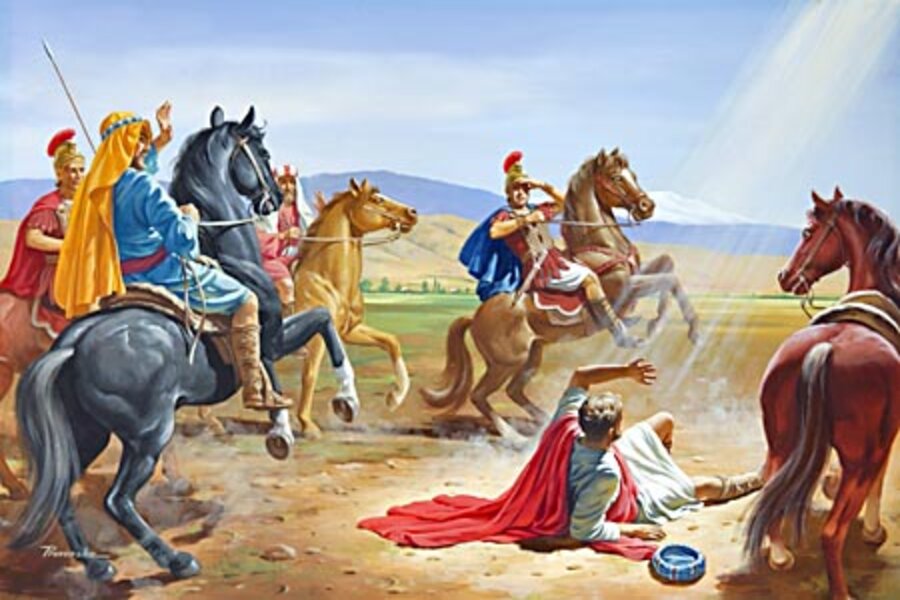
An argument for Christianity that seldom receives adequate attention is the conversion of Saul of Tarsus (also known as Paul) on the road to Damascus. There exist three accounts of Paul’s conversion in the book of Acts — in chapters 9, 22, and 26. The argument from Paul’s conversion has been laid out in most detail by Sir George Lyttelton (1709-1773), in his book Observations on the Conversion and Apostleship of St. Paul. The book is now in the public domain, and a free PDF copy can be obtained at this link. So strong and convincing is the argument from Paul’s conversion that Lyttelton wrote at the beginning of his book, addressing his friend Gilbert West [1],
In a late conversation we had together upon the subject of the Christian religion, I told you, that besides all the proofs of it which may be drawn from the prophecies of the Old Testament, from the necessary connection it has with the whole system of the Jewish religion, from the miracles of Christ, and from the evidence given of his resurrection by all the other Apostles; I thought the Conversion and Apostleship of St. Paul alone, duly considered, was of itself a demonstration sufficient to prove Christianity to be a Divine Revelation.
In this essay, I shall lay out in detail why Paul’s Damascus road conversion constitutes powerful evidence of the truth of Christianity.
When evaluating any set of testimonial claims, there exist three broad explanatory categories that might account for why the claim was made — that is, the claimant(s) was / were either lying, sincerely mistaken, or truthful in their testimony. These options are mutually exhaustive. In order, to evaluate those explanations, however, we must first establish what the original claimant(s) alleged. Thus, the argument of this essay will take the following structure:
- Proposition 1: The accounts in Acts substantially represent Paul’s own conversion testimony.
- Proposition 2: The accounts in Acts concerning Paul’s miracles represent Paul’s own testimony.
- Proposition 3: Paul was not plausibly sincerely mistaken.
- Proposition 4: Paul was not plausibly intentionally deceptive.
- Conclusion: Therefore, the best explanation of the evidence is that Paul did indeed encounter Christ on the Damascus road.
I shall now proceed to lay out the evidence for each of these propositions.
Proposition 1: The Accounts in Acts substantially represent Paul’s own conversion testimony.
For economy of space, the present article will take it for granted that Luke was a travelling companion of Paul. I and others have laid out this case in detail elsewhere. For those not familiar with the substantive evidence for this contention, I would suggest the following resources:
- Evidence and Paul’s Journeys: An Historical Investigation into the Travels of the Apostle Paul (Jefferson White)
- The Book of Acts in the Setting of Hellenistic History (Colin Hemer)
- Hidden in Plain View: Undesigned Coincidences in the Gospels and Acts (Lydia McGrew)
- Horae Paulinae, or, the Truth of the Scripture History of St. Paul Evinced (William Paley)
- The Voyage and Shipwreck of St. Paul (James Smith)
- St. Paul the Traveler and Roman Citizen (William Ramsay)
- Acts: An Exegetical Commentary (four volumes) (Craig Keener) — in particular the discussion of authorship in volume 1 (beginning pages 402) and the analysis of the “we” passages in volume 3 (beginning at Acts 16:10).
- “Just how wrong can Bart Ehrman be about Acts and Paul’s epistles?” (YouTube video by Lydia McGrew)
- “The Resurrection of Jesus — The Evidential Contribution of Luke-Acts” (Jonathan McLatchie)
- “The Book of Acts is High-Resolution Reportage” (Jonathan McLatchie)
- “The Fine-Grained Historicity of Acts” (Jonathan McLatchie)
Three of the books listed above are in the public domain — namely, those by William Paley, James Smith, and William Ramsay. For those, I have linked to a free PDF copy. The PDF that I have linked to for Paley contains both his A View of the Evidences of Christianity, as well as his Horae Paulinae, or, the Truth of the Scripture History of St. Paul Evinced. Both are very much worth reading, but the most relevant of those to our discussion here is the latter volume. In any event, many of the points surveyed in the ensuing discussion are positively relevant to the case for Paul being a travelling companion of Paul and habitually scrupulous.
Given that Luke was a travelling companion of Paul — someone who spent a great deal of time with him — he would have been in a strong position to know what Paul’s testimony was. Paul also appears to have repeated his testimony on multiple occasions — it is given three times in the book of Acts, twice being attributed to Paul’s own words — before a Jewish crowd in Jerusalem, to whom he spoke from the steps of the barracks (Acts 22), and later to the governor Festus and King Agrippa (Acts 26). When we consider the evidence for Luke’s meticulousness as an historian and attention to detail (laid out in the aforementioned resources), together with the fact that he was laying his own neck on the line for the gospel (as evidenced by the fact that he was present with Paul during many of Paul’s own sufferings for the sake of the gospel — including his imprisonment in Caesarea Maritima (for at least two years according to Acts 24:27) and later in Rome, as well as Paul’s hearing before the Sanhedrin (Acts 23) and formal trials before governors Felix and Festus in Caesarea. Taken together, this provides substantial reason to think that Luke very probably provided an accurate representation of Paul’s own testimony.
Paul’s Testimony Was Widely Known
Paul also implies in his letters that his audiences were familiar with his background and conversion testimony — and, thus, that his testimony was widely known among the churches. Jason Engwer explains the implications of this:
[T]he account [Paul] gave of what he experienced with the risen Christ surely was widely disseminated and often reinforced by the time he died. It would be difficult to get even a large percentage of Christians to accept a change in Paul’s account. It would be even harder to do it with every or almost every Christian. And the larger the change involved, the more difficult it would be to successfully carry out the change.
For example, Paul writes in 1 Corinthians 9;1, “Am I not free? Am I not an apostle? Have I not seen Jesus our Lord?” These are rhetorical questions. He does not take time to explain the circumstances under which he encountered Jesus — it is taken for granted that the Corinthians know the circumstances of which he writes. Likewise, in 1 Corinthians 15:8-9, he writes, “Last of all, as to one untimely born, he [Christ] appeared also to me. For I am the least of the apostles, unworthy to be called an apostle, because I persecuted the church of God.” It again seems implicit that his readers know something of the background. He writes to the Philippians, “If anyone else thinks he has reason for confidence in the flesh, I have more: circumcised on the eighth day, of the people of Israel, of the tribe of Benjamin, a Hebrew of Hebrews; as to the law, a Pharisee; as to zeal, a persecutor of the church; as to righteousness under the law, blameless,” (Phil 3:4-6). Again, it seems implicit that Paul’s audience in Philippi were acquainted, at least to some extent, with the background to which he alludes — particularly in his relation to his having been a former persecutor and Pharisee.
Undesigned Coincidences
The most striking example is in Galatians 1:11-17, in which Paul writes,
11 For I would have you know, brothers, that the gospel that was preached by me is not man’s gospel. 12 For I did not receive it from any man, nor was I taught it, but I received it through a revelation of Jesus Christ. 13 For you have heard of my former life in Judaism, how I persecuted the church of God violently and tried to destroy it. 14 And I was advancing in Judaism beyond many of my own age among my people, so extremely zealous was I for the traditions of my fathers. 15 But when he who had set me apart before I was born, and who called me by his grace, 16 was pleased to reveal his Son to me, in order that I might preach him among the Gentiles, I did not immediately consult with anyone; 17 nor did I go up to Jerusalem to those who were apostles before me, but I went away into Arabia, and returned again to Damascus.
Take note of Paul’s words in verse 13 — “For you have heard of my former life in Judaism, how I persecuted the church of God violently and tried to destroy it.” Paul’s readers had already heard about Paul’s background as a church persecutor and religious Jew. It is thus quite likely that they knew more about Paul’s conversion that transformed him into Christianity’s most ardent advocate. Observe too Paul’s words in verse 17 — “nor did I go up to Jerusalem to those who were apostles before me, but I went away into Arabia, and returned again to Damascus.” Paul does not take the time to explain to his readers why Damascus was the place to which he returned from Arabia. It is taken for granted that they already know the connection to Damascus — this is where he went immediately upon his conversion (Acts 9:8). William Paley remarks [2],
In this quotation from the epistle, I desire it to be remarked how incidentally it appears, that the affair passed at Damascus. In what may be called the direct part of the account, no mention is made of the place of his conversion at all: a casual expression at the end, and an expression brought in for a different purpose, alone fixes it to have been at Damascus; “I returned again to Damascus.” Nothing can be more like simplicity and undesignedness than this is.
This casual connection between Galatians and Acts is all the more striking when we consider that these two sources appear to be independent of one another — that is, the author of Acts did not use Galatians as a source, nor vice versa. As Paley observes [3],
Beside the difference observable in the terms and general complexion of these two accounts, “the journey into Arabia,” mentioned in the epistle, and omitted in the history, affords full proof that there existed no correspondence between these writers. If the narrative in the Acts had been made up from the Epistle, it is impossible that this journey should have been passed over in silence; if the Epistle had been composed out of what the author had read of St. Paul’s history in the Acts, it is unaccountable that it should have been inserted.
Indeed, the omission in Acts concerning the journey into Arabia for three years is quite surprising if the author of Acts was using Paul’s letter as a source. The accounts, though, are not mutually exclusive. The phrase “many days”, used by Luke in Acts 9:23 is most probably an idiomatic expression denoting an indefinite period of time. The equivalent phrase in Hebrew is used in 1 Kings 2:39, but the next verse indicates that those “many days” encompassed a three year period. It is also not particularly implausible that Luke simply was not aware of the journey into Arabia, or for some other reason chose not to write about it. Nonetheless, the apparent discrepancy between Acts and Galatians provides internal evidence of independence between the two sources. Paley offers another piece of evidence indicating independence [4]:
The journey to Jerusalem related in the second chapter of the Epistle (“then, fourteen years after, I went up again to Jerusalem”) supplies another example of the same kind. Either this was the journey described in the fifteenth chapter of the Acts, when Paul and Barnabas were sent from Antioch to Jerusalem, to consult the apostles and elders upon the question of the Gentile converts; or it was some journey of which the history does not take notice. If the first opinion be followed, the discrepancy in the two accounts is so considerable, that it is not without difficulty they can be adapted to the same transaction: so that, upon this supposition, there is no place for suspecting that the writers were guided or assisted by each other. If the latter opinion be preferred, we have then a journey to Jerusalem, and a conference with the principal members of the church there, circumstantially related in the Epistle, and entirely omitted in the Acts; and we are at liberty to repeat the observation, which we before made, that the omission of so material a fact in the history is inexplicable, if the historian had read the Epistle; and that the insertion of it in the Epistle, if the writer derived his information from the history, is not less so.
The internal evidence of independence between Acts and Galatians, together with the convergence of details relating to Paul’s conversion (particularly the reference to returning to Damascus) suggest that the accounts in Acts concerning Paul’s conversion are in alignment with Paul’s own testimony.
An additional reason for thinking that Acts and Galatians are independent is that Acts 9:27 indicates that, in Jerusalem, “Barnabas took him [Paul] and brought him to the apostles and declared to them how on the road he had seen the Lord, who spoke to him, and how at Damascus he had preached boldly in the name of Jesus.” Compare this to Galatians 1:18-19: “Then after three years I went up to Jerusalem to visit Cephas and remained with him fifteen days. But I saw none of the other apostles except James the Lord’s brother,” (emphasis added). On the surface, this appears to be a discrepancy. Of course, “the apostles” could be taken to refer to Peter and James (most scholars, including myself, are of the opinion that Galatians 1:19 identifies James the Lord’s brother as an apostle). We could also take it that Paul uses ‘saw’ to mean ‘conversed with’ or ‘met with,’ not that he did not even see any of the other apostles in a meeting, etc. We sometimes use ‘saw’ in this sense ourselves. One could imagine that perhaps Barnabas and Peter decided that they did not want to set Paul down in front of them like a tribunal and question him, so during that time he stayed, let us suppose, in someone’s home, met with James and Peter, and otherwise for those two weeks he was out talking and debating with Jews in Jerusalem (Acts 9:28-29), and eventually was rushed away due to a plot to kill him. In any case, the surface tension between these texts adds additional support for the thesis of independence.
It is also of note that, in Galatians 1:18-19, Paul indicates that his visit to Jerusalem was quite brief. One wonders why Paul’s visit to Jerusalem was cut short such that he only remained there fifteen days and reportedly saw none of the other apostles besides Cephas (Simon Peter) and James the Lord’s brother. Acts 9:29 indicates that there was an assassination plot against Paul by the Hellenists such that he needed to leave Jerusalem in haste. This explains the account in Galatians in an undesigned way, such that it serves to corroborate the historicity of both accounts. This further supports that the testimony in Acts concerning Paul’s conversion and the events shortly thereafter reflect Paul’s own testimony. We also read in Acts 22:17 Paul’s statement that “When I had returned to Jerusalem and was praying in the temple, I fell into a trance and saw him saying to me, ‘Make haste and get out of Jerusalem quickly, because they will not accept your testimony about me.’” Paley remarks, “Here we have the general terms of one text so explained by a distant text in the same book, as to bring an indeterminate expression into a close conformity with a specification delivered in another book: a species of consistency not, I think, usually found in fabulous relations.” [5]
A further point, relating to our text in Galatians 1:18-19, is that Paul some verses later indicates that “afterwards I came into the regions of Syria and Cilicia,” (Gal 1:21). The account in Acts 9 indicates that, when the brothers learned of the plot against Paul’s life, “they brought him down to Caesarea and sent him off to Tarsus,” (v. 30). Paley observes that, “if he took his journey by land, it would carry him through Syria into Cilicia; and he would come, after his visit at Jerusalem, ‘into the regions of Syria and Cilicia,’ in the very order in which he mentions them in the epistle.” Caesarea, of course, was a major port city, and so it is plausible that he made at least part of the journey by sea, before perhaps continuing on land. It is also of note that Paul indicates immediately following this statement in Galatians that “I was still unknown in person to the churches of Judea that are in Christ. They only were hearing it said, ‘He who used to persecute us is now preaching the faith he once tried to destroy,” (Gal 1:22-23). Paley observes, “Upon which passage I observe, first, that what is here said of the churches of Judea, is spoken in connection with his journey into the regions of Syria and Cilicia. Secondly, that the passage itself has little significancy, and that the connection is inexplicable, unless St. Paul went through Judea (though probably by a hasty journey) at the time that he came into the regions of Syria and Cilicia. Suppose him to have passed by land from Cæsarea to Tarsus, all this, as hath been observed, would be precisely true.” [6]
Finally, it may be noted that Paul’s own account of the plot against his life in Damascus, in 2 Corinthians 11:32-33, dovetails with the account in Acts 9:23-25. Paul writes, “At Damascus, the governor under King Aretas was guarding the city of Damascus in order to seize me, but I was let down in a basket through a window in the wall and escaped his hands.” Compare this with the account in Acts 9:23-25: “When many days had passed, the Jews plotted to kill him, but their plot became known to Saul. They were watching the gates day and night in order to kill him, but his disciples took him by night and let him down through an opening in the wall, lowering him in a basket.” Notice that the account in Acts emphasizes the involvement of the Jews, whereas Paul, in 2 Corinthians, emphasizes the involvement of Aretas IV, the king of the Nabateans (who reigned from 9 B.C. to 40 C.E.). These are not mutually exclusive (presumably, there was a conspiracy involving both parties). Nonetheless, the discrepancy between Acts and 2 Corinthians points to independence, which renders the points of convergence of significant evidential value. Why might Aretas IV be involved in the conspiracy against Paul in Damascus? Aretas IV had significant political influence and authority in the region, which was only about sixty miles from Nabataean territory. Following Aretas’ victory over Herod Antipas (36 CE) and the Roman delay in punishing him due to the death of Tiberias in 37 CE, Aretas may have taken temporary control of Damascus or installed a loyal ethnarch (governor) over the Nabataean community in Damascus.
There are also additional reasons to believe that Acts and 2 Corinthians are independent of one another. For example, Titus is mentioned throughout 2 Corinthians (2:13; 7:6, 13, 14; 8:6, 16, 23; 12:18), but is nowhere mentioned in Acts. Moreover, the list of Paul’s sufferings in 2 Corinthians 11:23-29 cannot be readily correlated with Acts (though it is by no means mutually exclusive). For example, 2 Corinthians 11:25 indicates that Paul endured three shipwrecks prior to the beginning of Acts 20 (when he wrote 2 Corinthians from Macedonia). Acts does not record any of those shipwrecks, but instead narrates an entirely different one in chapter 27. Furthermore, a major theme in the Corinthian letters, as well as Romans, is the collection being prepared for the relief of the saints in Jerusalem. Though Acts agrees with the implied order of travel, there is no explicit mention in Acts of fundraising as a purpose of Paul’s travels (though there is a cryptic allusion to it in Paul’s speech before Felix, in Acts 24:17: “Now after several years I came to bring alms to my nation and to present offerings”). Taken cumulatively, it seems near certain that Luke did not use 2 Corinthians as a source for the composition of Acts. As Paley notes, “Now if we be satisfied in general concerning these two ancient writings, that the one was not known to the writer of the other, or not consulted by him; then the accordances which may be pointed out between them will admit of no solution so probable, as the attributing of them to truth and reality, as to their common foundation.” [7]
As can be seen from the evidence provided above, several undesigned coincidences relate specifically to the account of Paul’s conversion in Acts 9. This further supports that the narrative concerning Paul’s Damascus road experience accurately represent Paul’s own testimony. When considered in conjunction with the other lines of evidence already considered (that Luke was a travelling companion of Paul and was thus in a position to know Paul’s testimony; Paul repeated his testimony multiple times and implies in his letters that his testimony was already widely known; Luke’s demonstrated meticulousness as an historian; and the fact that Luke was putting his own neck on the line), the evidence may be considered very convincing indeed.
Paul’s Speeches in Acts 22 & 26
The speeches recorded in Acts where Paul provides his conversion testimony display marks of realism that suggest they are accurate representations of the substance of Paul’s remarks. I am indebted to the work of the nineteenth century scholar J.S. Howson for the points that follow in this section. [8] Howson observes various marks of realism in the two speeches in Acts 22 and 26 that align with Paul’s own principle of “being all things to all men” (1 Cor 9:19-23), since Paul tells his conversion story in different ways in a manner that will be optimally received by his audience.
In both speeches, Paul omits particular details that may have been noteworthy for Luke as the author (and which are emphasized in Luke’s own telling of the story in Acts 9) but would have been of less interest to Paul’s own audience — for instance, Paul’s not eating for multiple days following his encounter with Christ on the Damascus road and the scales that fell from his eyes upon being healed by Ananias (these are both mentioned in Acts 9:9,18-19, when the story is recounted by the author Luke).
When Paul addresses the mob in Jerusalem, Paul positions himself as an observant Jew and underscores his zealotry for Judaism in order to maintain the attention of the crowd and win their favor. He addresses his audience as “brothers and fathers” (Acts 22:1) and emphasizes how he himself studied under the famed teacher Gamaliel (Acts 22:3). He also highlights Ananias’ religious devoutness, identifying him as “a devout man according to the law” (Acts 22:12) rather than as a believer in Jesus.
Paul delays using the word “gentiles” throughout the whole speech until he has completed his testimony. For instance, in verse 15, he says that Ananias advised him that “The God of our fathers” has appointed Paul to be a witness “to all men” (πρὸς πάντας ἀνθρώπους). When finally Paul declares that Jesus sent him to the gentiles (Acts 22:21), Luke tells us, “Up to this word they listened to him. Then they raised their voices and said, ‘Away with such a fellow from the earth! For he should not be allowed to live,’” (Acts 22:22). Paul’s delay in use of the word “gentiles” in this context allowed him to speak for some time.
Compare this to Paul’s speech before Festus and Agrippa. In this speech, there is no mention of Ananias. Howson notes, “The authority of an obscure Jew of Damascus could have no weight with Agrippa.” [9] In this address, Paul highlights multiple times that his opponents are Jews (Acts 26:2, 7, 21). In this speech, Paul speaks highly of the Christians from the outset, referring to them as “saints” (Acts 26:10). He highlights that he himself tried to induce the Christians to blaspheme (Acts 26:11), which comports well with Paul’s tendency to self-blame in his letters (cf. 1 Cor 15:9). This would not have been well received by his Jewish audience in Acts 22. Paul tells Festus and Agrippa that the voice addressed him “in the Hebrew language,” (Acts 26:14). This casually suggests that Paul was surely addressing his gentile audience in Greek, unlike his audience in Acts 22 where he spoke to them in Hebrew (v. 2). Remarking on these points, Lydia McGrew notes [10],
These little touches are well explained by Luke’s having accurate access to what Paul said on these occasions and to his being quite strikingly careful in recording it. Even though it is not by any means necessary to take Luke to be recording the speeches verbatim, they are more detailed and Pauline even than the phrase “Lukan summaries” might be taken to indicate. Yet these are precisely the kinds of speeches in which one might expect an author like Josephus to show his own eloquence rather than recording, with a notable degree of accuracy, a speech actually given by an historical person speaking to a specific audience in a specific language.
Internal Discrepancies?
Before moving on, a word must be said about a couple of alleged discrepancies between the accounts of Paul’s conversion in Acts. It has been observed that, according to Acts 9:7, “The men who were travelling with him stood speechless, hearing [ἀκούοντες] the voice but seeing no one,” whereas Acts 22:9 indicates that the travelling companions “saw the light but did not hear [οὐκ ἤκουσαν] the voice of the one who was speaking to [Paul].” Though οὐκ ἤκουσαν can be rendered “did not hear,” another legitimate translation is “did not understand” (indeed, it is rendered this way by the ESV, NIV, NASB, and NET, though the KJV translates it “did not hear”). In Luke 6:27-28, Jesus says, “But I say to you who hear [ἀκούουσιν], Love your enemies, do good to those who hate you, bless those who curse you, pray for those who abuse you.” Clearly, here, the meaning of Ἀλλὰ ὑμῖν λέγω τοῖς ἀκούουσιν is “But I say to you who understand…” Likewise, in Mark 4:33, we read, “With many such parables he spoke the word to them, as they were able to hear [ἀκούειν] it.” Clearly, in context, the verb ακουω means to understand. Acts 26:14 indicates that the voice spoke in the Hebrew language. If Paul’s companions were Greek speakers, this could plausibly account for why they were unable to understand the voice.
Another alleged discrepancy is that, according to Acts 9:7, Paul’s companions “stood speechless,” whereas Acts 26:14 indicates that they were thrown to the ground. Most probably the phrase “stood speechless” is simply an idiomatic expression that means they were stopped dead, without insinuating that they were standing up the whole time.
Proposition 2: The accounts in Acts concerning Paul’s miracles represent Paul’s own testimony.
Paul indicates in his letters that he performed miracles in attestation of his apostolic claims. For example, he wrote to the church in Corinth, “The signs of a true apostle were performed among you with utmost patience, with signs and wonders and mighty works,” (2 Cor 12:12) Note that this appeal is made to an audience who had in their midst individuals who doubted Paul’s apostolic credentials. It was risky to appeal to such miracles if there were no such convincing miracles to speak of that could be brought to the minds of his critics. There is a similar passage, indicating that Paul performed miracles, in his letter to the Romans: “For I will not venture to speak of anything except what Christ has accomplished through me to bring the Gentiles to obedience—by word and deed, by the power of signs and wonders, by the power of the Spirit of God—so that from Jerusalem and all the way around to Illyricum I have fulfilled the ministry of the gospel of Christ,” (Rom 15:18-19; emphasis added). Though Paul does not indicate what those signs purportedly involved, we read in Acts about the sort of miracles that Paul performed and experienced. A complete list is given below:
- Paul strikes Bar-Jesus/Elymas (a Jewish false prophet who had opposed Paul and Barnabas and sought to turn the Proconsul, Sergius Paulus, away from the faith) blind on command, a feat so convincing that it results in the conversion of the Proconsul (Acts 13:9-12)
- Paul and Barnabas perform miraculous signs in Phrygian Iconium (Acts 14:3)
- Paul heals a man who has been lame from birth (Acts 14:8-10)
- Paul and Barnabas speak at the Jerusalem council, about “what signs and wonders God had done through them among the Gentiles,” (Acts 15:12).
- Paul exorcises a spirit of divination, meaning that a slave girl’s owners were no longer able to use her for fortune telling — leading to the imprisonment of Paul and Silas in Philippi (Acts 16:15-24).
- Paul and Silas are freed from prison (where their feet had been fastened in stocks) by an earthquake (Acts 16:26).
- God does “extraordinary miracles by the hands of Paul, so that even handkerchiefs or aprons that had touched his skin were carried away to the sick, and their diseases left them and the evil spirits came out of them,” (Acts 19:11-12).
- Paul raises Eutychus from the dead, after he falls from a third-story window (Acts 20:9-10).
- Paul survives being bitten by a viper (Acts 28:3-6).
- Paul heals the father of Publius, who “lay sick with fever and dysentery,” as well as others, on the island of Malta (Acts 28:8-9).
To what extent can we be confident that these miracle reports are representative of Paul’s own claims? Of course, there is the general case for the author of Acts being a travelling companion of Paul and someone who was in the habit of being scrupulous and one who received reliable information from Paul concerning his itinerary and activities (an argument which I and others have laid out extensively elsewhere). Luke appears to have been present with Paul, beginning in Acts 16:10, though the “we” passages trail off when Paul passes through Philippi (the last use of the “we” pronoun, ἡμῖν, being in Acts 16:16) and commence again when Paul passes back through Philippi some seven or eight years later (Acts 20:6), continuing through the remainder of the book. This suggests that the author remained behind at Philippi, and subsequently rejoined Paul later when Paul again passed through Philippi. This provides an indirect justification for thinking that the accounts of those miracles in Acts represents Paul’s testimony. There are, however, more direct lines of evidence that bear more specifically on those miracle accounts. It is to these that I now turn.
Striking Elymas Blind
Acts 13:4-12 recounts Paul’s and Barnabas’ encounter with a magician by the name of Bar-Jesus, also called Elymas, on the island of Cyprus. Luke indicates that “he was with the proconsul, Sergius Paulus, a man of intelligence, who summoned Barnabas and Saul and sought to hear the word of God,” (v. 7). However, Elymas “opposed them, seeking to turn to the proconsul away from the faith,” (v. 7). In response, Paul “looked intently at him and said, ‘You son of the devil, you enemy of all righteousness, full of all deceit and villainy, will you not stop making crooked the straight paths of the Lord? And now, behold, the hand of the Lord is upon you, and you will be blind and unable to see the sun for a time.’ Immediately mist and darkness fell upon him, and he went about seeking people to lead him by the hand,” (v. 10-11). So convincing is this miracle that it results in the conversion of the Proconsul, Sergius Paulus (v. 12). If indeed this episode represents the testimony of Paul, it is an episode about which it would have been difficult for Paul to be sincerely mistaken.
One specific detail that Luke gets right is that Cyprus was under the governorship of a Pronconsul. At the time of Paul’s journey (47-48 C.E.), there were about 12-15 senatorial provinces (which were under the governorship of a Proconsul), compared to a larger number of imperial provinces (which were under the governorship of legates, who were directly under the emperor’s control). Senatorial provinces were considered to be more peaceful and civilized, and therefore did not require troops to maintain the peace. Imperial provinces, on the other hand (such as Judea) had a standing military presence. Cyprus became a senatorial province in 22 B.C.E., meaning it was governed by a Proconsul instead of a legate or prefect. The Roman historian Cassius Dio indicates that “It was at this time that he [Caesar Augustus] restored to the people both Cyprus and Gallia Narbonensis as districts no longer needing the presence of his armies; and thus proconsuls began to be sent to those provinces also.” [11] If Luke was simply making up details with no connection to actual events, it would have been easy for him to mistakenly call the governor a legate or to use some generic title. In fact, the evidence suggests that, by the time of the Flavian dynasty (commencing in 69 C.E. with the emperor Vespasian), Cyprus was transferred back to imperial control and under the authority of legates. If Acts were composed after 70 C.E., as many scholars maintain, it would have been even easier for Luke to err at this point. In an age before the internet and ease of access to information, small points of specialized local knowledge, such as this, evince the credibility of the account in Acts, since it would be significantly easier to get those details wrong than it would be to get them right. Details such as this would not be in the stock of common knowledge across the empire (see my essay here for a discussion of the significance of this type of evidence).
Another remarkable confirmation of the account in Acts is the identification of the Proconsul as Sergius Paulus. A Greek inscription of Soloi, on the northeast coast of Cyprus, is dated “in the Proconsulship of Paulus.” This inscription is shown in the photograph below:

Though we cannot say for certain, it is quite plausible that this is the same individual spoken of in Acts. Though the precise date of the inscription is uncertain, it likely belongs to the first century C.E. This individual is said to have served as Proconsul during the tenth year of an emperor, though the name is missing from the inscription. Ben Witherington notes, “If the emperor in question was Claudius, the inscription would date to about A.D. 50, but the very date line seems to be a later addition. It thus remains possible that this refers to the same Sergius Paulus as mentioned in Acts, but it is also possible on epigraphical grounds that the inscription comes from as late as the time of Hadrian in the second century.” [12] Nonetheless, regardless of whether this is the same individual or not, the inscription demonstrates a connection of the family to the island of Cyprus, consistent with the account in Acts.
There is another interesting inscription that was identified in Pisidian Antioch, shown below.

This inscription bears the name of “L. Sergius Paullus the younger, son of L.” (note that Paullus is the Latin spelling, whereas Paulus is the Greek spelling). It is probable that “L” stands for Lucius, given the limited number of commonly used first names among Roman men. The inscription reads, “To L(ucius) Sergius Paullus, the younger, son of L(ucius), one of the four commissioners in charge of the Roman streets, tribune of the soldiers of the sixth legion styled Ferrata, quaestor…” It has even been suggested that this could be the son, or another relative, of the Proconsul mentioned in Acts. Given the connection of this individual to Pisidian Antioch, is it a coincidence that Paul and Barnabas travelled to Pisidian Antioch immediately following these events, after Sergius Paulus’ conversion to Christianity? Pisidian Antioch was not the nearest or most obvious stop after Cyprus. It is plausible that Sergius Paulus convinced Paul to travel to Pisidian Antioch with a desire for his relatives there to hear the gospel.
These connections to the archaeological evidence strongly suggest that the account in Acts 13:4-12, in which Paul causes Bar-Jesus (Elymas) to go blind in response to his opposition to the gospel, represents the testimony of Paul himself.
Healing the Cripple at Lystra
In Acts 14:8-10, we read,
8 Now at Lystra there was a man sitting who could not use his feet. He was crippled from birth and had never walked. 9 He listened to Paul speaking. And Paul, looking intently at him and seeing that he had faith to be made well, 10 said in a loud voice, “Stand upright on your feet.” And he sprang up and began walking.
In this account, Paul miraculously heals a man in Lystra who had been crippled since birth, a feat which greatly impresses the crowds. Verse 11 indicates that, “when the crowds saw what Paul had done, they lifted up their voices, saying in Lycaonian, ‘The gods have come down to us in the likeness of men!’” Luke indicates that this was said in the Lycaonian language. The use of a native language, rather than Greek, was quite uncommon. Colin Hemer notes that “The use of a native language is unusual in the cosmopolitan, Hellenized society in which Paul moved. Lystra, however, as a Roman colony in a less developed part of Anatolia, preserved a language otherwise attested in a gloss in Stephanus of Byzantium.” [13] While Greek was widely spoken in urban centers and among the elite, rural populations (particularly in more isolated areas) retained their native tongue. This is, therefore, a specific (and unusual) local detail about Lycaonia that Luke gets right.
According to verse 12, “Barnabas they called Zeus, and Paul, Hermes, because he was the chief speaker.” A number of inscriptions have been identified that confirm that Zeus-Hermes was the local cult in Lystra. The first century Roman poet Ovid writes, in his poem Metamorphoses, about Zeus and Hermes visiting a town in Phrygia, disguised as mortals seeking hospitality. [14] Only an elderly couple, Baucis and Philemon, welcome them, and as a reward for their kindness, the gods transform their humble home into a temple and grant them their wish to die together. Phrygia and Lycaonia were both located in central Anatolia (modern day Turkey) and the story of Baucis and Philemon is generally thought to be set close to the border with Lycaonia. This is, therefore, another specific local detail that Acts gets right. The fact that Barnabas is identified as Zeus (the greater of the two gods), whereas Paul is identified as Hermes also reflects the ancient belief that, when two deities visited earth, the lesser god did the speaking.
These specific details relating to Lystra, related accurately by Acts, suggests that the account of the healing of the crippled man reliably represents Paul’s testimony.
Paul’s Prison Break in Philippi
In Acts 16, Paul and Silas, while in Philippi, cast out a spirit of divination from a slave girl. This leads to them being dragged into the marketplace before the rulers by the slave girl’s owners, and ultimately lands them in prison for causing a disturbance, their feet being fastened in stocks. At midnight, as they are praying and singing in the prison, there is a great earthquake, which shakes the foundations of the prison. The text tells us that “immediately all the doors were opened, and everyone’s bonds were unfastened,” (v. 26). The jailer is about to take his own life, but Paul cries out, “Do not harm yourself, for we are all here,” (v. 28). This ultimately leads to the conversion and baptism of the jailer and his household. In verses 35-40, we read,
35 But when it was day, the magistrates sent the police, saying, “Let those men go.” 36 And the jailer reported these words to Paul, saying, “The magistrates have sent to let you go. Therefore come out now and go in peace.” 37 But Paul said to them, “They have beaten us publicly, uncondemned, men who are Roman citizens, and have thrown us into prison; and do they now throw us out secretly? No! Let them come themselves and take us out.” 38 The police reported these words to the magistrates, and they were afraid when they heard that they were Roman citizens. 39 So they came and apologized to them. And they took them out and asked them to leave the city. 40 So they went out of the prison and visited Lydia. And when they had seen the brothers, they encouraged them and departed.
Paul briefly alludes to this episode in a letter to the Thessalonians: “But though we had already suffered and been shamefully treated at Philippi, as you know, we had boldness in our God to declare to you the gospel of God in the midst of much conflict,” (1 Thess 2:2, emphasis added). This raises the question as to how the Thessalonians knew about Paul’s shameful treatment in Philippi. Turning to Acts 17:1, we read, immediately following Paul’s experience in Philippi, “when they had passed through Amphipolis and Apollonia, they came to Thessalonica.” The route taken by Paul was, in fact, a major Roman highway, the Via Egnatia. Amphipolis and Apollonia were overnight stops along that route. Paul’s route from Philippi to Thessalonica is depicted in the map below.

One can imagine, then, Paul arriving in Thessalonica having just come from Philippi, still full of indignation about the unjust and illegal treatment he had received there, and recounting to the new converts in Thessalonica what had happened. This dovetails with Paul’s allusion in 1 Thessalonians 2:2 to how he had “been shamefully treated at Philippi, as you know…”
The evidential force of this coincidence is enhanced by the fact that Acts does not appear to be utilizing 1 Thessalonians is a source — that is to say, these two writings are independent of one another. In support of this, it may be observed that 1 Thessalonians 1:9 emphasizes the conversion of pagans in Thessalonica: “…you turned to God from idols to serve the living and true God…” The book of Acts, on the other hand, emphasizes the conversion of Jews and god-fearing gentiles (Acts 17:4). These are, of course, not mutually exclusive. Nonetheless, if the author of Acts were using 1 Thessalonians as a source, one would expect him to lay more emphasis on the conversion of pagans.
This undesigned coincidence provides evidence for the contention that the account of Paul’s prison break in Philippi, resulting from the earthquake, in fact represents Paul’s own testimony. The account is also linked to Paul having cast out a spirit of divination from the slave girl, which was the incident that led to his imprisonment along with Silas in Philippi.
Proposition 3: Paul was not plausibly sincerely mistaken.
Having established that the accounts in Acts concerning Paul’s conversion and miracles substantially represent what Paul himself testified to, we are now in a position to evaluate whether the specific set of claims recorded in Acts are the sort about which one might plausibly be sincerely mistaken.
Multisensory Experiences
Paul’s experience is alleged to have been multisensory — involving both a visual and auditory component (Acts 9:3-6, 22:6-10, 26:13-18; 1 Cor 9:1, 15:8). Moreover, it was intersubjective — affecting not only Paul, but also his travelling companions who were purportedly thrown to the ground, having heard the voice though seeing no one (Acts 9:7, 22:9; 26:14). Acts 22:9 indicates that Paul’s travelling companions nonetheless saw the light. Moreover, Paul was blinded by the experience for three days (Acts 9:8-9; 22:11) and later healed by Ananias who received a vision concerning Paul, and Paul a vision concerning Ananias (Acts 9:10-19; 22:12-16). It is difficult to envision Paul being sincerely mistaken about this set of claims — in particular given that he was not already predisposed to expect an appearance from the raised Christ. Paul was a persecutor of the church and a zealous Pharisee. What could have prompted him to so drastically change his mind, and reverse course 180 degrees? Sir George Lyttelton notes that “[Paul’s] mind, far from being disposed to a credulous faith, or a too easy reception of any miracle worked in proof of the Christian religion, appears to have been barred against it by the most obstinate prejudices, as much as any man’s could possibly be; and from hence we may fairly conclude, that nothing less than the irresistible evidence of his own senses, clear from all possibility of doubt, could have overcome his unbelief.” [15]
Though some have attempted to explain Paul’s experience by appeal to temporal lobe epilepsy (TLE), such a hypothesis is hardly credible. For one thing, TLE blindness is incredibly short — typically thirty seconds to ten minutes. Paul’s blindness, by contrast, lasted for three days and was healed on command by Ananias. It is also typical to quickly forget what happened during the seizure. Moreover, the fact that Paul’s companions also purportedly heard a voice and perceived a light and were thrown to the ground is surprising on the TLE hypothesis. The fact that something like scales fell from Paul’s eyes (Acts 9:18) also does not comport well with this explanation.
Miraculous Signs
Furthermore, as discussed in the previous section, Paul claims to have performed miracles. When we consider the content of Paul’s testimony concerning these purported miracles — including causing Elymas to go blind on command on Cyprus (Acts 13:6-12), healing the man who had been lame since birth in Lystra (Acts 14:8-10); or his casting out of the spirit of divination from the slave girl in Philippi, disrupting her owners’ business (Acts 16:16-19) and his subsequent miraculous jailbreak (Acts 16:25-40) — it seems to be difficult to account for on the supposition that he was sincerely mistaken.
Having established that Paul was not plausibly sincerely mistaken, only two options remain — either he was intentionally deceptive, or he really did have an encounter with Christ on the road to Damascus. It is to the hypothesis of deception that I now turn.
Proposition 4: Paul was not plausibly intentionally deceptive.
Patristic Sources Confirm Paul’s Suffering for the Gospel
There exists an abundance of evidence that Paul voluntarily endured significant hardships, dangers, persecutions, toils, labors, imprisonments and ultimately execution for the sake of the gospel. This goes a long way towards establishing his sincerity. For example, Clement of Rome, in his sole surviving letter, addressed to the Corinthian church, writes (1 Clement 5) [16],
But not to dwell upon ancient examples, let us come to the most recent spiritual heroes. Let us take the noble examples furnished in our own generation… Owing to envy, Paul also obtained the reward of patient endurance, after being seven times thrown into captivity, compelled to flee, and stoned. After preaching both in the east and west, he gained the illustrious reputation due to his faith, having taught righteousness to the whole world, and come to the extreme limit of the west, and suffered martyrdom under the prefects. Thus was he removed from the world, and went into the holy place, having proved himself a striking example of patience.
This epistle is generally dated to around the year 96 C.E., as the church emerged from the persecution under the emperor Domitian. Clement of Rome had been a companion of Paul, and is likely the individual referred to in Philippians 4:3: “Yes, I ask you also, true companion, help these women, who have labored side by side with me in the gospel together with Clement and the rest of my fellow workers, whose names are in the book of life,” (emphasis added]. Paul’s letter to the Philippians was composed during Paul’s first imprisonment in Rome. The second century church father Irenaeus of Lyons writes the following concerning Clement (Adv. Haer. 3.3.3) [17]:
This man, as he had seen the blessed apostles, and had been conversant with them, might be said to have the preaching of the apostles still echoing [in his ears], and their traditions before his eyes. Nor was he alone [in this], for there were many still remaining who had received instructions from the apostles. In the time of this Clement, no small dissension having occurred among the brethren at Corinth, the Church in Rome dispatched a most powerful letter to the Corinthians, exhorting them to peace, renewing their faith, and declaring the tradition which it had lately received from the apostles.
Clement was thus someone in a position to know about Paul’s sufferings for the sake of the gospel.
Polycarp of Smyrna, in his epistle to the Philippians, also testifies to the persecutions endured by Paul (Poly 9) [18]:
I exhort you all, therefore, to yield obedience to the word of righteousness, and to exercise all patience, such as ye have seen [set] before your eyes, not only in the case of the blessed Ignatius, and Zosimus, and Rufus, but also in others among yourselves, and in Paul himself, and the rest of the apostles. [This do] in the assurance that all these have not run in vain, but in faith and righteousness, and that they are [now] in their due place in the presence of the Lord, with whom also they suffered. For they loved not this present world, but Him who died for us, and for our sakes was raised again by God from the dead.
Irenaeus informs us concerning Polycarp (Adv. Haer. 3.3.4) [19]:
But Polycarp also was not only instructed by apostles, and conversed with many who had seen Christ, but was also, by apostles in Asia, appointed bishop of the Church in Smyrna, whom I also saw in my early youth, for he tarried [on earth] a very long time, and, when a very old man, gloriously and most nobly suffering martyrdom, departed this life, having always taught the things which he had learned from the apostles, and which the Church has handed down, and which alone are true.
Thus, given Polycarp’s acquaintance with the apostles, he was also in a position to know about the sufferings endured by Paul and the other apostles.
Paul Writes of Suffering for the Gospel
In addition to the foregoing, there is a lot of attestation to Paul’s sufferings in Acts and the Pauline corpus. For example, consider Paul’s list of his experiences in 2 Corinthians 11:24-27:
24 Five times I received at the hands of the Jews the forty lashes less one. 25 Three times I was beaten with rods. Once I was stoned. Three times I was shipwrecked; a night and a day I was adrift at sea; 26 on frequent journeys, in danger from rivers, danger from robbers, danger from my own people, danger from Gentiles, danger in the city, danger in the wilderness, danger at sea, danger from false brothers; 27 in toil and hardship, through many a sleepless night, in hunger and thirst, often without food, in cold and exposure.
Paul also expresses in 1 Corinthians 4:9-13:
9 For I think that God has exhibited us apostles as last of all, like men sentenced to death, because we have become a spectacle to the world, to angels, and to men. 10 We are fools for Christ’s sake, but you are wise in Christ. We are weak, but you are strong. You are held in honor, but we in disrepute. 11 To the present hour we hunger and thirst, we are poorly dressed and buffeted and homeless, 12 and we labor, working with our own hands. When reviled, we bless; when persecuted, we endure; 13 when slandered, we entreat. We have become, and are still, like the scum of the world, the refuse of all things.
Paul rejoiced in his own sufferings for the name of Christ. He wrote to the Philippians, “Even if I am to be poured out as a drink offering upon the sacrificial offering of your faith, I am glad and rejoice with you all. Likewise you also should be glad and rejoice with me,” (Phil 2:17-18).
Shamefully Treated at Philippi
Paul, moreover, writes to the Thessalonians, “But though we had already suffered and been shamefully treated at Philippi, as you know, we had boldness in our God to declare to you the gospel of God in the midst of much conflict,” (1 Thess 2:2, emphasis added). Earlier in this article, we discussed how this relates to the narrative in Acts 16:35-40 about Paul having been beaten with rods and imprisoned, uncondemned, despite being an Roman citizen. This undesigned coincidence also carries force for our purposes here, in establishing the historicity of Paul’s persecutions in Philippi.
Driven Out of Macedonia
We also read in Acts 17 about the persecution endured by Paul from a mob of Jews who stirred up trouble for him. According to Acts 17:5-9:
5 But the Jews were jealous, and taking some wicked men of the rabble, they formed a mob, set the city in an uproar, and attacked the house of Jason, seeking to bring them out to the crowd. 6 And when they could not find them, they dragged Jason and some of the brothers before the city authorities, shouting, “These men who have turned the world upside down have come here also, 7 and Jason has received them, and they are all acting against the decrees of Caesar, saying that there is another king, Jesus.” 8 And the people and the city authorities were disturbed when they heard these things. 9 And when they had taken money as security from Jason and the rest, they let them go.
Paul thus had to leave in haste to go to Berea (Acts 17:10). We read in Acts 17:13 that “when the Jews from Thessalonica learned that the word of God was proclaimed by Paul at Berea also, they came there too, agitating and stirring up the crowds.” Paul thus, again, had to leave in haste to travel to Athens — “Then the brothers immediately sent Paul off on his way to the sea, but Silas and Timothy remained there. Those who conducted Paul brought him as far as Athens, and after receiving a command for Silas and Timothy to come to him as soon as possible, they departed.” Paul’s route from Berea to Athens is shown in the map below.

Acts leaves unexplained why Paul left behind Silas and Timothy. This unexplained allusion is itself a hallmark of verisimilitude in the text. It is the texture of testimony — one does not typically leave loose ends like this in a fictitious work. Moreover, Silas and Timothy are instructed to rejoin Paul “as soon as possible.” We are therefore led to presume that they did rejoin Paul in Athens shortly thereafter (though the text does not indicate explicitly). Acts 17:16 actually says that “Paul was waiting for them at Athens.” Nonetheless, they are next reported to rejoin Paul not in Athens but in Corinth — and they arrived not from Athens but from Macedonia, where the cities of Thessalonica and Berea are (Acts 18:5).
What accounts for this gap in the text? An explanation is provided by 1 Thessalonians 3:1-5:
Therefore when we could bear it no longer, we were willing to be left behind at Athens alone, 2 and we sent Timothy, our brother and God’s coworker in the gospel of Christ, to establish and exhort you in your faith, 3 that no one be moved by these afflictions. For you yourselves know that we are destined for this. 4 For when we were with you, we kept telling you beforehand that we were to suffer affliction, just as it has come to pass, and just as you know. 5 For this reason, when I could bear it no longer, I sent to learn about your faith, for fear that somehow the tempter had tempted you and our labor would be in vain.
Thus, Paul indicates, under the circumstances, he had been concerned for the wellbeing of the Christians in Thessalonica, and so he commissioned Timothy to go back from Athens to Thessalonica to check on the believers there. This explains the gap in the account in Acts, and thereby corroborates the account in Acts. This undesigned coincidence is, again, all the more striking given the independence (as I have shown) between Acts and 1 Thessalonians.
Working as a Tent Maker
Connected to this, there is another undesigned coincidence relating to Paul’s time in Corinth (Acts 18:1-5):
After this Paul left Athens and went to Corinth. 2 And he found a Jew named Aquila, a native of Pontus, recently come from Italy with his wife Priscilla, because Claudius had commanded all the Jews to leave Rome. And he went to see them, 3 and because he was of the same trade he stayed with them and worked, for they were tentmakers by trade. 4 And he reasoned in the synagogue every Sabbath, and tried to persuade Jews and Greeks. 5 When Silas and Timothy arrived from Macedonia, Paul was occupied with the word, testifying to the Jews that the Christ was Jesus.
Paul encounters Aquila and Priscilla in Corinth, who had been exiled from Rome at the instigation of the emperor Claudius. The Roman biographer Suetonius also mentions this episode: “He [Claudius] banished from Rome all the Jews, who were continually making disturbances at the instigation of one Chrestus,” (Life of Claudius 25). [20] Our text in Acts indicates that Paul worked with them as a tentmaker to earn his keep during the week, and that he engaged in his evangelistic work on the Sabbath day, when he went into the synagogue and tried to persuade Jews and Greeks that Jesus is the Christ. However, in response to the arrival of Silas and Timothy from Macedonia, he changed his ministry model such that he devoted himself entirely to the work of the ministry. What prompted this change? Acts does not inform us. However, we read in 2 Corinthians 11:7-9:
7 Or did I commit a sin in humbling myself so that you might be exalted, because I preached God’s gospel to you free of charge? 8 I robbed other churches by accepting support from them in order to serve you. 9 And when I was with you and was in need, I did not burden anyone, for the brothers who came from Macedonia supplied my need. So I refrained and will refrain from burdening you in any way.
Apparently the brothers who came from Macedonia (whom we learn from Acts included Silas and Timothy) brought financial aid to Paul, which enabled him to devote himself entirely to the ministry. This detail, however, is not supplied by Acts. This is further corroborated by Philippians 4:14-16, in which we read (in a letter addressed to one of the churches in Macedonia),
14 Yet it was kind of you to share my trouble. 15 And you Philippians yourselves know that in the beginning of the gospel, when I left Macedonia, no church entered into partnership with me in giving and receiving, except you only. 16 Even in Thessalonica you sent me help for my needs once and again.
This, once again, serves to confirm the account in Acts — which reveals that Paul was willing to work for his keep as a tentmaker. In other words, he was evidently not in ministry for the purpose of extorting people for money. Moreover, the account in Acts continues with a note about another episode of opposition against Paul: “And when they opposed and reviled him, he shook out his garments and said to them, ‘Your blood be on your own heads! I am innocent. From now on I will go to the Gentiles,’” (Acts 18:6). This coincidence is all the more striking given the independence of Acts and 2 Corinthians, as demonstrated earlier in this article.
Persecuted in Antioch, Iconium, and Lystra
Another undesigned coincidence bearing on Paul’s sufferings relates to Paul’s statement in 2 Timothy 3:10-11:
10 You, however, have followed my teaching, my conduct, my aim in life, my faith, my patience, my love, my steadfastness, 11 my persecutions and sufferings that happened to me at Antioch, at Iconium, and at Lystra—which persecutions I endured; yet from them all the Lord rescued me.
The sufferings mentioned here are described in Acts 13:50-51 and 14:1-7, 19-21. Paul seems to imply, in his letter to Timothy, that Timothy had in fact witnessed the persecutions that he had endured in those cities. According to Acts, Paul embarked on a second missionary journey through the same country as the first journey. The purpose of his second missionary trip is given in Acts 15:36: “Let us return and visit the brothers in every city where we proclaimed the word of the Lord, and see how they are.” Thus, we learn, that the purpose of the journey was to check on those who had been converted during the first journey, to see how they were doing. In Acts 16;1-2, we further learn, “Paul came also to Derbe and to Lystra. A disciple was there, named Timothy, the son of a Jewish woman who was a believer, but his father was a Greek. 2 He was well spoken of by the brothers at Lystra and Iconium.” We are thereby informed that Timothy’s hometown was either Derbe or Lystra. And it is apparent from the text that Timothy had already been converted by this time. Paul himself refers to Timothy as “my true child in the faith” (1 Tim 1:2) and “my beloved child” (2 Tim 1:2). This implies that Timothy was probably Paul’s own convert. It then follows that Timothy was very likely converted during Paul’s preceding missionary journey through these cities, at the very time when Paul had undergone the persecutions referred to in the epistle. This supports both the historicity of Acts, as well as the genuineness of the pastoral epistles (which are among the disputed Pauline letters). For a more detailed discussion of the authenticity of the pastoral epistles, see my essay here.
There is also external evidence that corroborates the accounts in Acts concerning Paul’s suffering for the gospel. For example, Acts 22:25-29 describes Paul being before the Roman tribune:
25 But when they had stretched him out for the whips, Paul said to the centurion who was standing by, “Is it lawful for you to flog a man who is a Roman citizen and uncondemned?” 26 When the centurion heard this, he went to the tribune and said to him, “What are you about to do? For this man is a Roman citizen.” 27 So the tribune came and said to him, “Tell me, are you a Roman citizen?” And he said, “Yes.” 28 The tribune answered, “I bought this citizenship for a large sum.” Paul said, “But I am a citizen by birth.” 29 So those who were about to examine him withdrew from him immediately, and the tribune also was afraid, for he realized that Paul was a Roman citizen and that he had bound him. [emphasis added]
Note the tribune’s words to Paul, “I bought this citizenship for a large sum.” What is the historical background here? The second century Roman historian Cassius Dio informs us that, during the reign of Claudius it was introduced that one could purchase a Roman citizenship for a great sum. He writes (Historiae Romanae 60.17) [21],
For inasmuch as Romans had the advantage over foreigners in practically all respects, many sought the franchise by personal application to the emperor, and many bought it from Messalina and the imperial freedmen. For this reason, though the privilege was at first sold only for large sums, it later became so cheapened by the facility with which it could be obtained that it came to be a common saying, that a man could become a citizen by giving the right person some bits of broken glass.
Thus, though the privilege of Roman citizenship sold at first for great sums of money, the price progressively came down, until it had become so cheapened that it came to be a common saying that one could become a Roman citizen by bringing the right person some pieces of broken glass. This adds color to the tribune’s words, “I bought this citizenship for a large sum,” insinuating that Paul was able to acquire his citizenship for much less. Paul, in turn, corrects the tribune that he was a citizen by birth. Acts does not explain, for the sake of his readers, this historical background. Cassius Dio, in providing this background, renders the narrative in Acts quite credible.
Many Adversaries
That Paul wrote his first Corinthian epistle from Ephesus is indicated by his statement that “I will stay in Ephesus until Pentecost,” (1 Cor 16:8) together with other clues such as the fact that he sends greetings from Aquila and Priscilla, who are known to have been in Ephesus at this time. We can nail down the dating of this epistle quite precisely to Acts 19:22 at the time when he sent Timothy and Erastus through Macedonia while Paul remained behind in Asia Minor.
In 1 Corinthians 16:9, Paul explains that the reason he will remain in Ephesus is that “a wide door for effective work has opened to me.” This corresponds to the narrative in Acts 19:20: “So the word of the Lord continued to increase and prevail mightily.” Moreover, Demetrius the silversmith, in his complaint against Paul to the other workmen, states, “And you see and hear that not only in Ephesus but in almost all of Asia this Paul has persuaded and turned away a great many people, saying that gods made with hands are not gods,” (Acts 19:26).
Not only does 1 Corinthians 16:9 indicate that not only had a wide door for effective work opened for Paul in Ephesus, but that he also indicates that “there are many adversaries.” This again comports with Luke’s statement that “when some became stubborn and continued in unbelief, speaking evil of the Way before the congregation, he withdrew from them and took the disciples with him, reasoning daily in the hall of Tyrannus,” (Acts 19:9).
“Once I was Stoned”
As discussed earlier in this article, there is ample reason to think that Acts and 2 Corinthians are independent of one another. Among those lines of evidence is the fact that Paul’s laundry list of sufferings in 2 Corinthians 11 (all of which must have happened to him prior to Acts 20:1-2 when he wrote this epistle) cannot be readily correlated with Acts.
This presents no problem for Acts, since the author is clearly selective in what events in Paul’s life he recounts. Indeed, As Paley notes, referring to Acts 18-20, “the history of a period of sixteen years is comprised in less than three chapters; and of these, a material part is taken up with discourses.” [22] Moreover, Paul’s time in Tarsus (comprising several years) is skipped almost entirely (Acts 9:29-30; 11:25-26). Paul’s lengthy stay in Iconium is also glossed over very briefly: “So they remained for a long time, speaking boldly for the Lord, who bore witness to the word of his grace, granting signs and wonders to be done by their hands,” (Acts 14:3). Lengthy periods in Antioch are also described only in passing (Acts 11:25-26; 14:27-28).. Yet, strikingly, this account of the persecutions endured by Paul does not contradict Acts at any point, though it very well could have done so. For example, when Paul indicates that he was beaten with rods three times, Acts only reports one beating with rods (which happened in Philippi — Acts 16:22-23). This is consistent with the account in 2 Corinthians. But if Acts had mentioned four beatings with rods, we would have a very real contradiction between Acts and 2 Corinthians. More striking is Paul’s statement that “once I was stoned.” Acts also mentions exactly one time that Paul was stoned (which happened in Lystra in Lycaonia) (Acts 14:19-23). If, however, Acts had mentioned even one further instance of Paul being stoned, there would be an actual contradiction between Acts and the epistle. Consider too that there had been previously an intent to stone Paul in Iconium, though this plot failed: “But the people of the city were divided; some sided with the Jews and some with the apostles. When an attempt was made by both Gentiles and Jews, with their rulers, to mistreat them and to stone them, they learned of it and fled to Lystra and Derbe, cities of Lycaonia, and to the surrounding country, and there they continued to preach the gospel,” (Acts 14:4-7). Had Luke reported that this plot was successful, he would have contradicted 2 Corinthians. Paley remarks, “Truth is necessarily consistent: but it is scarcely possible that independent accounts, not having truth to guide them, should thus advance to the very brink of contradiction without falling into it.” [23]
The Riot in Ephesus
It may be established that Paul composed 2 Corinthians from Macedonia, at a time corresponding to Acts 20:1-2. Thus, 2 Corinthians was written very shortly following the uproar in Ephesus that was instigated by Demetrius the silversmith along with other craftsmen, of which we read in Acts 19:23-41. The riot was instigated by Demetrius’ stated concern that Paul’s message was a threat to their trade in idols. In verses 28-34, we read,
28 When they heard this they were enraged and were crying out, “Great is Artemis of the Ephesians!” 29 So the city was filled with the confusion, and they rushed together into the theater, dragging with them Gaius and Aristarchus, Macedonians who were Paul’s companions in travel. 30 But when Paul wished to go in among the crowd, the disciples would not let him. 31 And even some of the Asiarchs, who were friends of his, sent to him and were urging him not to venture into the theater. 32 Now some cried out one thing, some another, for the assembly was in confusion, and most of them did not know why they had come together. 33 Some of the crowd prompted Alexander, whom the Jews had put forward. And Alexander, motioning with his hand, wanted to make a defense to the crowd. 34 But when they recognized that he was a Jew, for about two hours they all cried out with one voice, “Great is Artemis of the Ephesians!”
It appears that the riot presented a credible threat to Paul’s life. The uproar was ultimately quieted by the town clerk (Acts 20:35-41). In Acts 20:1, we read, “After the uproar ceased, Paul sent for the disciples, and after encouraging them, he said farewell and departed for Macedonia.” It is at this point that Paul wrote his second epistle to the Corinthians. In 2 Corinthians 1:8-10, Paul writes,
8 For we do not want you to be unaware, brothers, of the affliction we experienced in Asia. For we were so utterly burdened beyond our strength that we despaired of life itself. 9 Indeed, we felt that we had received the sentence of death. But that was to make us rely not on ourselves but on God who raises the dead. 10 He delivered us from such a deadly peril, and he will deliver us. On him we have set our hope that he will deliver us again.
Paley remarks, “Nothing could be more expressive of the circumstances in which the history describes St. Paul to have been, at the time when the epistle purports to be written; or rather, nothing could be more expressive of the sensations arising from these circumstances, than this passage. It is the calm recollection of a mind emerged from the confusion of instant danger.” [24] Thus, 2 Corinthians indirectly confirms the historicity of Acts. This undesigned coincidence is rendered all the more striking by the very strong evidence that Acts is not literarily dependent upon 2 Corinthians (nor vice versa).
Aquila & Priscilla Risked Their Necks for Paul
In Romans 16:3-4, Paul writes, “Greet Prisca and Aquila, my fellow workers in Christ Jesus, who risked their necks for my life, to whom not only I give thanks but all the churches of the Gentiles give thanks as well.” This is an allusion that is unexplained. There is no account even in Acts of Priscilla and Aquila risking their necks for Paul’s life (a point that contributes to the case for Acts and Romans being independent). It does not look at all like this detail was invented by Paul, particularly since he does not develop any further on how precisely his two friends risks their necks for him. This unexplained allusion thus further evinces the context of danger and hardship to which Paul was subjected on account of the gospel.
Paul Before Ananias
In Acts 23:1-5, Paul, having been apprehended and brought before the Jewish council, was struck on the mouth at the behest of Ananias the high priest. This comports strikingly with the portrayal of Ananias’ character given by Josephus (Antiquities 20.9.2) [25]:
(205) but as for the high priest Ananias, he increased in glory every day, and this to a great degree, and had obtained the favor and esteem of the citizens in a signal manner; for he was a great hoarder up of money; he therefore cultivated the friendship of Albinus, and of the high priest [Jesus], by making them presents; (206) he also had servants who were very wicked, who joined themselves to the boldest sort of the people, and went to the threshing floors, and took away the tithes that belonged to the priests by violence, and did not refrain from beating such as would not give these tithes to them. (207) So the other high priests acted in the like manner, as did those his servants without anyone being able to prohibit them; so that [some of the] priests, that of old were wont to be supported with those tithes, died for want of food.
Paul responds by pointing out the hypocrisy of Ananias. To this, those who were standing by said, “Would you revile God’s high priest?” Paul’s response is somewhat odd: “I did not know, brothers, that he was the high priest, for it is written, ‘You shall not speak evil of a ruler of your people.’” This raises a natural question – why is it that Paul did not realize who the high priest was? This Ananias was the son of Nebedinus (Antiquities 20.5.3), who occupied the office of high priest when Quadratus (Felix’s predecessor) was president of Syria. Josephus reports that he was sent bound to Rome by Quadratus in order to give an account of his actions to Claudius Caesar (Antiquities 20.6.2). As a result of the intercession on their behalf by Agrippa, they were dismissed and returned to Jerusalem. However, Ananias was not restored to his former office of high priest. Ananias was succeeded by Jonathan, as is indicated by the fact that Josephus refers to one called Jonathan occupying the office of high priest during the government of Felix, which would imply that Ananias’ high priesthood was interrupted (Antiquities 20.8.5). Jonathan himself was assassinated inside the temple (Antiquities 20.8.5).
Following Jonathan’s death, the office of the high priest was not occupied until Ismael, the son of Fabi, was appointed by King Agrippa (Antiquities 20.8.8). The events that are recorded in Acts 23 took place precisely in this interval. Ananias was in Jerusalem and the office of the high priesthood lay vacant. It seems, then, that Ananias acted, by his own authority, in the assumed capacity of the high priest. This, then, illuminates Paul’s words in Acts 23:5: “I did not know, brothers, that he was the high priest.” Luke doesn’t even take the time to explain the historical backstory in his account of this event. The sources interlock in a way that points to the truth of the narrative we find in Acts. Paul’s sarcastic tone in verse 5 is also consistent with the Pauline letters, wherein we observe the same sarcastic tone:
- 1 Corinthians 4:8-10: 8 Already you have all you want! Already you have become rich! Without us you have become kings! And would that you did reign, so that we might share the rule with you! … 10 We are fools for Christ’s sake, but you are wise in Christ. We are weak, but you are strong. You are held in honor, but we in disrepute.
- 1 Corinthians 14:36: Or was it from you that the word of God came? Or are you the only ones it has reached?
- 2 Corinthians 11:19-21: 19 For you gladly bear with fools, being wise yourselves! 20 For you bear it if someone makes slaves of you, or devours you, or takes advantage of you, or puts on airs, or strikes you in the face. 21 To my shame, I must say, we were too weak for that!
- 2 Corinthians 12:13: For in what were you less favored than the rest of the churches, except that I myself did not burden you? Forgive me this wrong!
- Galatians 5:12: I wish those who unsettle you would emasculate themselves!
Felix and Drusilla
In Acts 24:24-25, Paul meets with the Roman procurator of Judea, Felix, along with his wife Drusilla. Drusilla would not have been a household name, and she would not have been widely known in the broader Greco-Roman world outside of Judea. It is thus impressive that Luke specifies her name and also indicates that she was Jewish. Those details are both confirmed by Josephus (Antiquities 20.7.2) [26]:
(141) But for the marriage of Drusilla with Azizus, it was in no long time afterward dissolved, upon the following occasion:—(142) While Felix was procurator of Judea, he saw this Drusilla, and fell in love with her; for she did indeed exceed all other women in beauty, and he sent to her a person whose name was Simon, one of his friends; a Jew he was, and by birth a Cypriot, and one who pretended to be a magician; and endeavored to persuade her to forsake her present husband, and marry him; and promised, that if she would not refuse him, he would make her a happy woman. (143) Accordingly she acted ill, and because she was desirous to avoid her sister Bernice’s envy, for she was very ill treated by her on account of her beauty, was prevailed upon to transgress the laws of her forefathers, and to marry Felix; and when he had had a son by her, he named him.
It is also noteworthy that, according to Josephus, Felix and Drusilla were in an adulterous marriage. This might illuminate Paul’s choice of conversation topics — “righteousness and self-control and the coming judgment” — and Felix’s resultant agitation (Acts 24:25).
Paul’s Voyage and Shipwreck
There is also a wealth of evidence for the authenticity of Paul’s voyage, as a prisoner bound for Rome, that ended in shipwreck (Acts 27). The report of that voyage notes, in verses 3-6, that,
3 The next day we put in at Sidon. And Julius treated Paul kindly and gave him leave to go to his friends and be cared for. 4 And putting out to sea from there we sailed under the lee of Cyprus, because the winds were against us. 5 And when we had sailed across the open sea along the coast of Cilicia and Pamphylia, we came to Myra in Lycia. 6 There the centurion found a ship of Alexandria sailing for Italy and put us on board.
Colin Hemer comments, “Myra, like Patara again, was a principal port for the Alexandrian corn-ships, and precisely the place where Julius would expect to find a ship sailing to Italy in the imperial service. Its official standing here is further illustrated by the Hadrianic granary. Myra was also the first of these ports to be reached by a ship arriving from the east, as Patara had been previously from the reverse direction.” [27]
Verses 13-14 indicate that they “…sailed along Crete, close to the shore. But soon a tempestuous wind, called the northeaster, struck down from the land.” In confirmation of Luke’s report, there is indeed a well confirmed wind that rides over Crete from the Northeast, and which is strongest at this exact time near the Day of Atonement in the Fall (Acts 27:9). Acts 27:16 describes how the ship was blown off course towards a small island called Cauda, as shown in the map below.

What is impressive is that the island of Cauda is more than 20 miles west-southwest of where the storm likely struck the travelers in the Bay of Messara. This is precisely where the trajectory of a north-easterly wind should have carried them, and it is not the sort of information someone would have inferred without having been blown there. Ancients found it nearly impossible to properly locate islands this far out. Colin Hemer notes that [28],
As the implications of such details are further explored, it becomes increasingly difficult to believe that they could have been derived from any contemporary reference work. In the places where we can compare, Luke fares much better than the encyclopaedist Pliny, who might be regarded as the foremost first-century example of such a source. Pliny places Cauda (Gaudos) opposite Hierapytna, some ninety miles too far east (NH 4.12.61). Even Ptolemy, who offers a reckoning of latitude and longitude, makes a serious dislocation to the northwest, putting Cauda too near the western end of Crete, in a position which would not suit the unstudied narrative of our text (Ptol. Geog. 3.15.8).
There are many other points at which Paul’s voyage and shipwreck may be confirmed. For a much more detailed discussion, I refer readers to James Smith’s book, The Voyage and Shipwreck of St. Paul. [29]
An Ambassador in a Chain
In Ephesians 6:18-20, Paul requests that the Ephesians make prayerful intercession on his behalf: “To that end, keep alert with all perseverance, making supplication for all the saints, and also for me, that words may be given to me in opening my mouth boldly to proclaim the mystery of the gospel, for which I am an ambassador in chains, that I may declare it boldly, as I ought to speak.” Though the ESV translation uses the phrase “an ambassador in chains,” the Greek term is in fact ἁλύσει (the dative case of ἅλυσις). Note that this word, in the original Greek, is in the singular form. Acts 28:16-20 describes Paul’s imprisonment as follows:
16 And when we came into Rome, Paul was allowed to stay by himself, with the soldier who guarded him. 17 After three days he called together the local leaders of the Jews, and when they had gathered, he said to them, “Brothers, though I had done nothing against our people or the customs of our fathers, yet I was delivered as a prisoner from Jerusalem into the hands of the Romans. 18 When they had examined me, they wished to set me at liberty, because there was no reason for the death penalty in my case. 19 But because the Jews objected, I was compelled to appeal to Caesar—though I had no charge to bring against my nation. 20 For this reason, therefore, I have asked to see you and speak with you, since it is because of the hope of Israel that I am wearing this chain.”
This text uses the same word for chain found in Ephesians — i.e., ἅλυσιν (the accusative form of ἅλυσις), again in the singular form. Thus, Paul describes his imprisonment in a manner that is similar to how it is described by Ephesians. There is, in fact, more than one way of referring to being a prisoner, some of which are used elsewhere in the epistles and also elsewhere in Acts. This particular word for “chain” is employed only twice in the Pauline epistles. In Acts 26:28-29, the following dialogue takes place between Paul and Agrippa:
28 And Agrippa said to Paul, “In a short time would you persuade me to be a Christian?” 29 And Paul said, “Whether short or long, I would to God that not only you but also all who hear me this day might become such as I am—except for these chains.”
Here, Paul uses a plural word to refer to his chains (i.e., δεσμῶν). If Luke were fictitiously creating the speech by Paul in Acts 28 on the basis of Ephesians, it is surprising that he chose to use a different word in this other speech. Moreover, as discussed further below, there are other words, besides this, used for Paul’s bond in his epistles, and those do not necessitate the singular usage. It is an undesigned coincidence that, though Paul uses the singular word ἅλυσις only twice in his epistles, this very same word is used in Acts 28:20. Moreover, though the plural use of the term could refer to singular as well as multiple chains (see, for instance, Col 4:18, Phil 1:7, 1:13-16; and Philem 10 for examples of the plural usage to describe Paul’s bondage in Rome; Paul also uses a generic term, δέδεμαι, “have been bound” in Col 4:3). However, the reverse is not true — the singular form could not be used to describe plural chains. As Paley explains, “Δεσμος the noun, and δεσμαι the verb, being general terms, were applicable to this in common with any other species of personal coercion; but ἁλυσις, in the singular number, to none but this.” [30]
As it turns out, according to Roman practice, this method involved being bound by a single chain to a soldier. For example, in Acts 12:6-7, Peter is bound to two soldiers by two chains. Moreover, Josephus writes of the imprisonment of Herod Agrippa by Tiberius. When a man observed Agrippa bound and wanted to talk with him, “he asked leave of the soldier to whom he was bound, to let him come near to him, to speak with him,” (Antiquities 18.6.7). Upon his release by Caius Caesar Agrippa, he was given a gold chain, which was equivalent in weight to the iron chain by which his hands had been bound (Antiquities 19.6.1). The word in the Greek is again the singular form, ἅλυσιν.
Acts 28:16 indicates that “Paul was allowed to stay by himself, with the soldier who guarded him.” Taken together with Paul’s allusion to “this chain” when addressing the Jewish leaders in verse 20, in addition to the historical background, Luke implies that Paul was bound by a chain to a soldier. This dovetails with Paul’s passing reference in Ephesians 6:20 to himself as “an ambassador in a chain.” Lydia McGrew notes that “There is no reason why a fictionalizing, later author of Acts should pick up on the isolated reference to ‘an ambassador in a chain’ and invent both a soldier who kept Paul and Paul’s somewhat dramatic reference to ‘this chain’ in talking with the Jewish leaders in Acts 28.” [31]
Expecting Others to Suffer for the Gospel
An additional point that bears mentioning is that Paul not only willingly endured hardships and persecutions himself, but he expected other believers to do the same. Consider the following texts:
- Philippians 1:29-30: For it has been granted to you that for the sake of Christ you should not only believe in him but also suffer for his sake, engaged in the same conflict that you saw I had and now hear that I still have.
- 2 Thessalonians 1:4-5: Therefore we ourselves boast about you in the churches of God for your steadfastness and faith in all your persecutions and in the afflictions that you are enduring. This is evidence of the righteous judgment of God, that you may be considered worthy of the kingdom of God, for which you are also suffering.
- Romans 5:3-4: Not only that, but we rejoice in our sufferings, knowing that suffering produces endurance, and endurance produces character, and character produces hope.
- Romans 8:35-36: Who shall separate us from the love of Christ? Shall tribulation, or distress, or persecution, or famine, or nakedness, or danger, or sword? As it is written, “For your sake we are being killed all the day long; we are regarded as sheep to be slaughtered.”
- 2 Corinthians 6:4-10: but as servants of God we commend ourselves in every way: by great endurance, in afflictions, hardships, calamities, beatings, imprisonments, riots, labors, sleepless nights, hunger; by purity, knowledge, patience, kindness, the Holy Spirit, genuine love; by truthful speech, and the power of God; with the weapons of righteousness for the right hand and for the left; through honor and dishonor, through slander and praise. We are treated as impostors, and yet are true; as unknown, and yet well known; as dying, and behold, we live; as punished, and yet not killed; as sorrowful, yet always rejoicing; as poor, yet making many rich; as having nothing, yet possessing everything.
Sir George Lyttelton notes [32],
But at that time when St. Paul undertook the preaching of the Gospel to persuade any man to be a Christian, was to persuade him to expose himself to all the calumnies human nature could suffer. This St Paul knew; this he not only expected, but warned those he taught to look for it too… How much reason he had to say this, the hatred, the contempt, the torments, the deaths endured by the Christians in that age, and long afterwards, abundantly prove. Whoever professed the Gospel under these circumstances, without an entire conviction of its being a Divine revelation, must have been mad; and if he made others profess it by fraud or deceit, he must have been worse than mad; he must have been the most hardened wretch that ever breathed. Could any man who had in his nature the least spark of humanity, subject his fellow-creatures to so many miseries; or could one that had in his mind the least ray of reason, expose himself to share them with those he deceived, in order to advance a religion which he knew to be false, merely for the sake of its moral doctrines? Such an extravagance is too absurd to be supposed; and I dwell too long on a notion that upon a little reflection confutes itself.
Short of being, as Lyttelton put it, the most hardened wretch that ever breathed, how could Paul expect his fellow believers to voluntarily undertake tremendous hardships and sufferings, even martyrdom, unless he had a sincere conviction of the gospel’s truth?
Was Paul in it for the Money?
In view of the voluntary sufferings of Paul, evinced above, it appears to be highly improbable that he was engaging in deliberate deception. And what motive could he have for had such a deception? Paul does not appear to have been in it for the money, as already seen from the reference to 1 Corinthians 4:11-13, and the foregoing discussion of Paul’s time in Corinth in Acts 18.
Paul’s allusion to “working with our own hands” (1 Cor 4:11) indicates that, right up to the present time of his writing (from Ephesus), Paul was working manually to support himself with his own hands. When Acts narrates Paul’s stay in Ephesus (Acts 19), there is no reference to his working with his hands. However, when Paul later addresses the Ephesian elders at Miletus, he reminds them that “You yourselves know that these hands ministered to my necessities and to those who were with me.” Consistent with the epistle, this indicates that Paul did in fact continue his manual labor at Ephesus (the city from which he wrote 1 Corinthians). Observe that Acts confirms Paul’s manual labor in Ephesus indirectly and retrospectively. It is completely unmentioned in the direct narrative of Paul’s time in Ephesus, but is alluded to in Paul’s farewell speech that was delivered later. If the author of Acts used 1 Corinthians as a source, it seems more likely that this detail would have been featured in the main account of Ephesus, rather than obliquely in a later reference. This supports the historicity of Acts on Paul’s working with his hands to earn his way while in Ephesus.
We also read in 1 Corinthians 9:14-18:
14 In the same way, the Lord commanded that those who proclaim the gospel should get their living by the gospel. 15 But I have made no use of any of these rights, nor am I writing these things to secure any such provision. For I would rather die than have anyone deprive me of my ground for boasting. … 18 What then is my reward? That in my preaching I may present the gospel free of charge, so as not to make full use of my right in the gospel.
Similarly, Paul writes in 2 Corinthians 12:14: “Here for the third time I am ready to come to you. And I will not be a burden, for I seek not what is yours but you. For children are not obligated to save up for their parents, but parents for their children.”
Paul also appeals to the Thessalonians’ memory of how Paul was among them: “For you yourselves know how you ought to imitate us, because we were not idle when we were with you, nor did we eat anyone’s bread without paying for it, but with toil and labor we worked night and day, that we might not be a burden to any of you,” (2 Thess 3:7-8).
In Paul’s address before the Ephesian elders, Paul likewise states, “I coveted no one’s silver or gold or apparel. You yourselves know that these hands ministered to my necessities and to those who were with me. In all things I have shown you that by working hard in this way we must help the weak and remember the words of the Lord Jesus, how he himself said, ‘It is more blessed to give than to receive,’” (Acts 20:33-35). The unity in style and mannerism between the account of Paul’s address to the Ephesian elders in Acts 20:17-38 and Paul’s letters supports the substantial authenticity of this speech (particularly given the demonstrable independence between Acts and the Pauline corpus). Lydia McGrew comments [33].
The speech breathes the personality of the author of the epistles, including both his genuine love and warm-heartedness and what one might less charitably be inclined to call his emotional manipulativeness and self-dramatization. The same Paul who brings the elders of Miletus to tears with his references to his own trials and tears (Acts 20:19) and his prediction of never seeing them again (Acts 20:25, 36-38) is the Paul who attempts, probably successfully, to induce Philemon to free the slave Onesimus by telling him that he ‘owes him his own life’ (Philem vv 17-19). He is the same Paul who says so much about his own trials and distresses in 1 Corinthians and reminds his readers that he is their spiritual father (I Cor 4:8-14). The same Paul who launches, at this intimate moment of farewell to his dear friends, into a spirited defense of his own blamelessness in financial matters (Acts 20:33-35) is the Paul who harps on this theme repeatedly in the epistles and who is almost painfully defensive about his apostleship in II Corinthians 11-12. The same Paul who urges the Corinthians to be imitators of himself (I Cor 4:16), who says that the “care of all the churches comes upon him daily (II Cor 11:28), and who earnestly uses his apostolic authority, his love, and the sheer force of his personality to dissuade the Galatians from yielding to the demand of circumcision (Gal 4:16-20) is the Apostle Paul who tells the elders in Acts 20:29-32 that after his departure they will be assailed by false teachers and should resist, remembering how he himself ‘admonished them with tears’ during his ministry.
We also see evidence of Paul’s integrity in regards to finances in Acts 20:1-4:
After the uproar ceased, Paul sent for the disciples, and after encouraging them, he said farewell and departed for Macedonia. 2 When he had gone through those regions and had given them much encouragement, he came to Greece. 3 There he spent three months, and when a plot was made against him by the Jews as he was about to set sail for Syria, he decided to return through Macedonia. 4 Sopater the Berean, son of Pyrrhus, accompanied him; and of the Thessalonians, Aristarchus and Secundus; and Gaius of Derbe, and Timothy; and the Asians, Tychicus and Trophimus.
This text provides the longest list in the book of Acts of companions of Paul all travelling somewhere at the same time. Moreover, their respective locations are very carefully noted together with their names. It is quite plausible that these various individuals are intended as representatives of the various gentile churches who were contributing to the collection that Paul was gathering at this time for the relief of the saints in Jerusalem. We see throughout Paul’s letters that he desires that everyone know that he is blameless about money and has no agenda of extorting people. This is a major theme in the Corinthian epistles in particular. In 1 Corinthians 16:3-4, Paul writes concerning the gathered collection, “And when I arrive, I will send those whom you accredit by letter to carry your gift to Jerusalem. If it seems advisable that I should go also, they will accompany me.” In other words, Paul suggests that someone else, rather than himself, accompany the Corinthians’ contribution to Jerusalem — he will go only if it seems appropriate. It seems likely, therefore, that Paul was accompanied from Greece to Jerusalem by this large group to demonstrate that he had not absconded with any of the collection and to provide more security as he made the journey. Acts never mentions the collection at all, except in Paul’s cryptic allusion to bringing alms to his nation in his speech before Felix in Acts 24:17.
Was Paul in it for the Power?
It does not appear that Paul was in pursuit of power either. In 1 Corinthians 15:9, he describes himself as “the least of the apostles.” There is no indication that he felt himself in competition for power with the other apostles. This is further expressed in 1 Corinthians 3:4-9:
4 For when one says, “I follow Paul,” and another, “I follow Apollos,” are you not being merely human? 5 What then is Apollos? What is Paul? Servants through whom you believed, as the Lord assigned to each. 6 I planted, Apollos watered, but God gave the growth. 7 So neither he who plants nor he who waters is anything, but only God who gives the growth. 8 He who plants and he who waters are one, and each will receive his wages according to his labor. 9 For we are God’s fellow workers. You are God’s field, God’s building.
In fact, Paul went up to Jerusalem to those who had been apostles before him to confirm that the gospel he had been proclaiming to the gentiles was the same as theirs, “in order,” he writes, “to make sure I was not running or had not run in vain,” (Gal 2:2).
Even when Paul was in prison in Rome, and others were seeking to take advantage of Paul’s circumstances for their own gain, Paul wrote to the Philippians (1:15-18),
15 Some indeed preach Christ from envy and rivalry, but others from good will. 16 The latter do it out of love, knowing that I am put here for the defense of the gospel. 17 The former proclaim Christ out of selfish ambition, not sincerely but thinking to afflict me in my imprisonment. 18 What then? Only that in every way, whether in pretense or in truth, Christ is proclaimed, and in that I rejoice.
Paul cared more about the advance of the gospel than his own reputation or influence.
Paul wrote to the Thessalonian Christians and appealed to their own experience of his conduct among them (1 Thess 2:3-12):
3 For our appeal does not spring from error or impurity or any attempt to deceive, 4 but just as we have been approved by God to be entrusted with the gospel, so we speak, not to please man, but to please God who tests our hearts. 5 For we never came with words of flattery, as you know, nor with a pretext for greed—God is witness. 6 Nor did we seek glory from people, whether from you or from others, though we could have made demands as apostles of Christ. 7 But we were gentle among you, like a nursing mother taking care of her own children. 8 So, being affectionately desirous of you, we were ready to share with you not only the gospel of God but also our own selves, because you had become very dear to us. 9 For you remember, brothers, our labor and toil: we worked night and day, that we might not be a burden to any of you, while we proclaimed to you the gospel of God. 10 You are witnesses, and God also, how holy and righteous and blameless was our conduct toward you believers. 11 For you know how, like a father with his children, 12 we exhorted each one of you and encouraged you and charged you to walk in a manner worthy of God, who calls you into his own kingdom and glory.
Another text that argues against Paul’s motivation being power is Acts 14:11-15, in which we read about an episode that transpired while Paul and Barnabas were at Lystra:
11 And when the crowds saw what Paul had done, they lifted up their voices, saying in Lycaonian, “The gods have come down to us in the likeness of men!” 12 Barnabas they called Zeus, and Paul, Hermes, because he was the chief speaker. 13 And the priest of Zeus, whose temple was at the entrance to the city, brought oxen and garlands to the gates and wanted to offer sacrifice with the crowds. 14 But when the apostles Barnabas and Paul heard of it, they tore their garments and rushed out into the crowd, crying out, 15 “Men, why are you doing these things? We also are men, of like nature with you, and we bring you good news, that you should turn from these vain things to a living God, who made the heaven and the earth and the sea and all that is in them.
This text is historically credible. First, note that the crowds are said to have spoken in Lycaonian. Jefferson White explains, “Concerning the crowd’s Lycaonian dialect, historical evidence reveals that the lower classes of the interior of Asia Minor still spoke in their native tongues as late as the first century. This was in contrast to the more heavily populated areas along the Mediterranean coast, where native languages had largely disappeared in favor of Greek. Thus Luke’s reference to a native dialect in this inland city is accurate.” [34] Archaeological evidence also indicates that Zeus and Hermes were the local cult deities of Lystra — various inscriptions reveal dedications to these two deities, which were linked in common worship. Evidence also indicates that it was commonly thought in the ancient world that, when there was a visitation of two deities, the lesser deity was the spokesman — this explains why Barnabas was called Zeus, even though Zeus was the more prominent of the two deities.
Take note of Paul’s and Barnabas’ reaction to their being hailed as deities — this is not the reaction of a narcissist who is hell-bent on his pursuit of power.
For the reasons surveyed above, I think it can be safely said that Paul was sincere in his belief that he had had an encounter with the risen Jesus on the road to Damascus — he was not setting out to intentionally deceive people. As Sir George Lyttelton concludes [35],
St Paul could have no rational motive to become a Disciple of Christ, unless he sincerely believed in him, this observation: that whereas it may be objected to the other Apostles, by those who are resolved not to credit their testimony, that having been deeply engaged with Jesus during his life, they were obliged to continue the same professions after his death, for the support of their own credit, and from having gone too far to go back, this can by no means be said of St Paul. On the contrary, whatever force there may be in that way of reasoning, it all tends to convince us that St Paul must naturally have continued a Jew, and an enemy of Christ Jesus: if they were engaged on one side, he was as strongly engaged on the other. If shame withheld them from changing sides, much more ought it to have stopped him, who, being of a higher education and rank in life a great deal than they, had more credit to lose, and must be supposed to have been vastly more sensible to that sort of shame. The only difference was, that they, by quitting their Master after his death, might have preserved themselves; whereas he, by quitting the Jews, and taking up the cross of Christ, certainly brought on his own destruction.
Conclusion
I began this essay by making the case that the accounts in Acts 9, 22, and 26 substantially represent the claimed testimony of the apostle Paul himself. I then proceeded to show that, given this premise, it is incredibly implausible either that Paul was sincerely mistaken in his belief that he had encountered the risen Christ or that he gave false testimony with an intent to deceive. The best explanation of the evidence, therefore, is that Paul did indeed encounter Christ on the Damascus road, and was appointed to the office of apostle by Christ himself. Since Jesus identified as the one whom Paul was persecuting (Acts 9:5, 22:8, 26:15), it stands as an endorsement of the core beliefs of the group that Paul was persecuting — chief among which was the belief that Jesus had been physically raised from the dead. The evidence surveyed in the foregoing, therefore, provides an independent line of confirmation of the resurrection of Jesus.
I will conclude this essay with a final quote from Sir George Lyttelton, who wrote the following at the conclusion of his book on Paul’s conversion [36]:
Some difficulties occur in that Revelation, which human reason can hardly clear; but as the truth of it stands upon evidence so strong and convincing, that it cannot be denied without much greater difficulties than those that attend the belief of it, as I have before endeavored to prove, we ought not to reject it upon such objections, however mortifying they may be to our pride. That indeed would have all things made plain to us; but God has thought proper to proportion our knowledge to our wants, not our pride. All that concerns our duty is clear; and as to other points either of natural or revealed religion, if he has left some obscurities in them, is that any reasonable cause of complaint? Not to rejoice in the benefit of what he has allowed us to know, from a presumptuous disgust at our incapacity of knowing more, is as absurd as it would be to refuse to walk, because we cannot fly.
Notes
1. George Lyttelton, Observations on the Conversion and Apostleship of St. Paul (The Institute Trust, 1747), 5.
2 William Paley, Horae Paulinae or, the Truth of the Scripture History of St. Paul Evinced (In The Works of William Paley, Vol. II [London; Oxford; Cambridge; Liverpool: Longman and Co., 1838].
3. Ibid., 380.
4. Ibid., 380-381.
5. Ibid., 293.
6. Ibid., 383.
7. Ibid., 359.
8. J. S. Howson, The Evidential Value of the Acts of the Apostles (New York: E. P. Dutton, 1880), 105–112.
9. Ibid., 112.
10. Lydia McGrew, The Mirror or the Mask: Liberating the Gospels from Literary Devices (DeWard Publishing Company), 174.
11. Cassius Dio, Dio’s Roman History, trans. Earnest Cary, vol. 6, The Loeb Classical Library (London; New York; Cambridge, MA: The Macmillan Co.; G. P. Putnam’s Sons; Harvard University Press; William Heinemann Ltd, 1914–1927), 291. (Cassius Dio, Historiae Romanae 54.4)
12. Ben Witherington III, The Acts of the Apostles: A Socio-Rhetorical Commentary (Grand Rapids, MI: Wm. B. Eerdmans Publishing Co., 1998), 399–400.
13. Colin J. Hemer, The Book of Acts in the Setting of Hellenistic History, ed. Conrad H. Gempf (Winona Lake, IN: Eisenbrauns, 1990), 110.
14. P. Ovidius Naso, Metamorphoses, ed. Arthur Golding (Medford, MA: W. Seres, 1567).
15. George Lyttelton, Observations on the Conversion and Apostleship of St. Paul (The Institute Trust, 1747), 85-86.
16. Clement of Rome, “The First Epistle of Clement to the Corinthians,” in The Apostolic Fathers with Justin Martyr and Irenaeus, ed. Alexander Roberts, James Donaldson, and A. Cleveland Coxe, vol. 1, The Ante-Nicene Fathers (Buffalo, NY: Christian Literature Company, 1885), 6.
17. Irenaeus of Lyons, “Irenæus against Heresies,” in The Apostolic Fathers with Justin Martyr and Irenaeus, ed. Alexander Roberts, James Donaldson, and A. Cleveland Coxe, vol. 1, The Ante-Nicene Fathers (Buffalo, NY: Christian Literature Company, 1885), 416.
18. Polycarp of Smryna, “The Epistle of Polycarp to the Philippians,” in The Apostolic Fathers with Justin Martyr and Irenaeus, ed. Alexander Roberts, James Donaldson, and A. Cleveland Coxe, vol. 1, The Ante-Nicene Fathers (Buffalo, NY: Christian Literature Company, 1885), 35.
19. Irenaeus of Lyons, “Irenæus against Heresies,” in The Apostolic Fathers with Justin Martyr and Irenaeus, ed. Alexander Roberts, James Donaldson, and A. Cleveland Coxe, vol. 1, The Ante-Nicene Fathers (Buffalo, NY: Christian Literature Company, 1885), 416.
20. C. Suetonius Tranquillus, Suetonius: The Lives of the Twelve Caesars; An English Translation, Augmented with the Biographies of Contemporary Statesmen, Orators, Poets, and Other Associates, ed. Alexander Thomson (Medford, MA: Gebbie & Co., 1889).
21. Cassius Dio, Dio’s Roman History, trans. Earnest Cary, vol. 7, The Loeb Classical Library (London; New York; Cambridge, MA: The Macmillan Co.; G. P. Putnam’s Sons; Harvard University Press; William Heinemann Ltd, 1914–1927), 411.
22. William Paley, Horae Paulinae or, the Truth of the Scripture History of St. Paul Evinced (In The Works of William Paley, Vol. II [London; Oxford; Cambridge; Liverpool: Longman and Co., 1838].
23. Ibid.
24. Ibid.
25. Flavius Josephus and William Whiston, The Works of Josephus: Complete and Unabridged (Peabody: Hendrickson, 1987), 538.
26. Ibid., 533–534.
27. Colin J. Hemer, The Book of Acts in the Setting of Hellenistic History, ed. Conrad H. Gempf (Winona Lake, IN: Eisenbrauns, 1990), 134.
28. Ibid., 331.
29. James Smith, The Voyage and Shipwreck of St. Paul: With Dissertations on the Life and Writings of St. Luke, and the Ships and Navigation of the Ancients, ed. Walter E. Smith, Fourth Edition, Revised and Corrected. (London: Longmans, Green, and Co., 1880).
30. William Paley, Horae Paulinae or, the Truth of the Scripture History of St. Paul Evinced (In The Works of William Paley, Vol. II [London; Oxford; Cambridge; Liverpool: Longman and Co., 1838].
31. Lydia McGrew, Hidden in Plain View: Undesigned Coincidences in the Gospels and Acts (Tampa, FL: DeWard Publishing Company, 2017), 186.
32. George Lyttelton, Observations on the Conversion and Apostleship of St. Paul (The Institute Trust, 1747), 36-39.
33. Lydia McGrew, Hidden in Plain View: Undesigned Coincidences in the Gospels and Acts (Tampa, FL: DeWard Publishing Company, 2017), 157.
34. Jefferson White, Evidence and Paul’s Journeys: An Historical Investigation into the Travels of the Apostle Paul (Independently Published, 2001/2019), 14.
35. George Lyttelton, Observations on the Conversion and Apostleship of St. Paul (The Institute Trust, 1747), 39-40.
36. Ibid., 119-120.