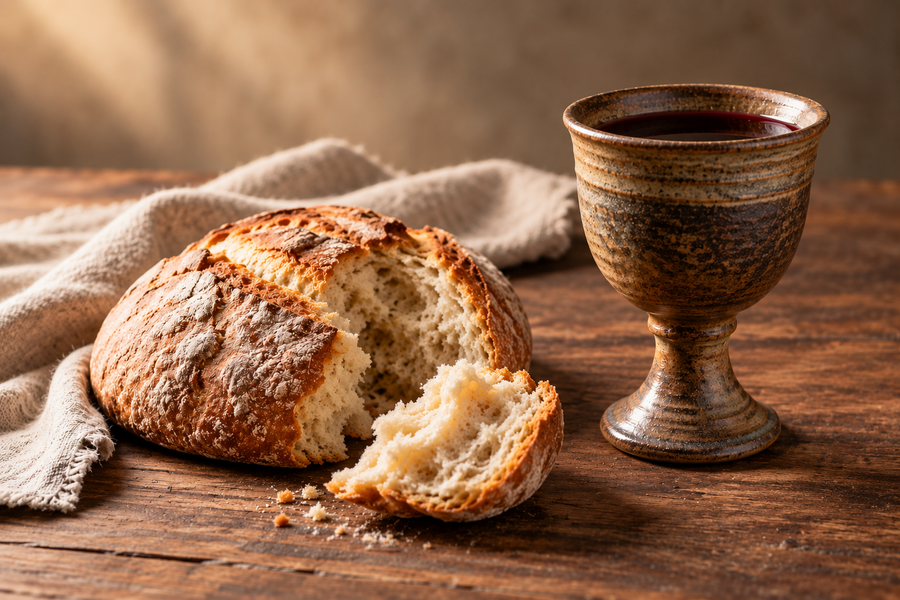
Within the earliest years of Christianity, two significant practices emerged – Christians gathered together on the first day of the week, and they broke bread in remembrance of a man who had been publicly executed. What prompted the early Christian movement to so promptly reorganize their sacred calendar and worship around Jesus’ death and supposed resurrection?
In 1694, Charles Leslie published A Short and Easy Method with the Deists, in which he attempts to “lay down such rules, as to the truth of matters of fact in general, that where they all meet, such matters of fact cannot be false.” [1] His rules are:
- “That the matters of fact be such as that men’s outward senses, their eyes and ears, may be judges of it.”
- “That it be done publicly in the face of the world.”
- “That not only public monuments be kept up in memory of it, but some outward actions to be performed.”
- “That such monuments, and such actions, or observances, be instituted, and do commence from the time the matter of fact was done.”
In this article, I will lay out a case that bears particularly on the third and fourth criteria put forward by Leslie. Herein, I will argue that the observances of both the Lord’s Day and the Eucharist were instituted right from the very earliest inception of Christianity, and that this can be marshalled as part of the cumulative case for Christianity.
The Institution of the Lord’s Supper
The words of the institution of the Lord’s supper are reported in the three Synoptic gospels, and, if authentic, demonstrate Jesus’ awareness of his impending violent death and that he related this to his Messianic mission and identity. Here are the synoptic reports of the words of institution:
- Matthew 26:26–28 – “Now as they were eating, Jesus took bread, and after blessing it broke it and gave it to the disciples, and said, ‘Take, eat; this is my body.’ And he took a cup, and when he had given thanks he gave it to them, saying, ‘Drink of it, all of you, for this is my blood of the covenant, which is poured out for many for the forgiveness of sins.’”
- Mark 14:22–24 – “And as they were eating, he took bread, and after blessing it broke it and gave it to them, and said, ‘Take; this is my body.’ And he took a cup, and when he had given thanks he gave it to them, and they all drank of it. And he said to them, ‘This is my blood of the covenant, which is poured out for many.’”
- Luke 22:19–20 – “And he took bread, and when he had given thanks, he broke it and gave it to them, saying, ‘This is my body, which is given for you. Do this in remembrance of me.’ And likewise the cup after they had eaten, saying, ‘This cup that is poured out for you is the new covenant in my blood.’”
Themes of Passover
These words of institution are deeply significant. The context, of course, is the Passover seder, and Jesus’ words cannot help but evoke themes of Passover (cf. Exod 12:13). Jesus is elsewhere described as our Passover Lamb (Jn 1:29,36; 1 Cor 5:7; 1 Pet 1:18-19; Rev 7:14, 12:11). The festival of Passover (also known as unleavened bread) is the retelling of the story of the nation of Israel, whereby they were redeemed by God from the harsh enslavement of Egypt (see in particular Exod 12:5-13). The focus of the celebration is a remembrance of the Passover lamb, which was sacrificed in order that the firstborn of every house might be spared from the wrath of God — which was death — as the Lord passed over the houses during the last and final of the ten plagues of Egypt. The slaughtered Lamb was to be eaten, and its blood smeared onto the doorposts of the houses as a sign of faith. God specifically stipulated to Israel that the Lamb that was to be slaughtered was to be a “male without defect” (Exod 12:5), which is the very same description given of Jesus (e.g. 1 Pet 1:18-19; Heb 9;14). Jesus was without sin (e.g. 2 Cor 5:21; Isa 53:9) and perfect in every way. Indeed, he had to be if he was going to atone for the sins of Israel by the sacrifice of Himself (Heb 7:27). When the lamb was roasted and eaten, none of its bones were to be broken (Exod 12:46). It was customary during an execution by crucifixion to break the legs of the victim so that they were no longer able to push up against the cross and draw in breath, thus hastening their death by asphyxiation. But, in the case of Jesus, though they broke the legs of the other two men, they did not break Jesus’ legs because he was already dead (Jn 19:32-36).
It is significant that Jesus’ death coincided with the first day of unleavened bread, on the fifteenth day of the month of Nisan, the very day on which the Passover was being remembered by the Jews. The words of the institution of the Lord’s supper, however, indicate that Jesus himself made the connection between his own impending death and the Passover feast. The unleavened bread was associated with Israel’s haste in leaving Egypt (Exod 12:39; Deut 16:3). The bread, then, functioned as a memorial of God’s redemptive act in the Exodus. Think, then, of the significance of Jesus taking the memorial bread and saying “This is my body, which is given for you. Do this in remembrance of me,” (Lk 22:19). Jesus thus reappropriates the object that was supposed to remind the people of Israel of the Exodus, transforming it into a command to remember Jesus, whose body was going to be “given for you.”
Other Old Testament Themes
In addition to the Passover themes, there are other echoes of the Old Testament in Jesus words. In Exodus 24, Moses sprinkled the people with the blood of sacrificial animals, thereby ratifying the covenant between God and Israel. He declared, “Behold the blood of the covenant that the LORD has made with you in accordance with all these words,” (v. 8). When Jesus says over the wine, “This is my blood of the covenant, which is poured out for many for the forgiveness of sin” (Mt 26:28; cf. Mk 14:24; Lk 22:20), Jesus identifies himself as the sacrifice whose blood establishes the covenant.
Jesus’ words also echo Zechariah 9:11 – “As for you, because of the blood of my covenant with you, I will set the prisoners free from the waterless pit.” Just as in the Exodus narrative, again covenant blood is the means by which God brings about liberation. This text is unmistakably Messianic, and the preceding context of this prophecy is fulfilled in Jesus’ triumphal entry into Jerusalem on the back of a donkey, deliberately enacting the scene depicted of Israel’s king coming to Jerusalem (see Zech 9:9-12 for the fuller context).
Also in the background is Jeremiah 31:31, “Behold, the days are coming, declares the LORD, when I will make a new covenant with the house of Israel and the house of Judah.” When Jesus, in reference to the cup, declares, “This cup that is poured out for you is the new covenant in my blood,” (Lk 22:20; cf. 1 Cor 11:25), he makes the provocative claim that the new covenant promised by Jeremiah is being inaugurated through his death. Jeremiah further writes concerning this new covenant that God says “I will forgive their iniquity, and I will remember their sin no more,” (Jer 31:34). This also casts light on Matthew’s version of the words of institution, where Jesus says, “This is my blood of the covenant, which is poured out for many for the forgiveness of sins.”
Along similar lines, the prophet Isaiah spoke of the Messiah as not merely delivering a covenant, but being the covenant himself – “I will give you as a covenant for the people, a light for the nations, to open the eyes that are blind, to bring out the prisoners from the dungeon, from the prison those who sit in darkness,” (Isa 42:6-7, cf. Isa 49:8). Isaiah 52:13-53:12 also indicates that this covenant will be established by the shedding of blood. In fact, Jesus likely also alludes to Isaiah 53:12 in the words of institution, where we read that “he poured out his soul to death and was numbered with the transgressors; yet he bore the sin of many, and makes intercession for the transgressors.” In Luke’s version of the last supper, Jesus goes on to explicitly quote from Isaiah 53:12: “For I tell you that this Scripture must be fulfilled in me: ‘And he was numbered with the transgressors.’ For what is written about me has its fulfillment,” (Lk 22:37).
The Significance of the Institution of the Lord’s Supper
Not a Liar, nor an Enthusiast
If the words of institution of the Lord’s supper are authentic and accurately represent the historical Jesus, a couple of observations may be made. First, Jesus understood from the Hebrew Bible that his Messianic mission would ultimately culminate in his own violent death for the sins of others. This points to Jesus’ sincerity in regards to his provocative self-claims, since it is incredibly unlikely that, if he were lying, he would have made his own brutal execution such a core aspect of his identity and mission.
Second, Jesus’ synthesis of the Old Testament Scriptures was utterly unprecedented, at least in surviving second temple Jewish literature. Syntheses of the Biblical Messianic portrait were quite diverse in the second temple period. The Psalms of Solomon, for example, envisioned a righteous Davidic king who would purify Jerusalem, defeat the gentiles, gather Israel, and rule the nation (Pss. Sol. 17:23–27). Texts among the dead sea scrolls distinguished between a priestly Messiah, a royal Messiah and the prophet like Moses (1QS 9:10-11; 1QSa 2:11-21; 4Q175), a view also represented in The Testament of the Twelve Patriarchs (T. Sim. 7:2; T. Jud. 21:2–5; 24:1–6; T. Levi 18:1–14). The Messianic Apocalypse, 4Q521, among the Qumran scrolls, anticipates an eschatological age associated with God’s Messiah in which the afflicted are restored, the poor receive good news, the sick are healed, prisoners are liberated, and the dead are raised (4Q521 2 ii 1–13). Later rabbinic tradition distinguished between Messiah ben Joseph, who would experience conflict and suffering, and Messiah ben David who would accomplish final redemption (b. Sukk. 5). Other rabbinic tradition maintained that the manner in which the Messiah would come (whether he came on the clouds of heaven or rode a donkey) would be determined by the moral state of the nation (b. Sanh. 11:1). Jesus’ interpretation put forward an unprecedented synthesis of the Hebrew Bible, tying together all of these threads in his own person. I would also contend that Jesus’ synthesis of the Old Testament is correct, though this is understood most clearly after the decryption key has been given (see my previous essay here). If Jesus is who he said he was, then we should expect him to have unparalleled insight into the Hebrew Bible, and in particular how it finds its fulfilment in him. If Jesus came up with this unprecedented synthesis himself, then why knowingly and willfully make his own violent death the culmination of his ministry, particularly since it was unnecessary in order to win the Jews over to his Messianic cause, and in fact more likely to turn them off? As William Paley notes [2],
Now, had Jesus been an enthusiast, it is probable that his enthusiasm would have fallen in with the popular delusion, and that, while he gave himself out to be the person intended by these predictions, he would have assumed the character to which they were universally supposed to relate. Had he been an impostor, it was his business to have flattered the prevailing hopes, because these hopes were to be the instruments of his attraction and success.
Not only did Jesus deviate from the prevailing expectations of what the Messiah was supposed to be, but his manner of death also was a symbol of defeat to both Jews and gentiles alike. According to Jewish law, to be killed by being hung on a tree was to be under divine curse. Paul wrote, only twenty years after Jesus’ death, “we preach Christ crucified, a stumbling block to Jews and folly to Gentiles,” (1 Cor 1:23). And, indeed, the cross was an item of ridicule by both Jews and gentiles. In the mid-second century, in Justin Martyr’s dialogue with the Jewish philosopher Trypho, Trypho said, “These and such like Scriptures, sir, compel us to wait for Him who, as Son of man, receives from the Ancient of days the everlasting kingdom. But this so-called Christ of yours was dishonourable and inglorious, so much so that the last curse contained in the law of God fell on him, for he was crucified,” (Justin, Dial. 32) [3] and “whether Christ should be so shamefully crucified, this we are in doubt about. For whosoever is crucified is said in the law to be accursed, so that I am exceedingly incredulous on this point. It is quite clear, indeed, that the Scriptures announce that Christ had to suffer; but we wish to learn if you can prove it to us whether it was by the suffering cursed in the law.” (Justin, Dial. 89) [4]. The second century pagan critic of Christianity, Celsus, moreover, also likewise ridicules the idea of a crucified Messiah (Orig., Cont. Cels. 6.34).
It is also noteworthy that this very same Messianic claimant who put forward this unprecedented and uniquely insightful synthesis of the Hebrew Bible, revealing how its numerous threads converge on himself, also happens to bring the knowledge of the God of Israel to the ends of the earth, having first been rejected by his own people, fulfilling specific prophecies (see Isa 42:6; 49:5-7; 52:15-53:4). His death, moreover, as we have seen, falls on the first day of unleavened bread, a striking coincidence given its symbolic import (and a connection that Jesus himself appears to have made). The convergence of these data is confirmatory of Jesus’ radical self-claims.
Significance to the Argument for the Resurrection
That Jesus’ earliest followers partook of the Lord’s supper from the earliest inception of the Christian movement carries another implication. Jesus’ earliest disciples treated the broken body and poured-out blood of a man who had died under the most degrading form of Roman capital punishment as the central focal point of their communal identity. The speed with which Jesus’ death was ritualized raises the question of how a community that had just witnessed the public humiliation and shameful execution of its leader – a death normally reserved for slaves, rebels, and the lowest of criminals, so quickly ritualized that death, making it the center of their communal worship. This is nearly incomprehensible unless the shame of Jesus’ death had been somehow transformed. As we have already seen, the Jewish law placed anyone hung on a tree under divine curse (Deut 21:22-23). For a man to claim to be the Messiah and yet be subjected to Roman crucifixion was, therefore, by ordinary Jewish expectation, a failed pretender who was forsaken by God. Why would the earliest Christians celebrate the very symbol that represented, in Jewish thought, the decisive defeat of their hopes?
The significance of this must be fully appreciated. If Jesus’ disciples experienced cognitive dissonance after his death, we might perhaps expect continued loyalty to Jesus’ ethical teaching while downplaying the cross, or perhaps they might give a spiritualized reinterpretation while avoiding the physical horror of crucifixion altogether. Instead, they ritualized it as their most distinctive rite.
This becomes less surprising if an event had demonstrated that God had reversed the verdict of the cross. The resurrection of Jesus from death supplies precisely this kind of event.
Are the Words of Institution Authentic?
A crucial aspect of this argument, then, is establishing the authenticity of the words of institution – do they indeed go back to the historical Jesus? It may be observed that the apostle Paul also wrote of Jesus’ institution of the Lord’s supper, which contains an implicit prediction of Christ’s death (1 Cor 11:23-26):
23 For I received from the Lord what I also delivered to you, that the Lord Jesus on the night when he was betrayed took bread, 24 and when he had given thanks, he broke it, and said, “This is my body, which is for you. Do this in remembrance of me.” 25 In the same way also he took the cup, after supper, saying, “This cup is the new covenant in my blood. Do this, as often as you drink it, in remembrance of me.” 26 For as often as you eat this bread and drink the cup, you proclaim the Lord’s death until he comes.
It does not appear that Paul is directly dependent on the gospel of Luke here. Paul wrote 1 Corinthians around 53 C.E. A date prior to this for the composition of Luke would be incredibly early. Moreover, Paul explicitly says, “I received (παρέλαβον) from the Lord what I also delivered (παρέδωκα) to you,” (1 Cor 11:23). Receive/deliver are technical rabbinic terms for passing on tradition, not for quoting a written source. This suggests that Paul is appealing to a received oral tradition rather than the text of Luke’s gospel. On this basis, Dale Allison acknowledges, “Mark and his fellow evangelists did not invent this motif.” [5] Paul’s indication that this tradition he “received from the Lord” most likely means that it ultimately goes back to Jesus. Paul himself was personally acquainted with Jesus’ earliest followers (e.g. Gal 1:18-19; 2:9), and it is extremely plausible that he received this tradition from them.
Supporting this contention further, the Lord’s supper appears to have been implemented extremely early after Jesus’ death, and therefore almost certainly goes back to the original apostles. Paul, writing to the Corinthians around 53-55 CE (only twenty years after Jesus’ death), assumes that the Lord’s supper was widely practiced. In fact, he brings the criticism before the Corinthian church that they are practicing this sacred rite incorrectly (1 Cor 11:20-22). Moreover, he indicates that he had already delivered these words of institution to the Corinthians previously (1 Cor 11:23), presumably when he founded the Corinthian church around 50 CE. Paul’s language also suggests that observing the Lord’s supper was universal Christian practice. Paul never argues whether Christians ought to celebrate the meal. The only issue is how they celebrated it.
Moreover, Acts 20:7 portrays believers gathering for “the breaking of bread” in Troas (Acts 20:7), some six or seven hundred miles away from Corinth. This indicates that the breaking of bread was practiced by churches across the Mediterranean. Acts 2:42 also explicitly indicates that “the breaking of the bread” was practiced from the earliest days of the Jerusalem church. Note that Luke’s language, τῇ κλάσει τοῦ ἄρτου (“the breaking of the bread”), implies a known, established practice rather than an incidental meal.
It may also be observed that the Greek text of 1 Corinthians 11:24 and Luke 22:19 are not identical. Here are the two Greek texts side-by-side, with the differences underlined:
- 1 Corinthians 11:23: τοῦτό μού ἐστιν τὸ σῶμα τὸ ὑπὲρ ὑμῶν· τοῦτο ποιεῖτε εἰς τὴν ἐμὴν ἀνάμνησιν.
- Luke 22:19: τοῦτό ἐστιν τὸ σῶμά μου τὸ ὑπὲρ ὑμῶν διδόμενον· τοῦτο ποιεῖτε εἰς τὴν ἐμὴν ἀνάμνησιν.
As shown above, not only does Luke contain an extra word (διδόμενον; being given), but there is also a slight difference in word order (μού ἐστιν τὸ σῶμα vs. ἐστιν τὸ σῶμά μου).
Here also are the two Greek texts of 1 Corinthians 11:25 and Luke 22:20:
- 1 Corinthians 11:25: Τοῦτο τὸ ποτήριον ἡ καινὴ διαθήκη ἐστὶν ἐν τῷ ἐμῷ αἵματι· τοῦτο ποιεῖτε, ὁσάκις ἐὰν πίνητε, εἰς τὴν ἐμὴν ἀνάμνησιν.
- Luke 22:20: Τοῦτο τὸ ποτήριον ἡ καινὴ διαθήκη ἐν τῷ αἵματί μου, τὸ ὑπὲρ ὑμῶν ἐκχυννόμενον.
As shown above, the phrase, “Do this, as often as you drink it, in remembrance of me,” is present in 1 Corinthians 11:25 but not in Luke 22:20. Luke has “which is poured out for you” instead. Luke also uses the implied verb “is” and expresses “my” with the genitive pronoun μου after “blood” (ἐν τῷ αἵματί μου), whereas Paul makes the verb explicit with ἐστὶν and uses the possessive adjective ἐμῷ before “blood” (ἐστὶν ἐν τῷ ἐμῷ αἵματι).
These points, taken together, further suggest that Paul is not copying the saying from Luke’s gospel.
Paul’s wording is very close to that of Luke, but varies from Matthew and Mark. Paul and Luke both preserve “Do this in remembrance of me,” and that Jesus’ body is given “for you,” neither of which motifs are present in Matthew or Mark. Matthew and Mark preserve the “poured out for many” motif, not present in Luke or Paul. This is indicative of two independent streams of tradition.
It should be noted here that there exists both a longer and shorter form of the words of institution in Luke’s gospel. The shorter (Western) text omits verses 19b and 20 (τὸ ὑπὲρ ὑμῶν … ἐκχυννόμενον). The longer version is found in all Greek manuscripts (as well as in most patristic witnesses) except the fifth century Codex Bezae Cantabrigiensis. The longer reading, however, is more likely. As Philip Comfort explains, “Very likely, the Bezaean editor (D) was puzzled by the cup/bread/cup sequence, and therefore deleted this portion, but in so doing the text was left with the cup/bread sequence, contrary to Matt 26:26–28; Mark 14:22–24; and 1 Cor 11:23–26.” [6]
There is an additional reason to believe that the Lord’s supper was instituted by Jesus himself. In John 6:53-56, Jesus gives a difficult teaching about eating his flesh and drinking his blood:
53 So Jesus said to them, “Truly, truly, I say to you, unless you eat the flesh of the Son of Man and drink his blood, you have no life in you. 54 Whoever feeds on my flesh and drinks my blood has eternal life, and I will raise him up on the last day. 55 For my flesh is true food, and my blood is true drink. 56 Whoever feeds on my flesh and drinks my blood abides in me, and I in him.
This saying, especially in a Jewish context, is difficult to envision being an invention on the part of the evangelists. In fact, it is such a difficult saying that it leads to many of his disciples turning away from him (Jn 6:66). Whereas John does not record the institution of the Lord’s Supper, where Jesus identifies the bread as his body and the wine as his blood, this is recorded by the synoptics (which do not recount the Bread of Life discourse from John 6). Thus, John provides the background that explains why Jesus’ words at the Last Supper would have been intelligible and meaningful to his disciples — they had already heard him speak metaphorically about eating his flesh and drinking his blood. Meanwhile, the synoptics give the actual institution of the rite, but not the earlier discourse. Lydia McGrew argues that [7],
[Jesus] was alluding cryptically to something that he would make clearer later to those who continued to follow him. This sort of veiled allusion would hardly be uncharacteristic of Jesus’ teaching as we find it elsewhere. For example, his words to Nicodemus about the Holy Spirit in John 3 would not have been clear to Nicodemus at the time but would have become much clearer in the light of Pentecost. The statement, “Destroy this Temple, and in three days I will raise it up” recorded in John 2.19 is glossed by John, in hindsight, as referring to the resurrection, but Jesus himself apparently did not explain it at the time.
This consistency with Jesus’ sometimes cryptic method of teaching, together with the later explanation at the institution of the Lord’s supper (present in the synoptics, omitted from John) is best accounted for on the hypothesis of historical reportage.
All of this evidence, particularly taken in aggregate, points to the conclusion that the Lord’s supper goes back to the original apostles of Jesus. Given that the symbols of the rite (body broken and blood shed) focus attention on the crucifixion event itself, it would be quite astonishing if this rite did not originate from Jesus’ own teaching — apparently the movement whose founder died the death of a failed Messiah made that death the central act of its worship. If the sacred rite of the Lord’s supper did not originate with Jesus, this is extremely difficult to account for.
A final reason to think that the words of institution ultimately derive from Jesus is that Luke appears to have reliable information concerning the event of the last supper. In Luke 22:24-27, we read,
24 A dispute also arose among them, as to which of them was to be regarded as the greatest. 25 And he said to them, “The kings of the Gentiles exercise lordship over them, and those in authority over them are called benefactors. 26 But not so with you. Rather, let the greatest among you become as the youngest, and the leader as one who serves. 27 For who is the greater, one who reclines at table or one who serves? Is it not the one who reclines at table? But I am among you as the one who serves.
What does Jesus mean by the phrase “But I am among you as the one who serves”? To what could he be referring? The answer is provided not by Luke but by John, who tells us that, at the last supper, Jesus undertook the lowliest of tasks (one normally reserved for a household slave) and washed the feet of the disciples (Jn 13:4-5). Moreover, this object lesson, related by John but not by Luke, makes sense in light of the occasion of the disciples arguing over who among them was the greatest, related by Luke not by John. This undesigned coincidence between John and Luke supports their mutual historicity, in turn indicating that Luke has reliable information concerning the last supper.
The Institution of the Lord’s Day
A striking feature of the earliest Christian movement is their reorientation of their sacred day around the first day of the week (which they referred to as the “Lord’s Day”) rather than the Sabbath. Indeed, this was universal in early Christianity, and the practice of honoring, and assembling on, the first day of the week appears to go back to the very inception of the Christian movement. According to early sources, the reason for this was because the first day of the week was the day on which Jesus’ rose from the dead. This suggests that something extraordinary really transpired on that day.
How Early Can We Trace the Institution of the Lord’s Day?
One of the key evidences that the earliest claim was that Jesus rose on the Sunday following His death is the universal practice of Christians of assembling to worship on the Sunday, rather than on the Jewish Sabbath, which was the Saturday. How far back can this practice be traced? It turns out, it has to have originated very early.
Tertullian of Carthage (160-225 C.E.) wrote (Apology, chapter XVI) [8],
Others, again, certainly with more information and greater verisimilitude, believe that the sun is our god. We shall be counted Persians perhaps, though we do not worship the orb of day painted on a piece of linen cloth, having himself everywhere in his own disk. The idea no doubt has originated from our being known to turn to the east in prayer. But you, many of you, also under pretence sometimes of worshipping the heavenly bodies, move your lips in the direction of the sunrise. In the same way, if we devote Sun-day to rejoicing, from a far different reason than Sun-worship, we have some resemblance to those of you who devote the day of Saturn to ease and luxury, though they too go far away from Jewish ways, of which indeed they are ignorant.
Further back, Justin Martyr (100-165 C.E.) even states that the purpose of assembling for worship on the Sunday was because Christ’s resurrection was on a Sunday (First Apology, chapter LXVII) [9],
And on the day called Sunday, all who live in cities or in the country gather together to one place, and the memoirs of the apostles or the writings of the prophets are read, as long as time permits; then, when the reader has ceased, the president verbally instructs and exhorts to the imitation of these good things […] But Sunday is the day on which we all hold our common assembly, because it is the first day on which God, having wrought a change in the darkness and matter, made the world; and Jesus Christ our Savior on the same day rose from the dead. For He was crucified on the day before that of Saturn (Saturday); and on the day after that of Saturn, which is the day of the Sun, having appeared to His apostles and disciples, He taught them these things, which we have submitted to you also for your consideration.
Going even further back still, the epistle of Barnabas (composed sometime between 70 and 132 C.E.), states (Epistle of Barnabas 15) [10],
Wherefore, also, we keep the eighth day with joyfulness, the day also on which Jesus rose again from the dead.
A further early source we have that addresses this subject is Ignatius of Antioch (35-108 C.E.), who, writing in the early second century, states that (Magnesians 9) [11],
If, therefore, those who were brought up in the ancient order of things have come to the possession of a new8 hope, no longer observing the Sabbath, but living in the observance of the Lord’s Day, on which also our life has sprung up again by Him and by His death…
An ancient first century church manual, called the Didache, also speaks of the so-called Lord’s day which, as we have seen already from Ignatius, was to be distinguished from the Saturday sabbath (Didache 14.1) [12]:
But every Lord’s day do ye gather yourselves together, and break bread, and give thanksgiving after having confessed your transgressions,13 that your sacrifice may be pure.
The concept of the Lord’s day is itself firmly rooted in the New Testament itself. The apostle John, towards the end of the first century, in the book of Revelation (1:10), states, “I was in the Spirit on the Lord’s day.” Since no further elaboration on the Lord’s day is supplied, it suggests that his readers were already acquainted with what that was and that it was already a widely recognized.
The apostle Paul, writing to the Corinthian Christians from Ephesus in the mid 50’s C.E., only a couple of decades after Jesus’ death and alleged resurrection, tells the Corinthian Christians, “On the first day of every week, each of you is to put something aside and store it up, as he may prosper, so that there will be no collecting when I come,” (1 Corinthians 16:2). Here, it is simply assumed that the Corinthian Christians were in the habit of assembling on the first day of the week, which suggests that this practice dates well before Paul wrote his letter to the Corinthians. We also read in Acts 20:7, “On the first day of the week, when we were gathered together to break bread…” On this occasion Paul was in Troas, which, as discussed previously, is some distance from Corinth, being on the other side of the Aegean sea.
Cumulatively, all of these lines of evidence indicate that the assembly for worship on the Sunday, or Lord’s day, was established as a practice very early on. This complements well the gospel narratives, all four of which maintain that the resurrection took place on a Sunday. As I have argued extensively elsewhere, the gospels themselves are firmly grounded in the testimony of the eyewitnesses. The fact that the four gospels themselves attest to the resurrection happening on a Sunday, therefore, would in itself be sufficient to establish that this claim goes back to the earliest apostles themselves. Furthermore, the early and universal changing of the Christians’ sacred day from Saturday to Sunday is, I would argue, best explained by the Lord’s resurrection taking place on the Sunday.
Revisiting Leslie’s Criteria
In this article, I have argued that the two most distinctive practices of the earliest Christian movement – the Eucharist and the assembly of believers on the first day of the week – provide significant evidence concerning the historical events at the heart of Christianity.
This brings us back to the third and fourth criteria put forward by Charles Leslie. Leslie emphasized the evidential significance of the establishment of “some outward actions to be performed,” which “commence from the time the matter of fact was done.” [13] The Lord’s day and the Eucharist serve as a weekly memorial of Jesus’ death and resurrection, and these practices may be traced back to the very founding of Christianity.
The Lord’s Day and the Eucharist thus constitute remarkably primitive and widespread memorial practices whose existence requires an explanation. According to Leslie, when instituted from the very beginning and connected to publicly accessible events, such practices carry significant evidential weight for the confirmation of those historical events.
References
1. Charles Leslie, A Short and Easie Method with the Deists: Wherein the Truth of the Christian Religion is Demonstrated by Such Rules as Stand upon the Conviction of Our Outward Senses, and Which Are Incompatible with the Fabulous Histories of the Heathen Deities, the Delusions of Mahomet, or Any Other Imposture Whatsoever. In a Letter to a Friend (London: W. Onley for H. Hindmarsh, 1698).
2. William Paley, A View of the Evidences of Christianity (London: J. Faulder, 1794).
3. Justin Martyr, “Dialogue of Justin with Trypho, a Jew,” in The Apostolic Fathers with Justin Martyr and Irenaeus, ed. Alexander Roberts, James Donaldson, and A. Cleveland Coxe, vol. 1, The Ante-Nicene Fathers (Buffalo, NY: Christian Literature Company, 1885), 210.
4. Ibid., 244.
5. Dale C. Allison, Jr. The Resurrection of Jesus: Apologetics, Polemics, History (Bloomsbury Publishing, Kindle Edition), 345.
6. Philip W. Comfort, New Testament Text and Translation Commentary: Commentary on the Variant Readings of the Ancient New Testament Manuscripts and How They Relate to the Major English Translations (Carol Stream, IL: Tyndale House Publishers, Inc., 2008), 232.
7. Lydia McGrew, Hidden In Plain View: Undesigned Coincidences in the Gospels and Acts (DeWard Publishing Company), 42.
8. Tertullian, “The Apology,” in Latin Christianity: Its Founder, Tertullian, ed. Alexander Roberts, James Donaldson, and A. Cleveland Coxe, trans. S. Thelwall, vol. 3, The Ante-Nicene Fathers (Buffalo, NY: Christian Literature Company, 1885), 31.
9. Justin Martyr, “The First Apology of Justin,” in The Apostolic Fathers with Justin Martyr and Irenaeus, ed. Alexander Roberts, James Donaldson, and A. Cleveland Coxe, vol. 1, The Ante-Nicene Fathers (Buffalo, NY: Christian Literature Company, 1885), 185–186.
10. Alexander Roberts, James Donaldson, and A. Cleveland Coxe, eds., “The Epistle of Barnabas,” in The Apostolic Fathers with Justin Martyr and Irenaeus, vol. 1, The Ante-Nicene Fathers (Buffalo, NY: Christian Literature Company, 1885), 147.
11. Ignatius of Antioch, “The Epistle of Ignatius to the Magnesians,” in The Apostolic Fathers with Justin Martyr and Irenaeus, ed. Alexander Roberts, James Donaldson, and A. Cleveland Coxe, vol. 1, The Ante-Nicene Fathers (Buffalo, NY: Christian Literature Company, 1885), 62.
12. Alexander Roberts, James Donaldson, and A. Cleveland Coxe, eds., “The Lord’s Teaching through the Twelve Apostles to the Nations,” in Fathers of the Third and Fourth Centuries: Lactantius, Venantius, Asterius, Victorinus, Dionysius, Apostolic Teaching and Constitutions, Homily, and Liturgies, vol. 7, The Ante-Nicene Fathers (Buffalo, NY: Christian Literature Company, 1886), 381.
13. Charles Leslie, A Short and Easie Method with the Deists: Wherein the Truth of the Christian Religion is Demonstrated by Such Rules as Stand upon the Conviction of Our Outward Senses, and Which Are Incompatible with the Fabulous Histories of the Heathen Deities, the Delusions of Mahomet, or Any Other Imposture Whatsoever. In a Letter to a Friend (London: W. Onley for H. Hindmarsh, 1698).