One of the lamentable facts about my field is the lack of high-quality critics. Thoughtful criticism can help to sharpen and develop arguments and scholarship, as well as expose weaknesses and vulnerabilities that proponents of these arguments might otherwise overlook. However, in the discipline of New Testament studies, the criticism of the historical reportage model, advocated by myself, Tim & Lydia McGrew, Craig Blomberg, Peter J. Williams, Wesley Huff, Erik Manning and others, has been underwhelming and disappointing.
There is a peculiar intellectual paralysis that often sets in when someone speaks with an air of academic authority and is introduced as having a doctorate after their name. Arguments that would, in other contexts, be immediately recognized as plainly absurd if uttered by an anonymous skeptic on the internet, suddenly become “serious scholarship” upon being delivered by someone with a formal credential. It is unfortunate that, for many people, ordinary critical faculties that would in other contexts detect B.S. are short-circuited by the mere fact that someone has a doctoral degree and speaks with an air of academic authority. This is often apparent when reading comments threads on YouTube videos – ideas that in other contexts would rightly be regarded as quackery are met with “How insightful!”, when in reality the speaker is doing little more than dressing up manifestly bad argumentation in academic-sounding jargon, delivered with confidence and sometimes condescension.
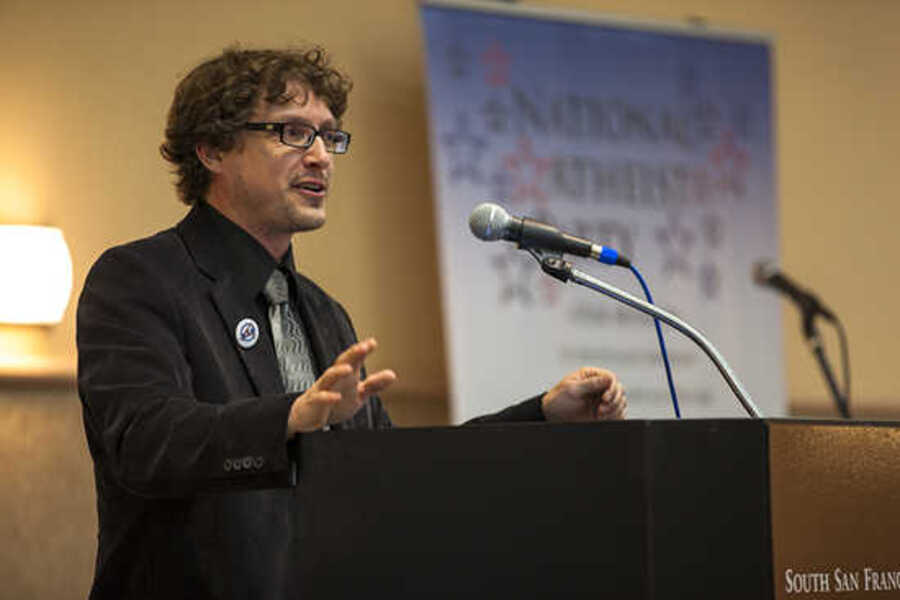
A case in point is Richard Carrier. Carrier has a PhD in ancient history from Columbia University. Most famous for his denial of the historicity of Jesus, Carrier has amassed a large following online. What he lacks in competence in New Testament studies, he more than makes up for in confidence and condescension towards those who hold a high view of the historicity of the New Testament. He has also acquired a reputation for using highly inflammatory rhetoric towards his critics. It is quite common for him, especially on his blog, to accuse those, even reputable scholars, who disagree with him of dishonesty, bad faith, and intentional deception, rather than merely being mistaken.
In a recent video on the channel, “Modern Atheism,” Richard Carrier offered a critique of the argument from undesigned coincidences for the historicity of the gospels. One positive aspect of his review was that he focused on undesigned coincidences more broadly than those pertaining to the feeding of the five thousand (which, for some reason, has been almost the sole focal point of other engagements with the argument by Michael Alter, John Nelson, and others). As we shall see, however, Carrier’s critique of the argument was not well informed.
General Comments
It is apparent to me from listening to Carrier’s commentary of Lydia McGrew’s work that he has not carefully read it. It appears that he has perused Hidden in Plain View, but I do not believe he has read it carefully. For example, he asserts that Lydia McGrew denies synoptic dependence (which is not true). In a previously published article engaging with McGrew’s book, Carrier attributed to McGrew an example of an undesigned coincidence (concerning Jesus being blindfolded) that she specifically says in her book that she does not think is a strong example and so will not be using it (see footnote 15 of chapter 3).
Carrier also falsely asserts that the argument from undesigned coincidences between the gospels was developed when it was believed that the four gospels were entirely independent of one another, a presumption that has been rendered obsolete by twentieth century scholarship. But this is not true. John James Blunt, who first applied this argument in detail to the gospels (as William Paley had previously done for Acts and the epistles) acknowledges that the question of dependence between the books of the Bible has been “much labored” already by scholars, though he believed that his argument swung free of that consideration. [1] Moreover, he repeatedly writes in ways that reveal that he was perfectly comfortable with a literary relationship between the gospels. Moreover, William Paley likewise acknowledges intersynoptic dependence as well. Indeed, he notes that “although it should appear that some of the evangelists had seen and used each other’s works, this discovery, whilst it subtracts indeed from their characters as testimonies strictly independent, diminishes, I conceive, little, either their separate authority, (by which I mean the authority of any one that is genuine,) or their mutual confirmation.” [2] So Carrier’s claim is just historically wrong.
Carrier also contends that the argument from undesigned coincidences has no bearing on the historicity of the resurrection, since none of the examples discussed in McGrew’s book relate to the resurrection. However, this is based on a false premise and, moreover, betrays a misunderstanding of how undesigned coincidences contribute to the case for Jesus’ resurrection. Undesigned coincidences are one of various lines of argument that cumulatively establish that the authors of the gospels and Acts are individuals who are extremely well informed, close up to the facts, and historically conscientious. This being the case, we have strong justification for believing that the accounts pertaining to the resurrection accurately represent what the original witnesses themselves claimed about the nature and content of the alleged encounters with Jesus alive from the dead. Given the context of the claim (in particular, the willingness of the apostles to endure dangers and hardships on account of the gospel), it is highly improbable that the apostles were lying about the resurrection. Given the content of the claim, it is highly improbable that the apostles were sincerely mistaken about the resurrection. Therefore, the best explanation of the evidence is that the content of their claim is in fact true.
It is also, however, incorrect to assert that there are no undesigned coincidences relating to the resurrection. In particular, in John 21:15, Jesus says to Simon Peter, following the resurrection, “Simon, son of John, do you love me more than these?” The most widely accepted interpretation of this question understands Jesus as asking Peter whether he loves him more than the other disciples do. This has grammatical support, since the phrase πλεῖον τούτων uses the genitive plural of the demonstrative pronoun, τούτων (“of these”). In Greek, a partitive genitive is often used after comparatives like πλεῖον (“more”) to indicate the group being compared with. Thus, the construction naturally suggests taking Jesus to be asking Peter if he loves him “more than these [do].” There is, in fact, a similar construction in Matthew 10:31, where Jesus says “you are of more value than many sparrows,” which treats both entities being compared as the subjects of the verb. This raises the question of why Jesus is asking Peter whether he loves him more than the other disciples do. When we turn to the synoptic gospels, we are given a detail not supplied by John — that prior to Jesus’ death, Peter had boasted that he was the most faithful of Jesus’ disciples — “Though they all fall away because of you, I will never fall away,” (Mt 26:33; cf. Mk 14:29). If John made up what Jesus said in 21:15, it is surprising that he does not mention the background throughout his gospel. Indeed, Peter’s prior boast can be found only in Matthew and Mark. This coincidence is confirmatory of the mutual historicity of these sources, including John’s account of the resurrection encounter at the shore of the sea of Galilee.
Carrier addressed a total of nine examples of undesigned coincidences relating to the gospels, which I shall address below. In each case, I will, for the sake of those not familiar with the argument or who need a refresher, provide a brief review of the coincidence, followed by a summary of Carrier’s critique along with my response.
1. Feeding of the Five Thousand – Philip & Bethsaida
Summary of the Coincidence
The first example Carrier engages with pertains to the feeding of the five thousand. In John 6:1-5, we are told,
After this Jesus went away to the other side of the Sea of Galilee, which is the Sea of Tiberias. 2 And a large crowd was following him, because they saw the signs that he was doing on the sick. 3 Jesus went up on the mountain, and there he sat down with his disciples. 4 Now the Passover, the feast of the Jews, was at hand. 5 Lifting up his eyes, then, and seeing that a large crowd was coming toward him, Jesus said to Philip, “Where are we to buy bread, so that these people may eat?”
Now, Philip is a fairly minor character in the New Testament. And one might, naturally, be inclined to wonder why Jesus hasn’t turned to someone a little higher in the pecking order (such as Peter or John). Perhaps even Judas Iscariot would have been a more suitable choice for this role in the account, since John informs us elsewhere that he was responsible for the money bag (Jn 13:29). Another relatively minor disciple, Andrew (the brother of Simon Peter) also gets involved in the reply in verses 8-9. Why does Andrew get involved here?
A partial clue is provided in John 1:44: “Philip, like Andrew and Peter, was from the town of Bethsaida.” Likewise, John 12:21 refers to “Philip, who was from Bethsaida in Galilee.” What is so significant about Philip and Andrew being from the town of Bethsaida? We don’t learn this until we read the parallel account in Luke’s gospel (9:10-17). At the opening of the account (verses 10-11) we are told,
When the apostles returned, they reported to Jesus what they had done. Then he took them with him and they withdrew by themselves to a town called Bethsaida, but the crowds learned about it and followed him. He welcomed them and spoke to them about the kingdom of God, and healed those who needed healing.
And so, we are informed by Luke (who does not mention Philip or Andrew in this context at all) that the event was actually taking place in Bethsaida — the town from which Philip and Andrew were from. Jesus thus turns to Philip, whom, he believed, would be familiar with the area. This also plausibly illuminates the involvement of Andrew (who was also from Bethsaida — Jn 1:44) in the reply. Andrew says to Jesus in John 6:9, “There is a boy here who has five barley loaves and two fish, but what are they for so many?” One may conjecture that Andrew, being from Bethsaida where this miracle took place, knew the boy, or perhaps Jesus had directed his question to Philip and Andrew, both of whom were locals.
The reason for Jesus addressing Philip in John 6:5 is never explicitly spelled out in the text. Instead, one has to do the detective work of piecing together the clues drawn from John 6:5; John 12:21 (and 1:44); and Luke 9:10-17. This is precisely the sort of casual connection between accounts that one might expect to see in historical reportage, though it is more surprising given the hypothesis of fictionalization.
Carrier’s Critique
Carrier notes that it is John uniquely who mentions that Philip and Andrew are from Bethsaida. This, Carrier asserts, is contrary to Mark’s statement that Philip and Andrew are from Capernaum. The only problem with this statement is that it is false. Nowhere do any of the gospels assert that Philip and Andrew are from Capernaum, nor is there any competing claim among the gospels about the location Philip and Andrew are from. Carrier literally made this up.
Carrier also asserts that John deliberately invented that Philip was from Bethsaida. He says, “This is a thing where John is getting Bethsaida from Luke and so he just wants to have another conversation. He wants to have a disciple come from Bethsaida to make sense of this… That’s who he would ask, right? Because that’s where he comes from it makes sense. He’s making all this up.” If John invented the detail about Philip being from Bethsaida, though, it would be far more natural for him to include this detail in closer proximity to the narrative concerning the feeding of the five thousand.
Carrier also asserts that, in John, “Philip has tons of lines,” in contrast to the synoptic gospels. Actually, there is a grand total of two other places in John’s gospel where Philip speaks (Jn 1:45-46; 14:8). There is also a very brief mention of Philip passing on a message to Andrew that certain Greeks wanted to speak to Jesus (Jn 12:21). Simon Peter, the beloved disciple (best understood to be John the son of Zebedee), and Thomas all play more prominent roles than Philip in John’s gospel. Other disciples explicitly named in John’s gospel (aside from Andrew who is also from Bethsaida) include Judas Iscariot, Nathanael, Judas (not Iscariot), and the sons of Zebedee.
Carrier also asserts that
Bethsaida even being the town is Luke’s invention and John is building on that. Prior authors put it somewhere else. Mark, when he originally built the five thousand story, has it in a town opposite Bethsaida because they go to Bethsaida after the feeding of the five thousand. So the town has been moved around freely, which of course doesn’t make sense for eyewitnesses.
For reasons I shall discuss, I would contend that Carrier is incorrect here. Readers should refer to the map below when reading the discussion that follows.

There is, in fact, evidence that is internal to Mark’s gospel itself that suggest the feeding of the five thousand took place on the northeast side of the Sea of Galilee (as opposed to the northwest side). Mark indicates that the disciples did not even have leisure to eat before the feeding, because there were “many coming and going” (Mk 6:31), and that they got into the boat to get away from the crowds. This fits well with the indication in John 6:4 that the feast of Passover was at hand (in particular, if Jesus and the disciples were in or near Capernaum, which was a major center). If they departed Capernaum by boat, it is not implausible that they ended up in the vicinity of Bethsaida (going along the top of the Sea of Galilee), which is what is indicated by Luke 9:10. Mark, in fact, explicitly says that they landed at Gennesaret when they had crossed over (Mk 6:53)! Gennesaret is geographically very close to Capernaum. Thus, this actually, far from contradicting, confirms the idea of which direction they were going. If they were really crossing over “to Bethsaida” as if to land at or near Bethsaida, they could not have landed at Gennesaret (see the map above)! Moreover, as Cyndi Parker observes [3],
Matthew and Mark both state that the disciples struggled to reach their destination because the wind was against them (Matt 14:24; Mark 6:48). Since weather systems typically come from the Mediterranean Sea, the fierce wind causing the terrifying storm was likely coming from the west. This small detail suggests the disciples were traveling from the eastern side of the Sea of Galilee to the western side, further supporting the suggestion that the miracle took place in Gaulanitis… [Bethsaida is in the province of Gaulanitis, east of the Jordan River]
In view of these considerations, the language of Mark 6:45 must be interpreted within the context of these indicators. As Parker concludes [4],
From these geographical clues, it is possible to conclude that Matthew’s account is similar to Luke’s. Therefore, although Matthew’s original “solitary place” is not specified, Jesus may have gone to Gaulanitis, fed the five thousand, sent the disciples ahead of him to Galilee, and arrived in Gennesaret after entering the boat. However, if Matthew’s account follows Mark’s Gospel, then the “solitary place” is in Galilee where the feeding of the five thousand takes place. The disciples are then encouraged to cross over to Bethsaida (in Gaulanitis), but when Jesus meets the disciples on the water, they arrive at Gennesaret in Galilee. As such, they arrive on the same side of the lake from which they departed. In this case, Mark’s geographical indicators do not match his otherwise consistent use of “to cross over.”
Carrier concludes this section by claiming that “most scholars put John’s gospel after 140 [CE] even.” This is completely untrue, and demonstrates how out of touch Carrier is with the scholarly literature. The standard scholarly range is somewhere between 90 and 100 CE, with some arguing earlier and some dating it to the early second century. Few scholars would place the gospel as late as 140.
2. The Green Grass
Summary of The Coincidence
The next example Carrier addresses also relates to the feeding of the five thousand – in particular, the coincidence relating to the green grass in Mark 6:39. This detail in Mark is significant, not because Mark mentions people sitting on the grass (Matthew 14:19 also records people sitting “down on the grass”, and Luke 9:15 reports that “everyone sat down”, and John 6:10 notes that “There was plenty of grass in that place, and they sat down.”). It is significant because Mark reports that the grass was “green”. This is particularly intriguing when one considers that, in Israel (particularly in Galilee) the grass is typically brown.
What makes this even more intriguing is that Mark’s gospel (6:30-42) also states, in verses 30-31 that,
The apostles gathered around Jesus and reported to him all they had done and taught. Then, because so many people were coming and going that they did not even have a chance to eat, he said to them, “Come with me by yourselves to a quiet place and get some rest.
Mark casually alludes to there being many people coming and going, indicating the hustle and bustle and general busyness of the area during this time. The participles ἐρχόμενοι (“coming”) and ὑπάγοντες (“going away”) seem to imply general movement rather than crowds that were specifically there for Jesus (though they were evidently interacting with Jesus). It is only after Jesus and the disciples cross the lake that Mark emphasizes the crowd that was seeking Jesus. Jesus’ instruction to go to the deserted area makes little sense if the crowds were there primarily because of Jesus. Indeed, when they do move away from the hustle and bustle, the crowds follow them only because people recognized (ἐπέγνωσαν) them as they were on their way to a deserted place. But why were there many coming and going? Mark does not tell us. In John’s account, however, we are told that “The Jewish Passover Festival was near,” (Jn 6:4). This explains why many people were “coming and going.” Moreover, during the season of the Passover (i.e., in the spring time), there is a relatively small window where the grass is indeed green in that area, due to elevated levels of rainfall. Here is a graph, showing the precipitation in millimeters at the nearby town of Tiberias [5]:

As shown in the chart, there is a significant amount of rainfall in the months of November, December, January, February, and March. There is also a need for sunshine following the rain to allow for the “greening up” of a large space, as indicated by Mark. Spring time is when one might expect to see a large amount of green grass.
When this is coupled with the detail given to us by John that the Passover festival (in the spring) was at hand, this illuminates and makes sense of the casual (but surprising) statements in Mark that the grass was green and that people were coming and going. As Peter J. Williams notes, “Between the years AD 26 and 36, all possible dates for Passover ranged between the last days of March and the end of April. So if this event really took place at the time recorded, we should indeed expect that after the five most significant months of precipitation, grass would have been green.” [6]
Carrier’s Critique
Unfortunately, the interviewer (Juan), in representing this coincidence, failed to mention the point about the “coming and going” crowds. Furthermore, he misrepresented the argument about the green grass, stating that advocates of this coincidence insist that the grass is green only at the time of Passover. This is false. I am not aware of any defender of this argument who has made this claim. Rather, the claim is that the grass is characteristically green during the spring time, owing to the higher levels of precipitation. As I already stated above, the landscape begins to turn green following the first significant rains, typically by late December. The peak period for observing green grass is usually January through March. By the middle of April, the ceasing of the rains and the climbing temperatures result in the landscape becoming brown again. This, of course, is only a rough guide. According to a 2022 article in Israel Today, by David Shishkoff,
As anyone who has been to Israel in the summer knows, the Holy Land is very dry, yellow and dusty for most of the year. It takes the “early rain” and several encores in the late Autumn after the Feast of Tabernacles before the seeds are convinced and send forth tentative green sprouts some time each December. Then we get a few precious months for our eyes to bathe in green Israeli vistas. [emphasis added]
Carrier asserts that two thousand years ago, Israel had a very different climate than it does today, and was much greener and more lush. This claim is also unsubstantiated. The climate of Palestine during the Biblical period was not appreciably different from that of today. As J.M. Houston explains [7],
There is no archaeological evidence that climate has changed since biblical times. Near the Gulf of Aqabah, a number of recently excavated Roman gutters still fit the springs for which they were constructed, and wherever the Byzantine wells of the Negeb have been kept clean and in constant use, the water still rises to the ancient levels. Thus the biblical narrative gives a convincing picture of the present climate. Distinction is made between the hot and cold seasons (Gn. 8:22; Am. 3:15), and the inception of the autumn rains is clearly described (Dt. 11:14; Ho. 6:3; Joel 2:23). Variability in the amount and distribution of rainfall is common (Am. 4:7), and the incidence of prolonged drought is recorded on a number of occasions (1 Ki. 17:7; Je. 17:8; Joel 1:10–12, 17–20).
Frank S. Frick agrees [8],
But have there been changes in the climate of Palestine during and since the biblical period? On the one hand, it seems clear that, in terms of what Butzer calls “third-order” changes profound enough to show up on the astronomical scale of climatic history (Butzer 1974: 730), the general pattern of the climate, with the alternation of dry and wet seasons, has not seriously changed since 6000 or 7000 B.C. in the Neolithic period. Below such third-order changes, paleoclimatologists speak of second-order variations, measured in hundreds of years, and first-order fluctuations which are observable within a lifetime (Butzer 1974: 730). With respect to such second-order variations and first-order fluctuations, Baly says, “That climate is not static but rather in a state of constant fluctuation is now beyond doubt, and it would be a great mistake to take any set of climatic figures as ‘normal’ ” (GB, 65). But having said this, he also adds, “Any attempt to reconstruct theoretically the relationship between climatic fluctuations of western Europe [where there is more complete data than for Palestine] and those of Palestine is fraught with danger” (GB, 67). Ben-Yoseph concludes that the amounts of precipitation have not changed in Palestine, but their usefulness has decreased as a result of human land-use patterns. Erosion on hillsides, owing to poor land management, has led to an increase in the water lost to runoff after rain. Deforestation reduced the fog and the amounts of water that accumulated in the treetops. Thus the same amount of water falling on the land lost part of its effectiveness through an increase and expansion of human neglect of the land. The gradual decline of the land was not caused by a change in climate but rather by the people living there (Ben-Yoseph 1985: 237).
We can then conclude with Hopkins that the climate of Palestine in the biblical period has not changed appreciably from that of today, but only varied around a mean that closely resembles present conditions (Hopkins 1985: 107).
Carrier further asserts that the grass starts to become yellow towards Passover. Around Passover (March/April), the grass in Galilee is typically still green. It is actually around late April through May that the grasses begin noticeably drying out.
Carrier also notes that the feeding of the five thousand took place by a lake, which also makes the grass more likely to be green due to the wetter territory. But even around the Sea of Galilee, much grass becomes yellow-brown as the dry season advances. The adjective χλωρός still sounds seasonally specific.
Carrier also asserts that the word χλωρός is not even specific to green, since “yellowing green is actually within the valance of the word that is used for the word green in the gospels.” While this is true, the context in Mark 6:39 in particular strongly supports the green sense of the word. [9] Χλωρός is in fact the word from which we get our word “chloroplast.”
Carrier also asserts that Mark 6:39 is riffing off of Psalm 23:2 (“he makes me lie down in green pastures”). But this is asserted without argument, as indeed it is by many other scholars. This is exemplary of the kinds of bad historical methodologies that pervade the discipline of New Testament studies. It is not difficult to come up with creative explanations for just about any detail given by the gospels. Indeed, had the text said that the people sat down on the brown grass, undoubtedly this would be taken to be symbolic of Israel’s spiritual barrenness, the point of the story being that Jesus alone can bring life to spiritual dryness. Jesus enters Israel’s wasteland to provide the true Bread that the nation lacks. Or perhaps it would be an echo of Isaiah 40:7-8, which says “The grass withers, the flower fades…” Or perhaps it could be seen as a subtle reversal of Psalm 23. Whereas the shepherd of Psalm 23 “makes me lie down in green pastures,” the brown grass in Mark indicates that the Messiah has come because the pastures have failed. He must therefore prepare a table in the wilderness, creating green pastures out of brown ones. Perhaps the brown grass symbolizes Israel’s wilderness wandering where the ground was lifeless. Jesus feeds his people in a desolate place, just as Moses did. Or if Jesus had had the people sit down on the rocky or stony ground, then that could be suggested to be an allusion to the ground upon the seed fell in Jesus parable of the Sower (Mk 4:5-6; Mt 13:5-6; Lk 8:6). The possibilities are literally endless.
Carrier claims that there is no reason for Mark to give us this unnecessary detail unless he is making a symbolic allusion to Psalm 23. In point of fact, however, authors do this all the time – including elsewhere throughout the gospels and Acts. Furthermore, giving an explanation for one side of the undesigned coincidence does not explain how it fits together, in an apparently incidental manner, with the other source. Thus, Carrier’s connection of the allusion to the green grass in Mark 6:39 does not account for its dovetailing with the reference to the Passover being at hand in John 6:4.
Carrier also asserts that,
Mark puts this in the middle of Jesus’ ministry, which is as far from the Passover as you can get, because Mark tells a single year ministry, right? But John tells a three-year ministry. So, he’s got four Passovers. He’s got his three years wrapped around – wrapped inside – four Passovers. And he makes this point of documenting the time changes with Passovers. So it makes sense for John to move the feeding to Passover because he changes the feeding narrative into a more explicit reference to the Eucharist – which is a sort of Christian reconstruction of the Passover narrative etc. So there’s literary reasons for John to do this and he’s already created the timeline construction to make that make sense. It doesn’t make sense in Mark.
While the synoptics only explicitly mention a single Passover, it is a very weak argument from silence to say that the Synoptics thereby represent Jesus as having had a single year ministry. Moreover, as James Hastings et al. explain [10],
Indications of a ministry of more than a single year are found in the Synoptics; e.g. Mk 2:23 (harvest) 6:39 (spring; ‘green grass’), for the length of the journeys of 6:56–10:32 shows that the spring of 6:39 could not be that of the Crucifixion. Thus Mk. implies at least a two years’ ministry. In Lk. also we see traces of three periods in the ministry: (1) 3:21–4:30, preaching in the wilderness of Judæa and in Nazareth and Galilee, briefly recorded; (2) 4:31–9:50, preaching in Galilee and the North, related at length; (3) 9:51-end, preaching in Central Palestine as far as Jerusalem. Ramsay (op. cit. p. 212) takes each of these periods as corresponding roughly to one year.
Thus, contra Carrier, even from the synoptic gospels there is reason to think that Jesus’ ministry spanned more than one year.
Carrier says, “I think McGrew’s answer is to say that well maybe Mark meant three years. It just looks like one year because he didn’t get specific and John did. But notice that’s apologetics. You’re sort of inventing stories to make up a harmony between the two.” This again exemplifies the bad methodologies and epistemic pathologies that pervade the discipline of New Testament studies. First, harmonization is good historical practice. Why shouldn’t you allow ancient sources that pertain to the same event illuminate and shed light on one another? Second, this particular kind of argument from silence is notoriously weak, as I and others have discussed at length elsewhere. [11] This example is in fact arguably the weakest form of the argument from silence. Carrier also attempts to poison the well by saying “notice that’s apologetics” (using the term here in a pejorative sense). This is typical of the field of New Testament studies – label anything that argues for the historicity of Scripture or which bears positively on the truth of Christianity, and then feel like you no longer have to address it. This is not responsible scholarship.
Carrier further asserts that John intended to turn the feeding of the five thousand into a eucharist narrative, which is why he connects it to Passover. But, again, this is an assertion made without argument. Apparently Carrier thinks that just asserting an author’s intent is tantamount to an argument. It isn’t. You don’t just get to make stuff up out of the top of your head.
3. Herod and His Servants
Summary of The Coincidence
Carrier’s next example is the coincidence relating to Herod and his servants. Here is a brief recap. According to Matthew 14:1-2, “At that time Herod the tetrarch heard about the fame of Jesus, and he said to his servants, ‘This is John the Baptist. He has been raised from the dead; that is why these miraculous powers are at work in him.’” Though Matthew is textually dependent on Mark 6, Matthew uniquely indicates that this was said “to his servants.” Did Matthew make up this detail? Or does he have independent reason to think that this was said to Herod’s servants? When we turn to Luke 8:1-3 (which is not a parallel account and concerning quite different subject matter), we learn that one of Jesus’ female disciples who followed him from Galilee was Joanna, who was married to Herod’s household manager — someone in the highest ranks of Herod’s employment. This dovetails neatly with Matthew’s statement that this was said by Herod to his servants, even providing an explanation for how Matthew could come to know what Herod was saying, presumably in the privacy of his own palace.
Carrier’s Critique
Carrier alleges that apologists invent a hypothetical transmission chain without evidence since no gospel says that the evangelist Matthew came to know about Herod’s conversation with his servants from Joanna. But this misses the entire point. The point is that it is not connected, but Luke, in a very incidental and undesigned fashion, illuminates a natural question raised by Matthew. This is of evidential value in confirming the mutual historicity of Matthew’s and Luke’s accounts.
Carrier also asserts that Joanna is a literarily invented character. He notes that Ἰωάννα is essentially the feminine form of John (Ἰωάννης). Moreover, the name Chuza means “prophet”. Thus, Carrier asserts, “it looks like Joanna is a literarily invented character that is a gender inversion of John the Baptist.” This inference is so incredibly torturous that to summarize it is to say enough. Ancient Jewish names were often heavily theological. Symbolic resonance does not, therefore, suggest invention. Joanna was also a common name. Even more damning, the name Chuza does not, as Carrier insists, mean “prophet” – another detail that Carrier simply made up. The name is usually linked to meanings like “seer,” “visionary,” or “the seeing one.” The actual word for prophet in Hebrew would be נָבִיא (pronounced “Navi”).
4. Temple Sayings at Jesus’ Trial
Summary of the Coincidence
In Mark 14:56-59, we read of a false testimony that was brought to the high priest, Caiaphas, at Jesus’ trial: “For many bore false witness against him, but their testimony did not agree. And some stood up and bore false witness against him, saying, We heard him say, ‘I will destroy this temple that is made with hands, and in three days I will build another, not made with hands.’’ Yet even about this their testimony did not agree.” This does not appear to be a whole cloth fabrication on the part of the witnesses who testified against Jesus — in particular, in view of the specificity of the reference to three days, in addition to the fact that they could not even agree on what precisely Jesus said. It appears as though this is a garbled version of something that Jesus said. Nothing in Mark, however, provides a pretext for this allegation. In the context of first century Judea, this allegation was quite a serious one. And, yet, the reader is left hanging as to what Jesus really said. This is an unexplained allusion in Mark, itself a hallmark of verisimilitude in its own right. In John’s gospel, however, we read about a challenge that was brought to Jesus by the Jews, in the wake of the temple cleansing towards the beginning of Jesus’ public ministry: “So the Jews said to him, ‘What sign do you show us for doing these things?’ Jesus answered them, ‘Destroy this temple, and in three days I will raise it up,’” (Jn 2:18-19). John interprets Jesus’ words to pertain to his own resurrection from the dead (Jn 2:21-22). Note, though, that Jesus never said anything about destroying a manmade temple and rebuilding it in three days but not by human hands. John reports Jesus’ original statement, but omits the later use of this saying as an accusation and the misrepresentation of Jesus’ words. Mark reports the misrepresentation of Jesus’ statement at his trial, but omits the original statement. The two accounts, therefore, interlock in a way that supports the historicity of both.
Carrier’s Response
Carrier’s response to this coincidence that this,
…of course is just John filling out the story, right? This is just fan fiction.” Carrier claims that the words of accusation in Mark 14:58 are “borrowed from Paul.” He asserts that “Paul talks about how God is going to tear down our current body and give us a new body not made by hands, which is a reference to the supernatural body that will replace the flesh. And Paul also talks about our bodies as being the new temple of God, that the spirit now inhabits us and we are the temples of God. So Mark has combined these ideas and had Jesus speak cryptically about how he’s going to resurrect everybody. So he’s like, ‘I’m going to tear down this temple, meaning himself, his body, and raise it in three days, meaning himself.’
The phrase “made by hands” is indeed used by Paul in 2 Corinthians 5:1: “For we know that if the tent that is our earthly home is destroyed, we have a building from God, a house not made with hands, eternal in the heavens.” But the phrase “made by hands” was common, especially in Greek-speaking Jewish contexts. It is also used in Acts 7:48 (where Stephen asserts “Yet the Most High does not dwell in houses made by hands”) and again in Acts 17:25 (where Paul says “nor is he served by human hands, as though ne needed anything…”). As Craig Keener explains [12],
The term used here for “made by hands” (χειροποίητος) was virtually a technical term in Greek-speaking Judaism for idols (cf. also 19:26). The lxx normally applied it to idols, emphasizing the foolishness of worshiping what humans create (Lev 26:1, 30; Isa 2:18; 10:11; 16:12; 19:1; 21:9; 31:7; 46:6; Dan 5:4, 23). Subsequent Jewish writers also applied this language to the folly of idolatry (e.g., Sib. Or. 3.722, where ἔργα … χειροποίητα is equivalent to εἴδωλα in 3.723; second century b.c.e.). Philo spoke of divine punishment on those who served idols “made with hands” (χειροποιήτοις; Mos. 1.303) and condemned the wilderness bull idol as “the work of their hands” (χειροποίητον; 2.165). A dedicatory inscription by one Pamphylia, apparently a God-fearer, likewise distinguishes the true God from those made with hands. In contrast to idols, the true God was not made by hands (Sib. Or. 4.6–7; Jos. Ant. 8.280). The echo of Acts 7:41 (χειρῶν) implied in “by hands” (the first part of χειροποιήτοις) drives home the point (cf. ποιέω in 7:40, 43; the compound with this verb in 7:41). (See further documentation in comment on Acts 7:41.) By contrast, it was God’s own “hand” that “made” everything (7:50), evoking the biblical image of folly in a created being worshiping what it created (Isa 46:6–7).
Of particular significance to our discussion here, Keener notes [13],
Early Christians may have developed the notion of a temple not made by hands, attested in Acts 7:48, from Jesus’s teaching (distorted in Mark 14:58, which uses ἀχειροποίητον) because they employed χειροποίητος for mere human temples (also Acts 17:24; Heb 9:11, 24; cf. 2 Cor 5:1; Heb 8:2) or physical ritual (Eph 2:11; cf. Col 2:11). Luke also looks more to a messianic house (Acts 15:16) and spiritual building up (9:31), with Jesus as the keystone (4:11); see comment on Acts 7:47. Early Christians may have contrasted the “spiritual” temple (Eph 2:21–22; 1 Pet 2:5) and worship “in the Spirit” (Phil 3:3; John 4:24) with the stone temple made with hands, massive but not eternal.1176 The Qumran scrolls also spoke of the Qumran community as a sort of spiritual house or temple (1QS VIII, 5–10). Stephen is able to demonstrate how God does not dwell in handmade temples by the rhetorical protest against houses “built” by Isaiah’s audience in the text quoted in Acts 7:49 (the use of hands being implicit in this case).
Given the widespread use of this terminology, it seems unjustified to assert that it is derived from Paul. In fact, I think it is more likely that Paul got this language from Jesus, rather than the other way round.
Moreover, if Mark’s intent was to echo Paul, inserting this garbled accusation in Mark 14:58 is a very round-about way of going about it. What we find in Mark 14:58 is not a theological exposition placed on Jesus’ lips by the evangelist, but rather a hostile accusation presented by false witnesses — precisely the sort of garbled allegation one might expect if Jesus had originally made some statement about the temple that his opponents misunderstood or deliberately twisted.
Carrier then asserts that John created a whole new dialogue on the basis of this fragment in Mark 14:58. But there is evidence of the independence between John and the synoptics in recounting this episode, since, in the synoptics, the temple cleansing (which precipitated this discourse) occurs towards the end of Jesus’ ministry, whereas John reports a temple cleansing towards the beginning. I would argue that the synoptics and John are reporting two separate events. Nonetheless, the apparent discrepancy between John and the synoptics (and this is true whether you consider this discrepancy to be real or only apparent) is internal evidence for their independence in recounting this scene — It does not at all look like John is combing through Mark and attempting to fit his account together with Mark’s narrative.
Moreover, that Mark leaves the allegation at the trial unexplained is itself evidence for Mark’s historicity in reporting the witnesses’ claim. If Mark invented this scene, why not explain to his readers what was the background to this accusation – i.e., what did Jesus actually say?
5. Washing of the Feet
The Coincidence
In the account of the last supper in Luke 22:27, Jesus says, “For who is the greater, one who reclined at table or one who serves? Is it not the one who reclines at table? But I am among you as the one who serves.” What does Jesus mean by this phrase, and to what could he be referring? When we turn over to John 13:4-5, we learn that Jesus on this same occasion gave the disciples an object lesson in servanthood: “[Jesus] laid aside his outer garments, and taking a towel, tied it around his waist. Then he poured water into a basin and began to wash the disciples’ feet…” This act (not reported by Luke) casually dovetails with Jesus’ statement in Luke 22:27 (not reported by John) that, though he is the greatest among them, he nonetheless acts as their servant. One may ask, however, why Jesus washes the disciples’ feet on this particular occasion. Luke 22:24 gives us a detail not supplied by John that provides us with some relevant background: “A dispute also arose among [the disciples], as to which of them was to be regarded as the greatest.” Luke, then, reports the occasion that gave rise to Jesus’ object lesson in servanthood, but not the object lesson itself. John, on the other hand, reports the object lesson but not the occasion that gave rise to it. The accounts dovetail so casually and artlessly that it supports that they are rooted in historical memory.
Carrier’s Critique
Carrier asserts that John consciously rewrote Luke. According to Carrier, John disliked Luke’s version of the story and replaced the dispute narrative with the foot-washing episode instead, thereby preserving the same theological message about humility. But Carrier does not explain what it is precisely that John did not like about Luke’s account. Again, it is merely asserted without argument.
Moreover, these narratives appear to be independent of one another. For example, the synoptic accounts include the words of institution of the Lord’s supper (“This is my body…this is my blood”) at the meal (Mt 26:26-29; Mk 14:22-25; Lk 22:19-20), whereas John entirely omits the eucharistic words and instead features the foot washing, which is not found in the synoptics. While the account in the synoptics emphasizes the new covenant and Jesus’ impending death, the account in John focuses on servanthood, love and unity, with an extended teaching section that is absent from the synoptics.
There is also other reason to believe that John has independent access to the facts pertaining to the last supper. For example, in John 14:22 a disciple speaks who is identified as “Judas (not Iscariot).” This is the only time in the entire gospel that this disciple is named. Presumably he is the same individual as Judas the son of James (cf. Luke 6:16). This disciple does not have any speaking roles in any other gospel. But why disambiguate him in such an awkward fashion, if John is making things up? As Lydia McGrew explains,
In 13.22 we have the attribution of a question to “Judas (not Iscariot).” If John felt free to transfer sayings from the mouth of one person to another, there was no reason for him to attribute this saying to so obscure a disciple, much less a disciple who unfortunately shared a name with the traitor and hence required a disambiguator to pick him out…It would have been easier to attribute the saying to a different disciple. There seems no reason other than reportage for John to make this note.
Carrier also asserts that the two accounts (the foot washing in John and the dispute among the disciples in Luke) occur at different times between the two gospels. But, again, this is simply false. Both John 13 and Luke 22, where those occasions are reported, pertain to the last supper.
6. Jesus’ Triumphal Entry
Summary of the Coincidence
In John 12:1-2,12-13, we are given a unique detail that is particular to the fourth gospel — that is, the specific day on which Jesus arrived in Bethany (six days prior to Passover), and that the triumphal entry into Jerusalem took place the following day (i.e., five days before Passover):
Six days before the Passover, Jesus therefore came to Bethany, where Lazarus was, whom Jesus had raised from the dead. 2 So they gave a dinner for him there. Martha served, and Lazarus was one of those reclining with him at table…12 The next day the large crowd that had come to the feast heard that Jesus was coming to Jerusalem. 13 So they took branches of palm trees and went out to meet him, crying out, “Hosanna! Blessed is he who comes in the name of the Lord, even the King of Israel!”
A parallel account of the arrival in Bethany can be found in Mark 11:1-11 (although Mark does not give us the time-stamp that John provides):
Now when they drew near to Jerusalem, to Bethphage and Bethany, at the Mount of Olives, Jesus sent two of his disciples 2 and said to them, “Go into the village in front of you, and immediately as you enter it you will find a colt tied, on which no one has ever sat. Untie it and bring it…7 And they brought the colt to Jesus and threw their cloaks on it, and he sat on it. 8 And many spread their cloaks on the road, and others spread leafy branches that they had cut from the fields. 9 And those who went before and those who followed were shouting, “Hosanna! Blessed is he who comes in the name of the Lord! 10 Blessed is the coming kingdom of our father David! Hosanna in the highest!” 11 And he entered Jerusalem and went into the temple. And when he had looked around at everything, as it was already late, he went out to Bethany with the twelve.
Mark does not tell us that Jesus approached Bethany six days before the Passover, nor that it was the following day that Jesus rode into Jerusalem. However, it appears implicit that they fetched the colt early in the morning — since the disciples fetch the colt, there is the triumphal entry and Jesus and the disciples entered the temple and “looked around at everything” (which was presumably a whole day’s activities). If, then, we assume that Jesus entered Jerusalem five days before Passover, then we can begin counting off the days narrated in Mark’s gospel, to see if the narrative synchronizes with that of John.
Verses 12-14 narrate the cursing of the fig tree, which according to verse 12 happened “the following day” (i.e. four days before the Passover, assuming John’s chronology to be correct). Jesus then cleansed the temple and according to verse 19 “when evening came they went out of the city.” In verse 20, we read, “As they passed by in the morning, they saw the fig tree withered away to its roots.” We are now therefore at three days before the Passover. In Mark 13, we read of the Olivet discourse on the Mount of Olives. This we can assume took place in the evening, since the Mount of Olives was mid-way between the temple in Jerusalem and Bethany where Jesus and the disciples were staying. This, then, marks the end of three days before the Passover. When we turn over to Mark 14, we read in verse 1, “It was now two days before the Passover.” Mark and John thus calibrate perfectly, thereby corroborating the specific time-stamp given to us by John.
Carrier’s Critique
Carrier asserts that this coincidence is readily explained by John reading Mark and abbreviating the timeline. According to Carrier, John simply condensed the chronology into a direct statement, rather than marking the days as Mark does.
But Mark and John appear to be relating these events independently — that is to say, John is not using Mark’s gospel as a source for this narrative. For one thing, Mark telescopes the narrative in Mark 11, and does not reveal that Jesus’ entrance into Bethany occurred the evening before his triumphal entry into Jerusalem. If you were to read only Mark you might come away with the impression that Jesus entered Bethany and Jerusalem on the same day, but this is contradicted by John, which gives further information (Jesus spent the night in Bethany before entering Jerusalem). Furthermore, Mark 13 does not explicitly state that the Olivet discourse took place in the evening, but this is something that may be inferred from the fact that Jesus’ accommodation for the evening was in Bethany (a detail supplied by John but not Mark) and the fact that the mount of olives is midway between Jerusalem (where Jesus had been all day) and Bethany where His accommodation for the evening was.
Perhaps the most compelling evidence of independence is an apparent discrepancy that exists between John 12:1 and Mark 14:3 in that John places the anointing at Bethany six days before Passover, whereas Mark appears to place it two days before Passover. John implies that it took place shortly after Jesus’ arrival in Bethany (before the triumphal entry into Jerusalem), while Mark implies that it took place after the triumphal entry. Craig Blomberg proposes that Mark is deliberately narrating events a-chronologically for thematic reasons since Jesus says that the anointing is for his burial (Mk 14:8; Jn 12:7). He notes that “Mark 14:3…is linked with verse 2 merely by a kai (and) and goes on to describe an incident that takes place at some unspecified time while Jesus ‘was in Bethany’. Once we observe that both Mark and John have Jesus interpreting the anointing as preparation for his burial, one can understand why Mark would insert the story immediately preceding a description of other foreshadowings of his death, including his last meal with the Twelve.” [14] I believe that this is most plausibly an example of a Markan sandwich, a technique used frequently in Mark where one story is interrupted by another and then resumed. Richard Bauckham explains [15],
One further aspect of the differences between Mark and John in their passion narratives can support the case that John has independent access to the facts of these politically charged events. John dates the anointing of Jesus by Mary at the beginning of the passion week (12:1–8), before the entry into Jerusalem (12:12–19), whereas Mark, as we have seen, sandwiches it between the plotting of the Jewish authorities, which is dated two days before the Passover (Mark 14:1), and Judas’s visit to them (14:10–11). Mark’s arrangement is surely determined by his desire to link the anointing with this particular context, rather than by a traditional dating of the anointing itself two days before the Passover. As an accurate date for the anointing itself, John’s is historically very plausible. Jesus is anointed as the Messiah in Bethany before riding into Jerusalem as the Messiah the next day. Although John, in his account of the anointing, has obscured its messianic significance even more than Mark by having Mary anoint Jesus’ feet rather than his head (12:3), he has at the same time preserved its messianic significance by placing it in immediate connection with Jesus’ riding into Jerusalem.
In any case, whether one regards those texts as harmonizable or resulting from a variation in eyewitness memory, this minor discrepancy between John and Mark is less surprising if John is not using Mark as a source for his account of these events.
7. Pilate Declares Jesus Innocent
Summary of the Coincidence
In John 18:33, Pilate asks Jesus, “Are you the king of the Jews?” This seems abrupt in John — where did Pilate get the idea of Jesus claiming to be a king from? When we turn to the gospel of Luke, we read that the Jewish leaders accused Jesus of claiming to be a king, which would be a political threat to Roman authority (Lk 23:2). John does not report that this allegation was made. One might object here that this coincidence may be explained by incomplete copying, where John, having access to Luke, might have simply neglected to write down the accusation of sedition found in Luke while copying the information that Pilate asked if he is the king of the Jews. However, these narratives appear to be independent. In John, Pilate asks the accusers what charge they bring against Jesus (Jn 18:29) and they answer him, “If this man were not doing evil, we would not have delivered him over to you.” This somewhat disrespectful answer is not found in Luke’s gospel. Rather, in Luke, they give a charge against Jesus — one that Pilate was bound to take notice of: “We found this man misleading our nation and forbidding us to give tribute to Caesar, and saying that he himself is Christ, a king,” (Lk 23:2). If John were copying Luke, why does he include this disrespectful reply from the crowd to Pilate’s request for a charge, which is not found in Luke? One might expect Pilate’s question about the charge to prompt his memory to include the charge given by Luke, if Luke is indeed his source here.
Moreover, in Luke’s gospel, upon Jesus’ affirmation in response to Pilate’s question, “Are you the king of the Jews?”, Jesus answers in the affirmative, “You have said so,” (Lk 23:3). Pilate promptly declares, “I find no guilt in this man.” This is a very peculiar response. Jesus has just pled guilty to the charge of claiming to be king of the Jews, and Pilate finds him to be innocent. The explanation for this is found in the parallel account in John’s gospel (18:33-38):
33 So Pilate entered his headquarters again and called Jesus and said to him, “Are you the King of the Jews?” 34 Jesus answered, “Do you say this of your own accord, or did others say it to you about me?” 35 Pilate answered, “Am I a Jew? Your own nation and the chief priests have delivered you over to me. What have you done?” 36 Jesus answered, “My kingdom is not of this world. If my kingdom were of this world, my servants would have been fighting, that I might not be delivered over to the Jews. But my kingdom is not from the world.” 37 Then Pilate said to him, “So you are a king?” Jesus answered, “You say that I am a king. For this purpose I was born and for this purpose I have come into the world—to bear witness to the truth. Everyone who is of the truth listens to my voice.” 38 Pilate said to him, “What is truth?” After he had said this, he went back outside to the Jews and told them, “I find no guilt in him.
Thus, Jesus indicates that his kingdom is not an earthly kingdom, but a spiritual one. Pilate thus apparently concludes that Jesus is a harmless religious crank, and therefore tells the Jewish authorities that he finds no guilt in this man.
Carrier’s Critique
Carrier maintains that John retroactively repaired witnesses that he perceived in earlier Passion narratives. John, Carrier suggests, recognized the historical implausibility of the scene of Jesus before Pilate in Luke, and therefore intentionally inserted explanatory dialogue to make the scene appear more credible.
But these narratives appear to be independent. In John, Pilate asks the accusers what charge they bring against Jesus and they answer him, “If this man were not doing evil, we would not have delivered him over to you,” (Jn 18:29-30). This somewhat disrespectful answer is not found in Luke’s gospel. Rather, in Luke, they give a charge against Jesus — one that Pilate was bound to take notice of: “We found this man misleading our nation and forbidding us to give tribute to Caesar, and saying that he himself is Christ, a king,” (Lk 23:2). If John were copying Luke, why does he include this disrespectful reply from the crowd to Pilate’s request for a charge, which is not found in Luke? One might expect Pilate’s question about the charge to prompt his memory to include the charge given by Luke, if Luke is indeed his source here.
One may also observe that the incompleteness and oddity of Luke’s narrative, taken on its own, is rather noticeable. It would not be easy for someone to conjecture what Jesus must have said in order to explain Pilate’s declaration that he finds no guilt in Jesus. If Luke had access to John’s version of events and was copying it, one might expect him to take the trouble to copy more of it rather than leave a lacuna. This is particularly the case since Luke was aware about the charge of sedition and reports it. It is even alleged that Jesus is travelling around inciting people to rebellion. In this context, Pilate’s repeated insistence that he finds no guilt in Jesus is quite peculiar, given the brevity of the account of Pilate’s questioning Jesus, and Jesus’ reply of “you have said it.” If Luke had access to the fuller account and was dependent upon it, one might expect him to include Jesus’ statement that his kingdom is not of this world.
8. Joseph Gathering Courage
Summary of the Coincidence
In Mark 15:43, we read, “Joseph of Arimathea, a respected member of the council, who was also himself looking for the kingdom of God, took courage and went to Pilate and asked for the body of Jesus,” (emphasis added). The allusion to Joseph’s courage is quite emphatic in Mark. Why does Mark emphasize the courageousness of Joseph of Arimathea? This fits together well with the account of Jesus’ burial in John 19:38: “After these things Joseph of Arimathea, who was a disciple of Jesus, but secretly for fear of the Jews, asked Pilate that he might take away the body of Jesus, and Pilate gave him permission. So he came and took away his body,” (emphasis added).
Lydia McGrew comments: “John does not emphasize Joseph’s courage, but what he does say explains why someone else writing about him might be moved to note it. According to John, Joseph had previously been a secret disciple for fear of the Jews; John implies that this was the first time that he had openly shown himself to be sympathetic to Jesus. As if to emphasize the point still further, John states that Joseph was joined in the work of burial by Nicodemus, who had previously come to Jesus by night (John 3), presumably out of a similar fear.” [16]
McGrew further notes that “John’s report tells of Joseph’s previous lack of boldness (not mentioned in any of the Synoptic Gospels), which the twelve disciples may well have known about and had different opinions about. John respects Joseph and Nicodemus only insofar as they finally step forward and make their discipleship known, which John may consider to be the least they could do. Mark, on the other hand, is more sympathetic and inclined to praise Joseph for ‘taking courage.’” [17]
Carrier’s Response
Carrier argues that Mark already provides adequate explanation. Pilate was violent and unpredictable. Jesus died unusually quickly. Thus, requesting the body could be risky. This is true insofar as it goes. Pilate was brutal and cruel. For example, he orchestrated a brutal suppression of a Jewish protest over his use of sacred funds to construct an aqueduct. He stationed soldiers disguised as civilians among the crowd, and when he gave the signal, they attacked, striking both those who were protesting as well as innocent bystanders (Antiquities 18.3.2; Wars 2.9.4). However, the point of this coincidence is that Mark is particular about emphasizing Joseph’s courage. What made him especially take notice? John doesn’t emphasize this detail, but instead notes Joseph’s earlier lack of boldness, a detail not mentioned by any of the synoptic gospels.
9. Water to Wash Hands
Summary of the Coincidence
At the wedding at Cana, where Jesus turned the water into wine, John is quite specific that “there were six stone water jars there for the Jewish rites of purification, each holding twenty or thirty gallons,” (Jn 2:6). One might wonder why these stone water jars were empty rather than full. Empty jars are not particularly useful for the rites of purification. The explanation of this is supplied in Mark 7:3-4, which indicates that “the Pharisees and all the Jews do not eat unless they wash their hands properly, holding to the tradition of the elders, and when they come from the marketplace, they do not eat unless they wash.”
Carrier’s Critique
Carrier argues that water jars at a wedding require no special explanation since water was necessary for drinking, diluting wine, and washing. John stresses that these water jars were there specifically for the rites of purification but mentions very casually (without explanation) why they are empty. John does not take any time out to explain this background for his gentile readers. He just wants to move on with his story, and does not seem to care what is or is not common knowledge to his gentile readers. Indeed, the very fact that Mark explains this background suggests that it was not common knowledge.
It may be acknowledged, however, that undesigned coincidences vary in evidential value, and that this is among the weaker examples.
Carrier further argues that the story of the wedding at Cana and Jesus turning water into wine was constructed on the basis of the Dionysius myth in order to present Jesus as the greater Dionysius. This theory, however, has been largely abandoned. As Don Carson explains [18],
Older attempts to interpret this sign as a Christianized version of the Dionysus myth (Dionysus was the Greek god of wine, the one who supplied the abundance of life and joy associated with inebriation) or of related stories have largely been abandoned in the light of evidence that the alleged parallels are wholly inadequate.
Moreover, the evidence indicates that John’s primary interpretive framework was the Hebrew Scriptures and Jewish theological tradition, not Dionysian mythology.
Undesigned Coincidences in Vespasian’s Miraculous Healings?
Towards the end, the interviewer (Juan) offers a counter-example to undesigned coincidences in the gospels, claiming to find one pertaining to the accounts in Tacitus and Cassius Dio concerning the Roman emperor Vespasian healing withered limbs and blind eyes. According to Tacitus, Vespasian waited for the summer weather to travel by boat (Histories 4.81), whereas according to the parallel account in Dio Cassius, the Nile overflowed when Vespasian entered Alexandria (Roman History 66.8). Though this particular example is weaker than many of the New Testament examples, I am prepared to acknowledge that this represents an example of an undesigned coincidence. But one can grant the historicity of these narrative details in Tacitus and Dio Cassius while still rejecting as a non-historical accretion the miraculous element of Vespasian performing actual healings. So this hardly presents a challenge to the argument from undesigned coincidences in the New Testament.
A Disappointing Showing
What is perhaps most striking about Carrier’s critique is not merely that it fails to refute, or even undermine, the case for the historical reportage view of the gospels but the extraordinary confidence with which it is delivered, despite repeated factual errors and speculative leaps masquerading as argument. This is ironic given how often he accuses those with whom he disagrees of dishonesty. On multiple occasions Carrier makes claims that are just egregiously and undeniably false – for instance, stating that Mark places the hometown of Philip and Andrew in Capernaum, or that the majority of scholars assign the date of the gospel of John to after 140 CE. These are not interpretive differences or even methodological issues. They are elementary errors that reveal that Carrier’s confidence and condescending rhetoric is disproportional to his competence in the field.
Footnotes
1. J. J. Blunt, Undesigned Coincidences in the Writings Both of the Old and New Testaments: An Argument of Their Veracity (New York: Robert Carter & Brothers, 1851), 8.
2. William Paley. A View of the Evidences of Christianity. Part I, chap. 8. London: R. Faulder, 1794.
3. Cyndi Parker, “Crossing to ‘The Other Side’ of the Sea of Galilee,” in Lexham Geographic Commentary on the Gospels, ed. Barry J. Beitzel and Kristopher A. Lyle, Lexham Geographic Commentary (Bellingham, WA: Lexham Press, 2016), 162.
4. Ibid.
5. Peter J. Williams, Can We Trust the Gospels? (Wheaton, IL: Crossway, 2018), 93.
6. Ibid., 94.
7. J. M. Houston, “Palestine,” in New Bible Dictionary, ed. D. R. W. Wood et al. (Leicester, England; Downers Grove, IL: InterVarsity Press, 1996), 858.
8. Frank S. Frick, “Palestine, Climate of,” in The Anchor Yale Bible Dictionary, ed. David Noel Freedman (New York: Doubleday, 1992), 126.
9. William Arndt et al., A Greek-English Lexicon of the New Testament and Other Early Christian Literature (Chicago: University of Chicago Press, 2000), 1085.
10. James Hastings et al., Dictionary of the Bible (New York: Charles Scribner’s Sons, 1909), 134.
11. Timothy McGrew (2014). The Argument from Silence. Acta Analytica 29 (2):215-228.
12. Craig S. Keener, Acts: An Exegetical Commentary & 2: Introduction and 1:1–14:28, vol. 1 (Grand Rapids, MI: Baker Academic, 2012–2013), 1416–1417.
13. Ibid., 1417.
14. Craig L. Blomberg, The Historical Reliability of John’s Gospel (England: Apollos, 2001), 175.
15. Richard Bauckham, Jesus and the Eyewitnesses: The Gospels as Eyewitness Testimony, Second Edition (Grand Rapids, MI: William B. Eerdmans Publishing Company, 2017), 196–197.
16. Lydia McGrew, Hidden in Plain View: Undesigned Coincidences in the Gospels and Acts (Chillicothe, OH: DeWard Publishing Company, 2017), 85.
17. Ibid., 85-86.
18. D. A. Carson, The Gospel according to John, The Pillar New Testament Commentary (Leicester, England; Grand Rapids, MI: Inter-Varsity Press; W.B. Eerdmans, 1991), 167.